HIPAA-Compliant Encrypted Email for Secure Healthcare Communications
In healthcare, a single unsecured email can undo years of patient trust. Every message might carry a diagnosis, a treatment plan, or billing details....
15 min read
Patient engagement used to end with a simple reminder text. Now, it's about keeping them constantly updated throughout their journey, helping them complete tasks without trapping the front desk in endless phone calls.
Hence, digital patient engagement is an evolution from simple notifications to full workflows. It's a necessary shift to deliver fast and clear communication at scale.
However, many healthcare providers still treat engagement as an add-on instead of a system. They send generic reminders and wonder why response rates stay low.
The missing piece is targeting, timing, and two-way interaction. This guide breaks down what modern providers need to build digital engagement that actually works.
Patient expectations have changed. They now expect clear updates, fast responses, and simple ways to manage appointments without calling an office. Long hold times and unanswered voicemails no longer fit how patients communicate in daily life.
Those same patient expectations put pressure on already stretched teams. Front desks and call centers manage constant call volume and the same routine requests throughout the day. Time spent answering phones pulls staff away from in-person care.
Digital patient engagement strategies address these gaps with consistent communication outside phone calls. Automated reminders reduce missed appointments. Self-service scheduling shortens the path to care. Two-way messaging handles simple requests without staff involvement. These workflows keep access moving without adding pressure to already stretched teams.
The impact shows up in daily operations. Fewer no-shows protect revenue. Faster access improves schedule utilization. Lower call volume gives staff time back. When providers evaluate the cost of digital patient engagement, these operational outcomes matter as much as the platform itself.
Digital tools create value for everyone involved in healthcare delivery. They remove friction from every interaction to improve outcomes. Here's what providers gain when they adopt digital patient engagement strategies.
There’s a common misconception that digital patient engagement replaces your existing systems. These tools actually connect them.
Think of it as an operating system that sits between your EHR, practice management software, and patients. It triggers actions based on what's happening in your workflow and then reaches out to patients through the right channels.
Their responses and information automatically route back to the right team member or system. This makes it easier to track the patient throughout their care journey, which often has several complex touchpoints.
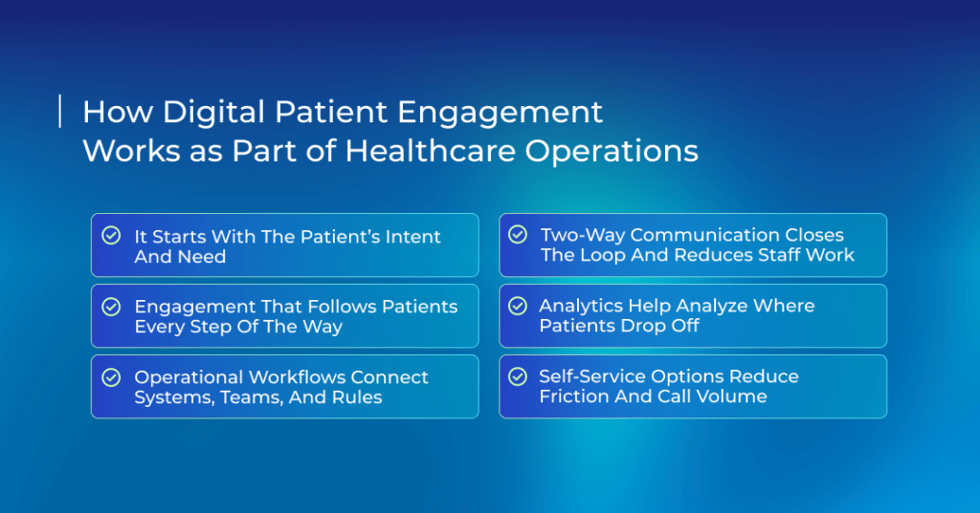
Every patient interaction begins with a specific intent. Someone might want to schedule an appointment or have questions about insurance coverage. They might call for a billing breakdown or ask a clinical question.
Mapping these intents creates workflows that match real patient tasks. Instead of just logging that a patient has cancelled their appointment, the system immediately offers an option to reschedule. Giving each message an intent means they arrive exactly when patients need them.
Every stage of a patient's journey has different success metrics. They also have their own triggers and channels. So a message meant for one stage won't have the same impact for another.
Digital engagement tools link workflows between different systems. This means that routine actions like appointment confirmations and payment reminders are automatically routed to the right people.
Your EHR and PM align with your teams and rules as a single, connected operational system. So billing handles all your insurance questions while scheduling coordinators manage appointment changes.
You define specific rule sets to control timing, frequencies, and even language for every message sent out. So patients receive timely communication without being overwhelmed. The result is less manual work for staff, fewer missed steps, and consistent, reliable workflows every time.
Messages that don't allow patients to respond don't count as engagement. Closed-loop interactions solve that problem by letting patients take action. They confirm appointments through text or tap on an included link to reschedule. Patients can pay bills online or complete intake forms from home. Each action closes a task without any staff involvement.
However, not all situations are meant for automation. Some patients may have a complex question or need special scheduling. These cases are escalated by the system with full context. Staff don’t have to ask the patient to repeat themselves or guess what happened. Everything is clear and the next step is obvious.
The cost of digital patient engagement drops significantly when automation handles most of your routine interactions. Your staff is left free to focus on the remaining cases that need their human judgment.
Tracking the right metrics gives you the clarity to see what’s actually working and what needs to be improved. Here are some of the popular ones in healthcare:
Drop-off data is especially valuable because it shows exactly where patients quit. If half of all patients are not finishing their intake forms, your form may be too long or confusing. If one message time performs better than another, it’s a clear sign to adjust your send schedule.
Use this data to refine timing (test morning vs evening sends), wording (A/B test message tone), and workflows (add steps that work, remove steps where patients bail).
Self-service tools take the repetitive, high-volume tasks that don’t require a staff member’s expertise and let patients handle them on their own.
Appointment management is one of the biggest wins here. Patients can book, reschedule, or cancel without calling the front desk.
Forms and intake work the same way. Patients complete medical history, insurance details, and consent forms from their phone before they arrive. Their information flows directly into the EHR so your staff doesn’t have to type it in again.
Payments become easier too because patients can set up payment plans and pay bills online using saved payment methods instead of waiting on a call. Even basic questions get handled without staff involvement thanks to chatbots or a knowledge base that answers common concerns like office hours, parking, insurance coverage, and preparation instructions.
The key is making self-service feel effortless. Focus on a friendly mobile design that’s easy to navigate. There also needs to be clear calls to action that guide patients through each task without confusion. A button that says “Reschedule Now” works a lot better than “Click Here.”
The best approach is to layer channels. Let patients set preferences but fall back to other channels when they don't engage.
SMS works best for messages that require quick action. Patients can confirm appointments with a single tap. They can also quickly pay their dues with a secure link. Both text reminders drive high response rates because they land directly on phones that patients constantly check.
Texts are also widely used for brief updates. A quick message like "Your lab results are now available in the portal" is more efficient than having someone place a call or expecting the patient to check the portal themselves.
Voice works for complex cases that involve multiple steps. A traditional phone call is still the best way to explain an upcoming procedure. Patients can ask questions and request further clarification in the same call as they gain new information. The same goes for urgent messages like missed appointments or chronic health alerts.
Older patients often prefer voice calls over text because they feel they are more personal. Modern healthcare providers cater to this by using automated voice systems. The same appointment reminder can be made via a call that asks the patient to press 1 to confirm or 2 to reschedule.
Emails are used to send detailed information that patients need to reference later. They are perfect for billing statements, visit summaries, educational content, etc. Patients can spend as much time on them as they need.
Emails, however, are strictly limited to non-urgent communication. Their response rates are lower than SMS and for good reason. Most patients don’t check their email as frequently as their texts. Some emails also land in junk folders. So any message or outreach that requires the patient to respond quickly is never sent as an email.
Chat channels allow patients to resolve their general inquiries without calling the office. They can go online from their phone to chat with live agents to ask about insurance coverage or even request a prescription refill. This significantly reduces the call volumes for providers.
Live chat becomes even more effective when patient engagement and AI work together Chatbots pull information from knowledge bases to answer common questions. They can also route the patient to a specialist upon request.
Patient portals centralize all patient communication. Think of them as a secure hub where each patient can download their test results or see their past medical records. This is also where they can easily manage appointments and message their doctors about new possible symptoms.
While the adoption rate of portals varies from patient to patient, those who do use them tend to be more satisfied and compliant.
WestCX shows how a multi-channel approach closes gaps and drives higher engagement rates. It gives patients choices. Someone might prefer getting a vaccine reminder as an email with detailed information. Others might simply prefer a text. Laying channels ensures your message gets through when patients are ready to act.
Five core components work together to create effective patient engagement through digital channels.
The orchestration platform sits at the center. It coordinates when messages go out and which channel to use. It also confirms what happens when patients respond. This layer ensures that you're managing five different tools that talk to each other.
Messaging channels are next. They deliver your outreach through text, voice, chat, and email. Each channel serves specific purposes and preferences.
Automation and AI handle repetitive workflows. A patient confirms an appointment via text and the system updates your schedule automatically. No staff intervention needed. Most providers use AI-driven virtual assistants that can answer common questions and complete routine tasks 24/7.
Integrations connect everything to your EHR. WestCX's platform, for example, reads appointment data directly from Epic, Cerner, or NextGen. When a patient reschedules via text, that change writes back to your system immediately. No dual entry. No missed updates.
Analytics form the last part of the stack. You see response rates by channel, patient trends by segment, and which workflows need adjustment. Data drives decisions instead of guesswork.
A unified system cuts down the number of separate tools you must manage. You don’t need one product for reminders and another for chat. WestCX helps by making your team spend less time on fixing service gaps and more time helping patients.
Implementing digital patient engagement requires more than turning on a few tools. The difference lies in how you design workflows and handle patient responses. Here's what works.
Offer 2-3 primary channels based on patient preference and then use fallback logic when patients don't respond.
Start with the channel the patient chose and give them a full day to respond. Move to the next channel if there’s no activity. When that still doesn’t prompt a response, switch to a different method or flag it for staff follow-up.
This approach generates 3.4x higher response rates. It works best when you let patients choose their primary channel during registration or through profile updates.
Build workflows where every message includes a clear action. Don’t just remind patients about an appointment. Include a link that they can tap to confirm or reschedule. Let them use portals to ask questions in the same thread and route their responses to the appropriate system or staff to keep everyone on the same page.
This spikes your completion rates while reducing your phone volumes.
Remembering the patient’s first name doesn’t make a message personal. Using context to send the right message at the right time does.
New patients need more guidance than older ones. Someone with an upcoming procedure will appreciate preparation instructions instead of general wellness tips. Send directions to the specific department instead of the main campus. Match the patient’s preferred language in all communication.
Make sure to build templates that pull these contextual signals from your EHR. It helps boost your response rates.
Automation handles routine tasks. Escalation handles exceptions. The key is knowing when to switch from one to the other. This requires you to set clear escalation triggers.
You might have an automated loop to confirm appointments but if the patient replies with a question, the system should take it as a trigger to escalate the case to a human specialist. Another example can be if someone’s payment attempt has failed twice or their intake process is stuck at 50% even after two reminders.
However, handoffs with context is a critical requirement for every escalation. Your staff needs to know what the patient has already said or tried. They need to know where the automation stopped. This stops your staff from asking the patient to repeat themselves.
The last step in closing the loop is tracking which scenarios trigger escalation most often and then improving automation to handle those cases. If 30% of appointment confirmations escalate because patients ask about parking, add parking information to the initial message.
Traditional chatbots are no longer suitable for healthcare communication. Conversational AI delivers context and flow with every message instead of following rigid scripts. These smart systems are excellent at supporting digital engagement by guiding patients without involving any staff.
However, AI only works best with guardrails. Your system needs to have clear escalation rules and not generate responses based on assumptions. There also needs to be accuracy checks. Don’t let AI make guesses on medical questions.
AI improves over time by learning which questions it handles well and which need staff. Track escalation patterns to expand the AI’s capabilities while maintaining quality.
Some tasks need more than plain text. RCS messaging adds interactive buttons and images to increase completion rates. Patients tap buttons to reschedule appointments instead of replying with another text or clicking external links.
This format reduces confusion during multi-step tasks and keeps the interaction contained on the phone screen.
Use RCS for tasks where the visual layout matters like payment with itemized charges, forms with multiple fields, or scheduling that shows available time slots. Reserve SMS for simple confirmations.
However, keep SMS as a fallback for patients who use phones that cannot receive rich messages.
Every provider that implements digital engagement tools faces certain obstacles. Knowing how to overcome them means improving your outcomes.
Your system can look great on paper but it won't improve engagement if it treats every patient the same way.
Sending repeated reminders to every patient isn't effective. Patients who are due in the next few days need timely nudges. Those who are weeks away don't. A single reminder is enough for them. Anything more just adds noise.
The same goes for billing messages. A payment reminder only makes sense if a patient is done with their visit. Someone still waiting for their discharge instructions will simply ignore a billing alert.
Targeted messages feel relevant. Patients respond more and complete their tasks on time.
Too many reminders or updates annoy patients. They get the message but lower their engagement over time.
The first step in fixing this is to let patients control frequency through preference settings. Some might prefer to see every urgent message. Others might only want to see alerts like appointment reminders and test result availabilities.
The next step is limiting all your messages. Anything that’s not urgent should be spaced out by at least a week. There’s no point in sending the same survey link three times.
Wrong phone numbers, outdated addresses, and incorrect insurance information cause failed messages and frustrated patients.
The fix is to clean your data at every touchpoint. Ask patients to confirm their details during every interaction like when they check in. Run quarterly data audits to confirm the percentage of bounced messages and ensure there are no systematic issues. Bad data can still seep into your EHR but regular checks flag failed deliveries for the staff to follow up.
Delays happen because messages don’t reach the right team the first time.
This problem just means that your digital systems aren’t working as intended. Digital tools are meant to route information to the right team. If they’re not, you need to review your workflows.
Make sure to assign clear ownership for each task. Map every message type and confirm it lands with the correct team. Test these workflows before launching your digital systems to catch gaps early on.
Patients still get inconsistent experiences because staff continue using old processes. This is because they’re not comfortable using a new tool.
The fix here is to train them on why digital engagement matters and how these tools reduce their workload. Hold workshops to show how it reduces phone calls and manual effort.
It’s also important to get feedback from your staff. If checking a dashboard takes longer than answering phones, staff won't adopt it. Your workflows should integrate with existing systems or else you’re just creating new work for your staff.
Limited channel support, poor EHR integration, or clunky mobile experiences create friction.
The fix is choosing a platform designed to work together from day one. Pre-built EHR integrations keep data flowing automatically. Test all workflows on mobile devices to ensure they’re easy to navigate and focus on multichannel capabilities so you're not stuck with one communication method.
Investing in a system that doesn’t perform like a single unit leads to investing more in custom integrations with disconnected tools. This significantly increases the cost of digital patient engagement.
Choosing a patient engagement platform involves more than just reviews and flashy demos.
The platform should connect directly to your EHR so patient data moves automatically without manual work or constant oversight. Look for solutions that already integrate with your specific systems to support true bidirectional data flow. Outbound messages should pull accurate patient details and inbound responses should update records in real time.
Don’t just take integration claims at face value. Ask the vendor to show exactly how appointment data triggers messages or how patient responses sync back to the EHR. If they can’t demonstrate it live, it’s not really integrated.
The solution should support SMS, voice, email, and chat at a minimum. RCS support is a plus. Verify beforehand that all channels work together in coordinated workflows instead of as separate tools.
The platform should also handle fallback logic automatically and let patients set their channel preferences.
Confirm that the platform lets patients take actions through messaging. This means confirming, rescheduling, or asking questions in the same communication thread. Review how responses route to staff and how escalation works when automation can't handle a request.
The platform should track response and completion rates (and other metrics) so you know where patients follow through and where they drop off. Ask vendors for benchmark data and whether they support testing message variations to improve results over time.
Self-service is the backbone of any patient engagement platform. Check whether patients can complete tasks within messages or if they're forced to open separate portals. Look for in-message scheduling, form completion, and payment options.
Any engagement platform you consider should meet HIPAA requirements. It should encrypt data and maintain clear audit trails.
Go deeper than surface claims. Ask how patient data is stored and who has access to it. Look for vendors who can clearly explain their breach response process. If they can’t answer these questions confidently, that’s a risk you don’t want to inherit.
Understand how pricing works so that you’re not left with an inflated bill. Does it cost you per message or per patient? Is there a hidden cost based on your operation size?
Make sure to also factor in the cost of digital patient engagement beyond the platform fee. This includes staff time for implementation, training, and ongoing management.
Calculate ROI based on reduced no-shows, higher patient pay collection, and lower staffing needs for routine tasks.
A common question is whether the investment pays off. Many providers recover their costs through improved operations and patient behavior. For example, automated reminders and follow-ups can cut missed appointments by 20-30%. Referral automation can shorten scheduling time to 40%. That adds real revenue back to the clinic.
You can also use WestCX’s ROI calculator to get an accurate estimation of how reducing no-shows and filling more slots can increase clinic revenue and improve scheduling efficiency.
Beyond direct revenue, digital patient engagement strategies reduce administrative burden. This reduces your overhead from hiring and managing more staff during peak times.
Frost & Sullivan recognized WestCX for creating customer value and strong ROI through flexible pricing and workflow alignment that fit a practice’s goals.
Finally, better engagement affects patient experience. Research shows that automated texts can improve satisfaction scores, and satisfied patients are more likely to stay with a provider and follow care plans. These outcomes help justify the up-front cost as part of the broader value of modern patient engagement through digital channels.
When a patient can’t confirm an appointment in seconds, your staff ends up doing it in minutes. WestCX lets patients take those actions themselves without adding work for your staff.
Engage is our conversational AI solution that handles routine questions and tasks through voice, chat, and SMS. Patients can start a conversation with our IVAs to confirm or reschedule appointments without waiting on hold. They can also get quick answers and manage billing and refills through our self-service chat.
We also offer Insights360 to give you visibility into how those conversations actually perform. These journey insights show where patients drop off, which messages work, and where you can tighten the workflow.
Schedule a demo and we’ll show you how WestCX delivers a digital patient engagement system that works for your staff and your patients.

In healthcare, a single unsecured email can undo years of patient trust. Every message might carry a diagnosis, a treatment plan, or billing details....

A referral system in healthcare is more like a bridge than paperwork. You are essentially carrying patients from one node (their primary doctor) to...

There's a notion that healthcare systems are struggling with patient engagement because they lack data. The truth is that they're just struggling to...