Elevate Your Online Presence with WestCX's AI-Powered Websites
By: Akshay Mathur, WestCX Product Manager
6 min read

Clear communication is the core of safe, effective care. When medical professionals explain things in plain terms, patients are more likely to follow instructions, ask questions, and share important details. Strong communication improves outcomes because everyone knows what to expect and what to do next. Let’s see how that can be achieved for better patient outcomes.
Good communication leads to better outcomes in healthcare, and it all starts with listening to one another. Patients with sensitive conditions, such as a fungal rash, would be more comfortable with a doctor who takes time out to listen and communicates professionally. That’s versus a doctor rushing through patients to get back on schedule.
Medical professionals have to learn to listen and communicate to make patients comfortable enough to not just talk about their health conditions, but also follow instructions. This effective communication approach is something all leading healthcare organizations understand, especially when it comes to building credibility within the local community.
Healthcare organizations looking to improve their communication have to face certain pitfalls. It's important to identify them first before learning how to address them.
You cannot expect the average patient to understand complex medical terminology. Between "myocardial infarction" and "heart attack," patients are likely to take the latter more seriously. They will also rarely admit confusion, fearing they'll appear unintelligent.
It's human for patients to become overly stressed after receiving difficult diagnoses, making it hard for them to process information. Someone who has just been diagnosed with cancer will only focus on the disease and not on the treatment plans being explained by the doctor. Since anxiety creates selective hearing, frightened patients end up missing critical details. This necessitates repeated explanations and written instructions for home reference.
Technological advances are helpful in healthcare, but they're not something most patients appreciate. Those living in rural areas might not have a stable internet connection to access their self-service portals. The elderly with limited technical skills or the disabled might have trouble navigating through complex interfaces. These factors make it difficult to improve patient engagement.
It's common for patients to forget or misunderstand instructions they received during their visit. Either that or they develop new questions without answers, making it critical for healthcare providers to follow up on their patients. If they fail to close communication loops, they lose the trust of their patients. For instance, a patient who leaves an unanswered message on a portal will eventually seek care elsewhere.
When appointment reminders come by email, test results through portals, and billing by mail, important messages get missed. This is because patients struggle to track their care story across different platforms. Additionally, communication method preferences vary by age group. Older patients often prefer phone calls, while younger patients expect text options.
Rushed conversations lead to mistakes. When providers see 30 or so patients daily, each interaction gets compressed. Not to mention that burnout affects listening quality. Exhausted providers miss subtle clues in patient stories and rush through explanations to stay on schedule.
Medical professionals should take a close look at the practical approaches mentioned below. They will help them connect better with their patients.
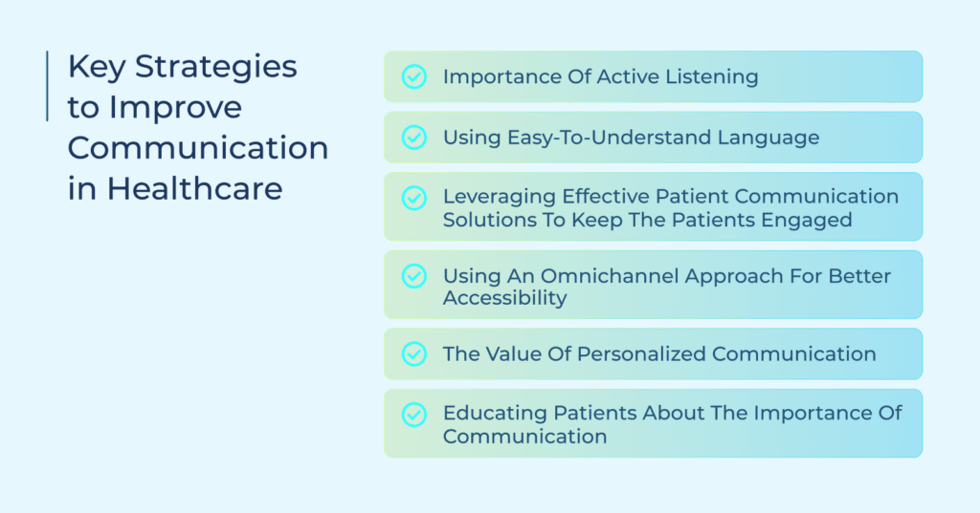
Actively listening to your patients makes them feel valued and understood. Maintain eye contact when patients speak to show them you're listening and acknowledging their issues. Catch important details to clarify so that they leave without any confusion. This is how medical professionals and staff build trust with patients.
When doctors speak in complex terms, they are just confusing their patients. For instance, why say "antihypertensive" when you can say "blood pressure medicine?"
Speaking in plain language and breaking down medical jargon gives clarity to patients. This is important because it enables patients to ask better questions about their health and follow care plans correctly.
Clear communication also reduces anxiety, as patients who understand their medical situation feel more in control of their healthcare decisions.
Patient engagement strategies are key to effective communication in healthcare. Digital services like WestCX allow for consistent check-ins, appointment reminders, and follow-up care instructions. These tools maintain communication between visits and reduce missed appointments through timely notifications.
Healthcare organizations cannot limit patients to specific channels. Patients who prefer text messages will not appreciate receiving phone calls, and that too at the wrong hours. Hence, it's important not just to have an omnipresent system, but also to know the best time to reach out. This increases the likelihood of patients actually acting on information. For instance, wellness tips and other educational materials are best received through email.
Personalized messages go a long way in gaining patients' attention. Don't just remember names and birthdays. Tailor messages by including references to their health conditions or previous visits. It shows patients that they are seen as individuals and not just another number in the system.
Patients need to understand why ongoing communication matters. Explaining how regular updates help providers track treatment progress encourages patients to stay in touch. Simple instruction on how and when to communicate health changes gives patients clear guidelines for maintaining contact with their healthcare team.
Technology fills critical gaps in healthcare communication by providing tools that connect patients and providers more effectively. Digital solutions address timing constraints, language barriers, and information access issues that traditional communication methods can't solve.
Medical staff spend hours making appointment reminder calls and sending follow-up instructions. Automation handles these repetitive tasks accurately and consistently.
For example, WestCX's automated systems send appointment reminders through text messages, reducing no-shows by 30% in many practices. Staff members can then focus on direct patient care instead of administrative work.
Patients and providers operate on different schedules. Asynchronous messaging lets both parties communicate when convenient.
For instance, patients can ask questions at 9 PM after remembering medication concerns, and providers can respond during office hours. This flexibility removes the frustration of phone tag and missed calls.
Patients feel more connected to their care team and ask questions they might have skipped during rushed appointments.
When communication platforms work with EHRs, patient conversations become part of their medical history. Staff see previous interactions before responding to new questions. These connections also allow automated messages based on specific health data, such as medication refill reminders triggered by prescription end dates.
Health concerns don't follow business hours. Technology provides continuous access to information and basic support.
Chatbots answer common questions about medication timing, symptom management, and appointment scheduling at any time of day. On the other hand, patient portals give access to test results and health records whenever patients need them.
Language differences create significant healthcare obstacles. Thankfully, digital translation tools make communication possible across dozens of languages instantly. Patients receive instructions in their primary language, improving understanding and compliance.
Additionally, these tools translate patient responses back to providers, creating true two-way communication regardless of language differences.
It takes a lot more than just speaking skills to effectively communicate with patients. Consider the practical approaches mentioned below as a core focus of major healthcare organizations to reach their communication goals.
 Take Your First Step Towards Better Communication With WestCX
Effective communication is the backbone of better patient care, and WestCX makes it effortless. Our SMART Agent empowers your team with intelligent, automated conversations that engage patients at every stage of the care journey.
From reducing no-shows to improving satisfaction and streamlining operations, our AI-driven communication solution delivers real results across your healthcare organization.
However, SMART Agent doesn’t just automate outreach, it personalizes it. Your patients receive the right message at the right time, improving adherence and trust while freeing your staff to focus on high-value tasks.
Whether you're managing a single clinic or a large health system, WestCX scales with your needs and delivers results you can track.
See for yourself what our SMART tech can do for you by scheduling a demo today.
By: Akshay Mathur, WestCX Product Manager

Hospitals and health systems employ various channels such as websites, phone calls, email, and recently, even texting to take advantage of patient...
Every credit union works hard to win new members. But that effort tends to fade once the account opens and the welcome email goes out. That's a big...