What True Member-Centricity Looks Like for Healthcare Payers in 2025
In today’s payer sector, member-centricity isn’t just a selling point––it’s the defining factor in a growing divide between the nation’s highest and...
7 min read
Even seasoned healthcare providers can lose their patients' trust with a single phone call. You can't afford to mishandle sensitive patient information.
That's what makes a reliable answering service so important. It ensures that your patient interactions follow HIPAA standards at every touchpoint, saving you from penalties or worse, losing your license.
In this blog, we’ll break down the features that make these services secure and effective, and highlight some of the top providers trusted by healthcare organizations today.
Healthcare providers can use regular contact centers to handle their calls, but that carries a risk of violating HIPAA regulations. HIPAA-compliant answering services are built around protecting patient information as per federal law. They have trained agents that follow strict security standards, as well as a designated HIPAA Compliance Officer for internal audits and policy updates. This makes sure that your organization is safe from violating any health laws, either intentionally or unintentionally.
Picking a HIPAA-compliant answering service means looking past basic call handling. You need systems that actually protect patient information and keep your practice compliant. These features aren't optional. They're what save you from making violations that put your organization at risk.
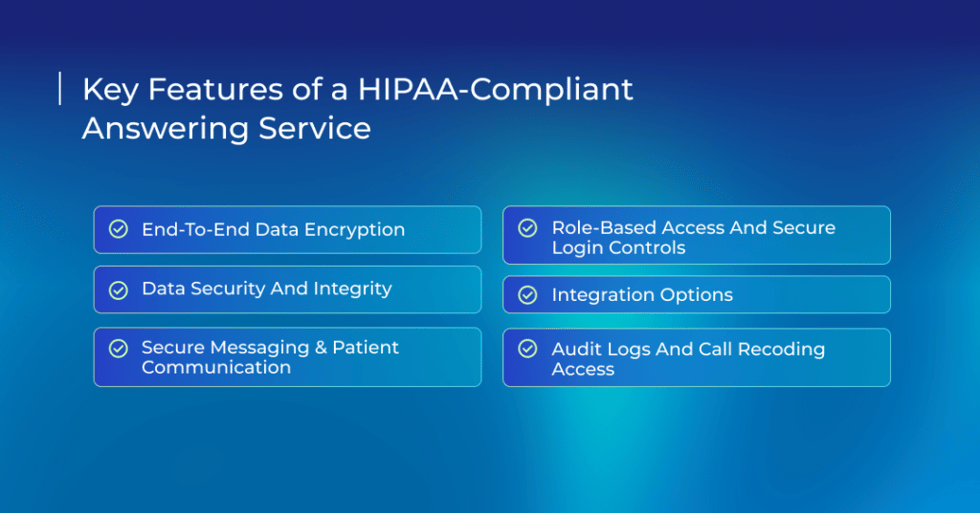
Encryption makes sure nobody can read your patients' data without authorization. This is a must from both ends. So, when a patient calls regarding a lab result, the data must be scrambled as it's going through the system and when it's stored.
TLS protocols handle this by converting readable information into coded text. Hackers only get gibberish instead of private health details. The same protection applies to stored messages, so if a phone gets stolen, its data stays locked.
Most providers are using automated answering services that block users after failed login attempts. There are also other safeguards.
Employees are required to prove their identity with two-factor authentication. Even authorized individuals can only view records necessary for them to do their job.
Additionally, regular data backups protect against loss, but HIPAA-compliant systems must also be able to destroy PHI beyond retrieval when needed.
Regular text messages are a compliance nightmare. They sit in phones unencrypted, visible to anyone who picks up the device. That's why the best HIPAA-compliant answering services for healthcare use dedicated messaging platforms instead.
These platforms encrypt every message and require authentication to view anything. When you send appointment reminders or follow-up instructions, patients get a notification but have to log in to see the actual content.
The system also logs patient consent for electronic communication and makes it easy for them to opt out. Two-way texting works well here. It's more convenient for everyone and fully protected.
There's no need to give everyone access to everything. Your billing clerk doesn't need access to prescription information. Your front-desk scheduler doesn't need to look at a patient's clinical notes, either.
Multi-factor authentication adds another security wall, as do session recordings. In case you are ever the target of an audit or dispute, these logs document who had access and what they did with it. That's accountability built into the system.
Manual data entry creates problems. Someone has to type appointment details from the answering service into your EHR, then update the calendar, then file the notes. Each step is a chance for mistakes and a moment when patient information sits exposed.
When a HIPAA-compliant answering service for healthcare plugs directly into your existing software, information flows automatically. A patient requests an appointment through the service, and it appears in your schedule without anyone touching it. Messages route to the right patient chart. Updates happen instantly across all platforms.
Less handling means fewer errors and smaller compliance gaps. Everything stays connected and secure.
Every system should track who accesses what record, when, and what they do with it. These logs are required by default for HIPAA compliance because they get reviewed during audits. Having clean, complete records shows you take data protection seriously.
Call recordings offer the same security. So, if a patient says you never returned their call or gave different instructions than they remember, you have their recordings as proof. But note that recordings need the same security as live conversations. They must be encrypted, assigned role-based access with authentication requirements.
Not all answering services for medical offices handle HIPAA compliance the same way. Some lean on automation, others use live agents. Some specialize in triage, others focus on appointment booking. What matters is finding one that matches how your practice actually operates. Here are six options that get the security part right while offering different approaches to call handling.
WestCX isn't your typical answering service. It's an AI platform that handles patient conversations across phone, text, and chat. Their SMART Agent can book appointments, answer common questions, and manage routine communications without putting staff on the line.
Everything runs encrypted with audit trails tracking each interaction. The system connects to your EHR and practice management software, so information flows between platforms automatically.
This works if you want to cut down on repetitive calls through automation. Patients get instant responses, and your staff handles only the conversations that actually need human judgment.
Additionally, WestCX signs BAAs and follows HIPAA and HITECH rules.
OhMD built its platform around secure messaging and virtual receptionist features. Their Call-to-Text feature allows patients to speak with the staff on phone, leave a voicemail, or simply send a text message. The system automatically transcribes every voicemail and adds it to the patient's chart.
The platform does more than answer calls, though. Secure texting, video visits, electronic forms, broadcast messages—it all runs through encrypted channels. If you already use OhMD for messaging, the answering features come with it.
Smith.ai offers 24/7 call coverage by combining human receptionists and AI technology. The platform handles all scheduling, intake, insurance, and routine inquiries while following all basic HIPAA standards. You also get custom scripts to match your virtual assistants' voice and speech with your brand.
Smith.ai have no issues signing BAAs, and make sure to encrypt everything end-to-end. Pricing starts at $240 monthly for 30 interactions, then scales with volume. They are a good fit if you want the personal touch without hiring a full-time staff.
MedCall works exclusively with medical practices and puts three in-house RNs on training duty. These nurses bring over 60 years of combined experience and teach call center agents how to handle medical conversations properly.
The service includes nurse triage using evidence-based protocols, on-call scheduling, appointments, emergency dispatch, etc. The agents assess symptoms, figure out urgency, and route calls where they need to go.
They follow HIPAA, Joint Commission, and HITECH standards, making them a great choice for clinical after-hours support.
Dexcomm is one of the oldest (and most experienced) medical answering services on this list. They've been around since 1954, building experience across multiple medical specialties. Their agents know medical terminology and how to handle emergencies because three in-house RNs train them continuously.
Every call gets answered by a live person who speaks English or Spanish with clear, neutral accents. The service covers after-hours emergencies, overflow calls, and routine bookings.
Along with encryption protocols, Dexcomm employees sign confidentiality agreements and complete annual HIPAA training for a patient-first approach.
AnswerConnect provides hybrid support combining live receptionists with digital tools. Their healthcare team answers calls, books appointments, and responds to patient questions.
You activate HIPAA compliance through their online portal. Once enabled, messages become password-protected and accessible only through secure channels. The service integrates with scheduling systems and can book appointments directly into your calendar.
AnswerConnect trains receptionists on HIPAA requirements and medical terminology. They work in a distributed model, protecting against localized power outages or disruptions.
What's convenient is that you pay for services as you use them. So, you get the flexibility to adjust your monthly billings as you need.
Just because it carries a HIPAA tag doesn't mean it's a great fit for your organization. You need to consider several factors, like call volumes, patient needs, budget, etc, before signing off on a medical answering service.
WestCX gives healthcare providers a smarter, safer way to stay connected with their patients. Our AI-driven answering solution does a whole lot more than just pick up the phone. We naturally blend automation with personalization to transform how your team manages communication while keeping every interaction fully HIPAA compliant.
SMART Agent is your very own virtual assistant, using conversational AI to help patients handle everything from appointments and billing questions to prescription refills and intake forms.
Every exchange feels personal as patients can reach your practice through the channel they prefer, anytime.
Behind it all is robust security. Every call, text, or chat is encrypted and stored within a controlled, auditable system designed to meet HIPAA standards.
WestCX has been trusted by thousands of healthcare organizations for over three decades, proving that scalability and compliance can go hand in hand.
If you’re ready to make patient communication effortless and secure, now’s the time to see it in action. Schedule a demo and discover how we can take the pressure off your front desk while keeping every patient conversation protected.

In today’s payer sector, member-centricity isn’t just a selling point––it’s the defining factor in a growing divide between the nation’s highest and...
Every credit union works hard to win new members. But that effort tends to fade once the account opens and the welcome email goes out. That's a big...
The standard pharmacy phone call hasn't changed much, but the technology and expectations around it have. Voice AI now gives pharmacies a way to...