How Patient Relationship Management Is More Than Patient Engagement
When couples decide to get married, they typically have an engagement period. It’s an exciting time for sure, with several decisions to make on...
7 min read

What makes a patient return or recommend their healthcare provider to someone else? Net Promoter Score (NPS) helps answer just that. Originally built for customer experience, NPS is now helping both providers and payer organizations understand how patients feel about their care, not just the outcomes.
In this blog, we’ll look at why NPS matters more than ever in healthcare, how it connects to trust, satisfaction, and value-based care, and what providers and payers can do to turn feedback into measurable loyalty.
Healthcare organizations use the Net Promoter Score to measure how many patients are going to recommend them to their friends and family. While that signals happy patients, it's a bit different from other metrics that check patient satisfaction.
NPS is primarily used to check patient loyalty—basically, the number of patients who turn into brand ambassadors for your organization.
Responses range from 0 to 10. Patients who give a 9 or 10 are your biggest promoters. Those in the 7–8 range are passives, and anyone scoring 6 or below represents the detractors. Your overall NPS is the percentage of promoters minus the percentage of detractors, revealing at a glance how loyal your patients truly are.
Patient loyalty plays a direct role in clinical outcomes and revenue growth. It goes beyond basic satisfaction from a single service or interaction. You're measuring an overall emotional connection. That said, the metric matters in different ways depending on who uses it.
Getting patient feedback doesn't have to be complicated. Measuring NPS in healthcare comes down to asking the right question at the right time, and then actually doing something with the answers you get.
“How likely are you to recommend us to a friend or family member?” - That's all you need. Skip adding any medical jargon. The strength of NPS lies in its simplicity.
Patients respond on a scale from 0 to 10. Following that, you can give them space to explain why. This is optional, though, but some people might want to elaborate.
Now, you sort patients into three groups:
Timings make a huge difference. Someone who was just discharged will be too exhausted to care about a survey. However, wait too long and they will probably forget any details.
For hospital stays, wait a day or two after discharge. For regular office visits, same day or next day works fine. Billing surveys should go out after patients have actually seen and paid their bills.
Something else that makes a huge difference is the channel. Different patients prefer different ways to be contacted. Younger people check texts constantly. Older patients might prefer email or even a phone call. Some clinics have tablets at checkout where patients can respond before they leave.
Try different methods and see what gets you responses. You're looking for what actually works with your patient population.
This is healthcare, so HIPAA applies. Use a survey platform that encrypts everything. Don't attach names to responses. People prefer to stay anonymous anyway. You can also reassure them by placing a privacy note on surveys informing them that their names will not be made public.
Your NPS = (% Promoters - % Detractors)
Say 100 patients responded. 70 gave you a 9 or 10. That's 70% promoters. 10 gave you a 6 or below. That's 10% detractors. The remaining 20 were passives, and you ignore them for the calculation.
70 minus 10 equals 60. Your net promoter score in healthcare is 60.
Track your score over time, so you can identify trends. A score of 40 that used to be 20 last year says you're doing something right. A slight fluctation or worse, you're moving in reverse since the last quarter? It's time to find out what changed.
Break down your surveys by departments or doctors. Maybe one unit is struggling with patient experiences, dragging the others with them. Make sure to also read and sort all comments based on the most common complaint.
Patient loyalty drives a lot of improvements in a healthcare setting, so here's how to move the needle on your scores.
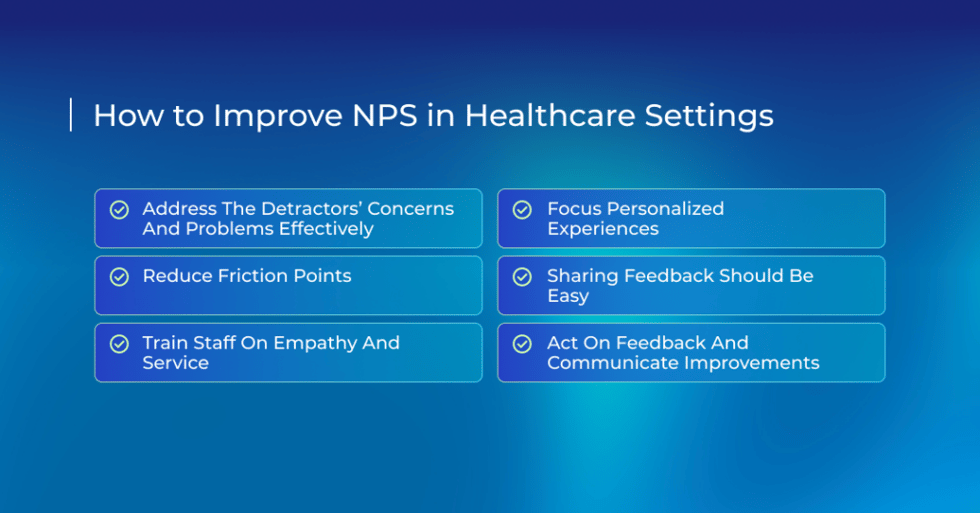
Contact dissatisfied patients as soon as possible. You'll hurt retention if you wait too long. This is not always possible with a manual approach, but real-time feedback tools allow your staff to reach out before the patient even leaves your building.
Use them to create automated workflows that flag detractors on the spot for timely outreach. For post-discharge care, send surveys within a day or two, but not any longer. This is how you use NPS to turn negative experiences into positive ones.
You don't need tools to know that most complaints happen at scheduling appointments, dealing with bills, and managing follow-ups. Patients want these interactions to be simple, quick, and helpful.
Digital tools help here by meeting those patient expectations. They prepare patients for each touchpoint with automated reminders, self-service portals, secure payment links, and clear communication to answer questions they will likely ask. All this without burdening your staff or creating bottlenecks.
Empathy makes a big difference in patient experiences. Run workshops to train your staff on how to communicate with patients. Most healthcare organizations simulate interactions based on real-world data to better build empathic skills.
It also helps frontline employees identify moments where they can make human connections instead of passing them off to another agent.
Patients don't like to be treated as just another number in the system. Match them with the right services based on their demographic, clinical, and behavioral data, as well as past interactions.
This ranges from contacting them through their preferred channel to using their primary language to remembering personal details like preferred appointment timing windows. This kind of targeted communication reduces no-shows and keeps care on track.
Hardly any patient will take time out to fill a long, convoluted questionnaire. Therefore, make your surveys short. This goes for NPS and all other metrics.
Mix rating questions with open-ended prompts. You want both quantitative data and qualitative insight. Also, make sure the interface is clean and mobile-friendly. Sharing feedback shouldn't be a chore.
Your net promoter score only matters in healthcare if you do something with it. Use the data to make targeted improvements. Organizations often share scores internally to create a culture of continuous improvement. This allows them to celebrate wins with staff and recognize departments or individuals who helped drive positive changes.
Most importantly, update patients on their feedback. If someone complains about disabled parking, let them know when you add more spaces. This shows them their voice matters.
The average net promoter score varies from industry to industry. This is because every industry has unique customer expectations.
In healthcare, an NPS between 40 and 70 is considered world-class. The bottom line has actually increased by 10 points in recent years because the standards for patient experience have risen. As a result, what used to be seen as a strong score (around 30–50) is now just average.
If you're generating a 60+ NPS for your healthcare organization, you're not just satisfying patients, you're building genuine loyalty and long-term trust.
Look at NPS as a roadmap to a better patient experience instead of just a number. The feedback you get from every touchpoint shows exactly what needs your immediate attention.
Dipping numbers here often point to long wait times, broken online booking systems, confusing forms, or staff who couldn't answer basic questions. Addressing these issues helps reduce frustration right from the start.
The feedback about the actual visits is critical in helping organizations train their staff, optimize workflows, and ensure patients feel heard and respected. The surveys here check how helpful or courteous the staff was, whether doctors rushed through their appointments, or if patients tend to wait too long in exam rooms without anyone coming.
The discharge experience helps confirm if patients understood their care plan. The feedback also reports unclear medication instructions, nobody explaining warning signs to watch for, or confusion about follow-up appointments. When someone flags these problems, care teams get automatic alerts to call the patient and clear things up.
A surprisingly common source of dissatisfaction is billing confusion. Monitoring NPS trends here helps teams simplify invoices, clarify insurance coverage, and set realistic expectations before charges occur.
Healthcare settings can't use a single metric to reveal the full story. NPS has its benefits, but you have to combine it with other metrics to get a 360-degree view of patient satisfaction and loyalty.
Where NPS measures overall loyalty, CSAT tracks day-to-day improvements with specific interactions like scheduling or discharge. You also have HCAHPS that goes much deeper to ensure you're aligned with regulatory benchmarks.
Each metric looks at patient experience from a different angle. Using all three helps you connect compliance data with real patient sentiment and turn feedback into action.
Improving your NPS starts with better conversations, and WestCX makes each one of them count. Our automated feedback tools capture your patients' sentiments across the entire journey, starting from the first appointment call to post-visit surveys and follow-up reminders.
With Engage, our conversational AI, you engage patients naturally through text, voice, and chat. It handles appointment scheduling, billing inquiries, and prescription refills, offering consistent, 24/7 support that makes every interaction faster and easier.
Your team also gains access to built-in analytics, EHR integration, and intelligent workflows that transform raw feedback into actionable insights. All that without adding more to your team’s plate.
If you want to close the loop between what patients say and how you respond, schedule a demo today and start driving your NPS.

When couples decide to get married, they typically have an engagement period. It’s an exciting time for sure, with several decisions to make on...

While Electronic Health Records (EHRs) are essential for organizing clinical data, they often fall short in supporting personalized, ongoing patient...

Automation technology continues to revolutionize the healthcare industry, improving patient care and operational efficiency. And, as staffing...