Streamlining Credit Union Member Onboarding for Better Experience and Retention
Every credit union works hard to win new members. But that effort tends to fade once the account opens and the welcome email goes out. That's a big...
6 min read

No-shows are the bane of healthcare organizations. Patients who miss their appointments end up costing healthcare providers millions on an annual basis. They also disrupt patient care and daily operations because there are always other patients waiting for appointments that could have been filled.
The following blog goes into practical solutions that healthcare providers can implement to reduce no-show rates while highlighting several reasons why patients fail to keep their appointments.
Missed appointments create substantial losses for healthcare providers. This is because when patients fail to show up, the scheduled time slot goes unused, but the medical facility still pays the associated cost.
For over a decade, automation has been recommended to reduce no-show rates. The United States healthcare system reportedly lost an estimated $150 billion due to missed appointments, a figure that has only increased over time.
More recently, HCA Healthcare reported revenue losses of up to $300 million in the fourth quarter of 2024, primarily due to delays in medical procedures caused by hurricanes. Although this loss is attributed to natural disasters, it underscores the substantial financial challenges healthcare providers face from unforeseen disruptions, including missed appointments.
Below are the most common factors contributing to high no-show rates in healthcare. We’ll discuss how to reduce them afterward.
Most patients simply forget about their appointments. In the case of elderly patients, most of them tend to write down appointments on paper, which are easy to misplace. They can also end up writing down incorrect or unclear information about the time or location.
Phone calls going straight to voicemail or unopened emails mean appointment reminders may never even reach patients.
Scheduling patients to meet their doctors after weeks or months is another key factor in high now-show rates. It most often happens that patients may feel better while waiting extensively for their appointment dates, convincing them not to go in the end.
Some patients also have a habit of scheduling multiple appointments with different healthcare providers to get the earliest appointment possible. Both cases see unnecessary appointments that could have helped other patients.
Healthcare providers with poor communication can make it difficult for patients to reschedule their appointments. Slapping a late rescheduling fee also discourages patients from reaching out. They would rather wait or consult with another available physician.
While most healthcare providers have online portals to showcase your appointment details, they can still force patients to reschedule or cancel by phone instead of allowing them to do so online. Patients are more likely to never make that call because they can simply choose not to show up.
Times are tough, so it should not be surprising to know that patients skip appointments after knowing the cost. Poor insurance coverage or verification issues, unexpected and unclear pricing can make patients postpone care until absolutely necessary.
Anxiety also plays a part in high no-show rates in healthcare. It is common for patients to feel embarrassed about sharing their health issues.
They can also make the mistake of thinking their concerns are not serious enough to warrant a visit or that they cannot take time off from work for appointments.
Do note that negative healthcare experiences in the past can significantly contribute to patients being reluctant to go for healthcare.
Household chores or family responsibilities often make patients perceive their health concerns as optional. Not to forget that language barriers also play a role in making patients feel uncomfortable in going for healthcare.
In the rural areas, a lack of or poor transportation system can make it difficult for patients to make it in time. This can also be because of weather conditions or traffic congestion.
Now that we have gone through the most common reasons behind patient no-shows, let's dig into how to reduce them. This is important because patient no-shows cost healthcare providers time and money, both of which can stack up to cause massive annual losses.
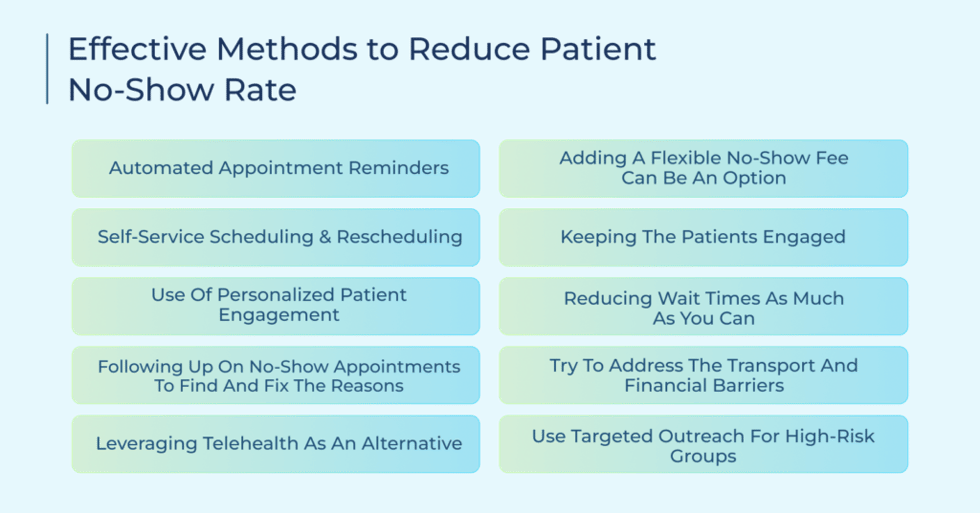
It is good practice to remind patients about their upcoming appointments 48 hours in advance. This gives patients enough time to confirm or reschedule and also reduces the chance of them forgetting about the appointment. Hence, whether by phone, text, or email, appointment reminders are highly necessary to reduce no-shows.
Healthcare providers can opt for automated appointment reminder systems to reduce their administrative burden. WestCX is a good example of a customizable solution that can be set to send automated reminders one week before, two days before, and on the day of the appointment.
Most patients prefer the freedom to schedule and reschedule without making unnecessary phone calls. Online portals are a perfect solution in that regard, allowing patients to make changes 24/7 without any staff assistance. This works especially for younger patients who prefer digital interactions.
Do not take the power of personalized messaging lightly. Tailoring engagement based on the patient's history or appointment type can help build trust. It makes patients feel valued and understood. When patients understand that their conditions or concerns are being taken seriously, they will try their best to show up for clinical appointments.
It's not possible to reduce no-show rates to zero in healthcare. There will always be reasons for a missed appointment, but healthcare providers should contact them to ask why.
Consider it a survey to ask if something could have been done to help patients show up. Maybe the hours were too limited, or there was some miscommunication.
No-show follow-ups can help identify these issues. Find the reason and fix it to reduce no-show appointments.
Telehealth has been booming as of late due to how much we have started relying on digital technology in our lives. Consulting doctors online instead of making in-person visits removes several barriers.
Patients may be finding it difficult to leave work or have to tend to children. There might be transportation issues as well. Giving them access to video consultations cuts now-show rates dramatically. However, this holds true for only minor concerns.
Here's something to take home today. The most successful medical practices do not aim to collect fees but use them as motivation for notification. You can cut down a lot of patient frustration by just conveying clear fee policies in advance. Have a reasonable fee with clear waiver policies for emergencies. This will be appreciated by patients because it's fair.
Educating patients about their health goals or concerns significantly reduces no-show rates in healthcare. Providers should have procedures in place to regularly communicate with their patients. Send them health tips or medical newsletters between visits.
Pre-appointment questionnaires are another way to mentally prepare patients for their visits. These methods maintain the importance of appointments in patients' minds.
Healthcare providers will always see high no-show rates if they are booking appointments weeks or months in advance. Reduce the wait times as much as possible by scheduling patients within the week at most.
This also covers waiting times in the waiting areas. Patients who arrive on time but still have to wait hours are more likely to not show up for their next appointment.
It is good practice for the medical staff to have accurate time estimations for each appointment type. This prevents scheduling backlogs, ensuring properly spaced appointments without any delays.
Helping patients overcome transportation barriers is a practical solution to reduce no-shows but is not something that can be expected from every healthcare provider. Those who do make an effort, though, will leave their patients highly satisfied and happy.
Consider partnering with ride-hailing services to help patients without reliable transportation. You can also partner with community organizations to provide transportation vouchers for qualifying patients.
As for financial concerns, enact flexible payment plans by partnering with different banks and insurance firms. Patients with a wide range of payment options are less likely to skip appointments due to cost concerns.
Special attention to patients with complex needs or a history of missed visits prevents future problems. Case managers assigned to high-risk patients help coordinate care and transportation.
Some practices use risk scoring to identify which patients need extra reminders or support. Data analysis helps identify which demographics or appointment types have higher no-show rates, allowing for focused solutions.
There's a simple formula that you can use to calculate your patient no-show rates. Divide the total number of missed appointments by the total number of scheduled appointments. This will give you a percentage for a specific period.
Now-Show Rate = (Total Missed Appointments / Total Scheduled Appointments) x 100
For example, if there were 1600 scheduled appointments for a quarter, but only 1100 showed up, the no-show rate would be approximately 31 percent.
By keeping track regularly (monthly/quarterly/annually), healthcare providers can confirm if changes to their systems and procedures are helping reduce no-show rates.
WestCX helps healthcare organizations reduce their no-show rates with its next-generation Patient Relationship Management platform. Our AI-driven systems automatically take charge of your appointment scheduling and reminders, pushing conversational AI virtual agents to effectively engage patients before, during, and after their visits.
Our HIPAA-compliant SMART technology also provides self-service options and answers any questions patients might have, leaving patients understood and valued with a higher chance of keeping their appointments.
Healthcare providers using WestCX experience fewer no-shows because patients receive the right message at the right time through their preferred channel. The system also flags high-risk appointments, allowing staff to focus on patients most likely to miss visits.
Schedule a demo today to learn how we can help reduce no-shows and automate your healthcare operations.

Every credit union works hard to win new members. But that effort tends to fade once the account opens and the welcome email goes out. That's a big...

The standard pharmacy phone call hasn't changed much, but the technology and expectations around it have. Voice AI now gives pharmacies a way to...

A conversation about improving patient engagement in the pharmaceutical sector doesn't stop when a prescription is written. Patients still need to...