Patient Relationship Management: Expanding Beyond Patient Engagement
By Don Thompson, Head of Marketing, WestCX
5 min read

Every missed appointment, unanswered question, or delay in paperwork chips away at your patient's experience. Generative AI is stepping into healthcare to close those gaps. It’s already helping providers cut through administrative clutter, engage patients more effectively, and make care delivery more efficient. It's why modern healthcare systems run smoothly for both patients and providers.
Healthcare providers are adopting generative AI because they see real improvements in how they operate and care for patients.
We're not talking about futuristic concepts anymore. Generative AI use cases are happening right now in medical facilities across the country. It's freeing up professionals to focus better on their patients.
Let's explore nine ways healthcare organizations are using generative AI to improve patient engagement and operational efficiency.
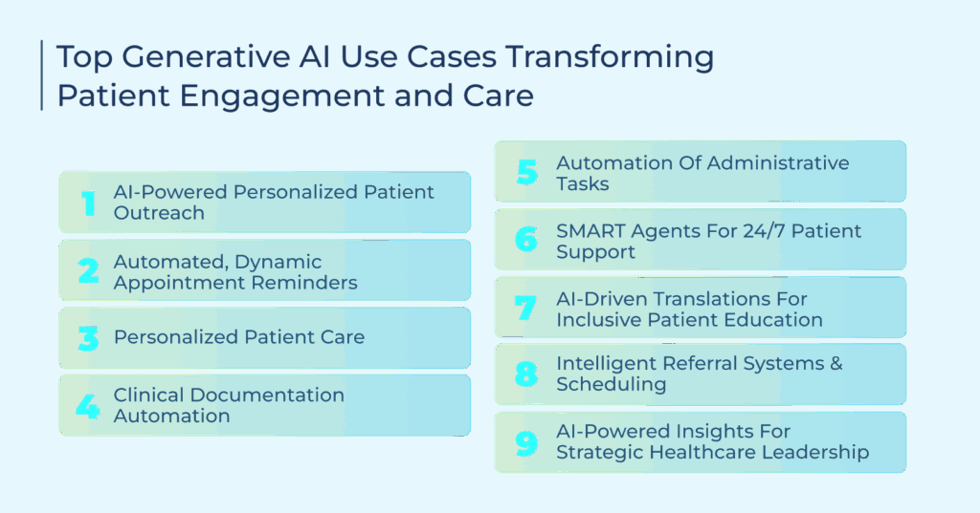
Generative AI creates healthcare messages that actually connect with patients. Instead of generic reminders that end up ignored, AI analyzes what works for each individual patient.
The system learns from patient responses, adjusting its approach based on what gets attention and what gets deleted. This ensures better engagement and, along with that, better preventive care.
Some patients prefer texts, others want phone calls. Some need three days' notice, others respond better to same-day reminders. Generative AI figures out these preferences by watching how patients interact with different types of messages.
For complex procedures, AI includes specific preparation instructions. For routine check-ups, the tone stays light and convenient. This personal touch reduces no-shows while making patients feel understood rather than bothered.
Generative AI use cases in healthcare include medication adherence programs that take into account patient schedules, lifestyles, and personal preferences.
These care plans adapt as patients progress. If someone experiences side effects, the AI adjusts recommendations immediately. When recovery goes faster than expected, the system updates accordingly. This continuous personalization keeps patients engaged and motivated throughout their treatment journey.
AI is handling the paperwork that eats up so much of a physician's day. It listens to patient conversations and automatically creates SOAP notes, visit summaries, and EHR updates. The technology captures important details while the doctor focuses on the patient sitting across from them.
That said, generative AI is more about eliminating the admin burden than replacing clinical judgment. When documentation happens automatically, doctors can ask better questions and provide more attentive care.
Healthcare administration is drowning in repetitive tasks that AI can handle better than humans. This includes billing inquiries, insurance verification, prior authorization requests, and other related matters.
You never have to worry about putting patients on hold. AI gives quick, accurate answers to routine questions. It automatically processes forms, confirms eligibility, and submits claims, cutting down on delays and errors.
Additionally, automated scheduling is a major benefit for providers to reap from generative AI. The system manages slots on its own and even coordinates multi-provider visits.
AI agents neither sleep nor take breaks. They understand medical terminology to address related questions any time, any day.
Generative AI examples here can include post-discharge follow-ups that check on patient recovery, medication adherence calls that ensure treatment compliance, and appointment scheduling that works around patient preferences and provider availability.
AI translates medical instructions, consent forms, and educational materials into multiple languages without sacrificing clinical accuracy. The system knows that literal translations tend to omit cultural subtleties that affect how patients comprehend information. This cultural sensitivity helps improve patient engagement.
AI systems connect patients with appropriate providers based on their specific needs, location, and specialist expertise. It generates referral letters that include relevant patient history and specific consultation requests. This helps specialists provide focused care from day one rather than wasting time chasing information.
Generative AI makes sense of complex healthcare data by turning it into clear insights that organizations can actually use. It can track how patients move through the system, reveal where operations slow down, and show what factors really impact patient satisfaction.
It also helps executives plan ahead to schedule staff, manage capacity, or decide how to grow different service lines.
Generative AI poses real challenges in healthcare that go beyond technical setup. These concerns affect patient safety, privacy, and trust. Here's how these challenges play out and how WestCX addresses each one.
Healthcare organizations worry about where patient information goes when using AI systems and whether AI companies properly protect sensitive data.
How WestCX Addresses This: WestCX keeps patient data within healthcare organizations' existing secure systems. Their HIPAA-compliant AI works with EHR information without sending it to external servers.
AI can become biased if its training data is of low quality. Without learning from a diverse patient population, it can potentially start providing different quality care to different patients.
How WestCX Addresses This: WestCX works with diverse healthcare organizations to ensure their AI communicates effectively across different cultural backgrounds and adjusts based on individual patient needs.
Most patients are unaware that their healthcare experience is impacted by AI. This brings into question informed consent and if patients should be made aware when they are communicating with a bot.
How WestCX Addresses This: WestCX makes it clear to patients when they're interacting with AI systems. Their conversational agents identify themselves as AI assistants and direct patients to human healthcare providers when conversations exceed their capabilities. Patients know what they're talking to.
With AI supporting decision-making, patients wonder what happens when AI suggestions or automated processes go wrong.
How WestCX Addresses This: WestCX helps healthcare organizations establish clear policies about AI use and human oversight. Their systems include documentation and audit trails that help maintain professional responsibility while using AI tools.
Generative AI is already being applied by leading health systems to improve both patient engagement and provider efficiency. Here are two such examples.
 Final Thoughts
The role of generative AI in healthcare should now be clear! It’s helping providers like you cut down on repetitive work, improve communication, and give patients a smoother experience from the first interaction.
While health systems are exploring many different approaches, WestCX keeps its focus on patient engagement. With Insights360, providers gain diagnostic analytics that show how well intake and communication efforts are working.
For practices and health systems alike, we offer digital intake tools that handle patient verification, insurance checks, co-pay collection, and eCheck-in.
Your patients can also use our SMART SMS and SMART Agent to complete tasks or get quick answers without tying up staff. This balance of automation and oversight makes it easier to keep patients moving forward without creating extra work behind the scenes.
To see how these tools can fit into your organization, schedule a demo and try WestCX in action.

By Don Thompson, Head of Marketing, WestCX

By Don Thompson, Head of Marketing, WestCX

By Chuck Hayes, VP of Product