Smart Patient Outreach Strategies for Better Outcomes & Fewer No‑Shows
The old ways of spamming messages in bulk to the same patient are long gone. Today, it's all about sending the right message at the right time. It...
6 min read
A patient engagement platform is a digital hub that makes it easier for patients to stay connected with their healthcare providers. With a growing shift toward more accessible and patient-centered care, these software solutions are becoming essential in driving improved communications, scheduling, self-service, etc.
A successful patient engagement platform combines various features throughout the patient's journey to create a more accessible healthcare experience.
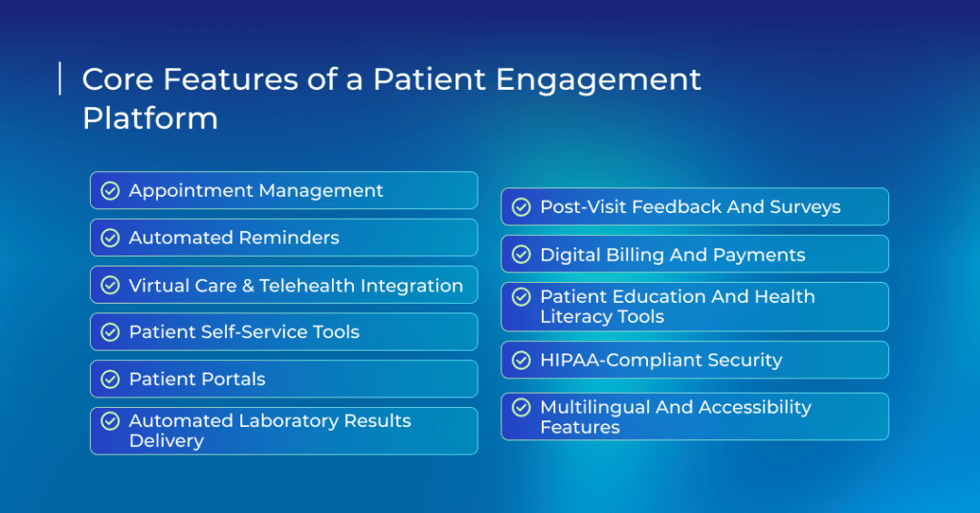
An engagement platform supports self-service options, so patients aren't forced only to call the office for their appointments. They can book or cancel visits online, even at midnight if that's when they remember. This takes pressure off your front desk so that they have more time to help people in the office.
Reducing no-show rates is a core feature. The platform sends automatic appointment reminders to patients through text, email, or voice. These messages also tell patients what to bring or what to do for specific procedures. It saves patients from the stress and potential wasted visit because they arrived unprepared.
Disabled patients or someone living far away can still consult with their providers through virtual visits. These platforms support telehealth devices that monitor your health information in real time. This data is accessible to doctors who might be living in another state. Hence, they can make informed decisions. Telehealth support is another way to make care accessible to everyone.
We’ve already talked about how self-service support makes scheduling easier, but its impact extends far beyond appointments. Patients can update their contact information and insurance details, or upload test results from their homes or on their own time. This also means better patient management for your front desk, especially in a crowded waiting room.
Any health information that patients used to get by visiting a clinic or calling their office can now be accessed through portals and apps. They give patients a single place to see their medical records, test results, current medications, and health information that their provider shares with them.
Just as important, patient portals enable two-way communication. Someone can send a quick message about a new symptom and receive timely guidance from their provider.
Remember when you had to go to the clinic to get your lab report? Patient engagement platforms automatically pull them now, as soon as they are available, and add them to your profile.
Some reports might even include steps to guide patients on what to do next. For instance, if something needs attention, the system flags it and recommends the patient for a quick follow-up appointment.
Patient engagement platforms automate feedback collection. Instead of asking your front desk to hand out comment cards, the system automatically sends short surveys to patients after their appointments to ask about their experience. AI further helps by sorting out the feedback to give you a complete look into what needs immediate attention.
Patients see what they owe upfront and pay through the platform using saved payment methods or text-to-pay links. The system shows cost estimates before appointments when possible. This transparency makes collections easier for practices.
Healthcare providers use engagement platforms to push health resources tailored to a patient's condition. These are not just random articles. Someone with diabetes might receive simple wellness tips about foods to avoid, while a patient about to undergo a procedure gets guidance about how their health will change afterwards.
Healthcare providers manage sensitive patient information. Engagement platforms have built-in protocols that protect this data by encrypting your communications. Hence, providers get to comply with HIPAA standards from day one. They also get access to detailed logs of all activity, making audits easier.
Modern engagement platforms use AI to communicate with patients in the language they’re most comfortable with. A patient can write a message in their native language, and the system will automatically translate it for their doctor with great accuracy.
These tools also make sure care is accessible to everyone. Features like screen readers, adjustable text sizes, and other assistive options help patients with different abilities navigate their health information more easily.
Patient engagement platforms come in different configurations. Each type addresses specific needs for healthcare organizations.
These platforms don't attach to your EHR. They operate separately and connect through basic data links when needed.
Practices pick standalone options when they want features their EHR can't provide or when they're using different EHR systems across multiple offices.
You're not waiting on your EHR vendor to add something or approve an integration. If you decide to switch later, you can without ripping apart your entire tech setup.
You basically choose the exact tools you want without being stuck with whatever comes bundled.
These platforms are embedded directly within your EHR systems or close enough to function as a single unit. Patient information moves between systems automatically, so your staff doesn't jump between different programs or type the same information twice.
The catch is you're working with whatever your EHR vendor offers or allows for integration. If they don't support something, you're probably not getting it.
Large health systems with dozens of clinics and departments need platforms that work everywhere at once. These handle huge patient volumes and coordinate across specialties. They also bring all reporting under one roof, so admins can pull a single report that shows what's happening across all sites.
Solo practices or small clinics do need engagement platforms. What they don’t need are advanced features that don’t apply to them. Such providers can do with software that sticks to basic features like scheduling and messaging. They’re easy to use, affordable, and don’t need an IT team to keep them running.
Some platforms are made for particular types of medicine. For example, oncology platforms track complicated treatment schedules, medication protocols, and things like clinical trial enrollment.
Dental platforms, on the other hand, handle treatment plans with tooth diagrams, procedure-specific consent forms, and recall reminders for routine cleanings.
These platforms already know the compliance rules and paperwork requirements for that specialty, instead of trying to be everything to everyone.
The right patient engagement platform changes day-to-day operations and how patients show up for their care. Here’s what providers gain:
You're not investing in a patient engagement platform for the present. You're investing in the future when your organization scales up. Here's what to pay attention to when you're comparing different options:
It must integrate with your existing systems. EHR, PMS, billing, everything must work with your new platform, or else you'll have to deal with disconnected experiences.
Don't forget the user experience for both patients and staff. The best way is to try the software yourself.
If you're clicking around confused, or taking too long to find basic features, your patients won't bother, and your staff will show that much resistance.
Core features should match your workflow. Make a list of everything you need from the platform, and cross-check that with the vendor.
A small office might just need scheduling and reminders, while a bigger practice with multiple specialties needs way more.
HIPAA compliance and data security are not optional. Have the vendor show how their encryption works, who can access what, and how they back up data.
A security mess ruins your reputation and gets you in legal trouble. They should be able to show you proof they're compliant.
It should grow with you. Think about where you're headed in a few years. Can it handle more doctors, another location, and new services you want to add? Some platforms charge by provider or by message, which adds up fast when you expand. So, know what you'll be paying before you sign anything.
Vendor support and training. Ask what happens after they set everything up. Do they train new hires? How fast do they fix problems? Read what other practices say about getting help. The platform doesn't matter if you can't reach someone when it breaks.
Customization options are good. See if you can adjust things to work how you work. Can you change forms, set up your own workflows, or control when messages go out? Some patient engagement software is locked down, while others let you tweak almost everything.
Most healthcare providers lose precious time repeating the same calls and reminders every single day. This is time that they could spend on actual patient care. WestCX removes that burden by automating your daily, repetitive tasks like appointment reminders, follow-ups, and patient check-ins.
Our award-winning Patient Relationship Management (PRM) solution goes beyond one-way communication, allowing your staff to send personalized messages, track patient responses, and manage interactions across phone, SMS/RCS, email, and web chat.
With WestCX, patients can confirm appointments, ask questions, and access relevant information without adding work for your staff. Providers get a clear view of each patient’s voice journey with Insights360, making it easier to measure effectiveness at every stage, from the first dial to the final hang-up. This approach your team identify root causes of escalation, measures handle time, and pinpoints where agent workflows can improve for better patient care and service.
Sounds good? Schedule a demo today and see for yourself how we simplify communication to improve patient engagement.

The old ways of spamming messages in bulk to the same patient are long gone. Today, it's all about sending the right message at the right time. It...

Ever felt like a number in the healthcare system? The fact is that patients expect more, and healthcare organizations need to accept this as soon as...

Trust is everything in the healthcare sector. If your patients don't trust you, they will never be open about their symptoms and health conditions....