Cross-Selling in Banking: Matching Account Signals to the Right Offer
Ever received a call from your bank trying to sell you an additional product or service? That's cross-selling, a sales technique that aims to...
12 min read

Ever received a call from your bank trying to sell you an additional product or service? That's cross-selling, a sales technique that aims to convince existing customers to buy something new. While that may appear simple, most banks actually lose the sale before the offer ever has a chance to work.
What makes the offer lose value is that banks are never sure if the customer is even a good fit or ready to consider another product. It also often happens that banks get their account signals mixed up, so the offer either lands through a channel the customer never responds to or is directed to a customer who was never going to take it in the first place.
Addressing these fragmented workflows matters because banks are already putting more of their marketing budget toward finding new customers than retaining existing relationships, even though existing customers are far easier to cross-sell to than a new audience.
Hence, cross-selling isn't about sending more offers. What makes a good pitch is whether it's actually based on a genuine opportunity, and those opportunities only surface when banking systems are set to read signals.
The nature of the banking industry means its cross-selling programs run much more slowly than in other industries, like retail, where a cashier can recommend a warranty and the customer can make a decision within seconds.
Firstly, banking products are about long-term relationships. Customers can't simply decide in the moment when it comes to mortgages or credit cards. They often relate each decision to allowing a new service provider to take control of a part of their financial life.
Secondly, everything in banking requires proof. That's just how regulated industries work. Customers have to verify their identities and income sources, and provide various documents to activate a single product. It doesn't matter how well-timed the cross-sell was. It still requires approval.
Lastly, the customers you're trying to cross-sell almost always have the same product elsewhere. They probably have a checking account with another bank that came with a credit card, so why should they agree to have another with yours?
Similarly, a customer might be interested in a house loan, but they're already on an auto loan with someone else. Running that second loan application with the first provider seems logical. This makes cross-sell less about filling a gap at the right time, and more about pulling customers from their previous agreements.
This third constraint is why cross-selling strategies in the banking sector lean on data and timing instead of volume. They're anything but a loyalty program.
Something else worth clarifying before moving forward is how cross-selling is different from up-selling. The first is about convincing a customer to add a new product, which can be a different tier from what they're already using. The second is about upgrading a tier of a product they already have. That difference matters when you're building strategies.
Now that we've established the constraints, let's dive into some examples of cross-selling in banking.
Someone applying for a mortgage can be asked to create a checking account as well. The cross-selling here typically focuses on the ease of making mortgage payments internally instead of switching to another outside transfer system. The customer will accept the recommendation because it removes a step from their journey.
Someone else with a specific spending history, like on traveling or dining out, can be offered a credit card that offers better rates (or discounts) and loyalty points in that category. The customer will accept that recommendation because the amount involved shows up in their statements. Most simply say yes because they intend to funnel those savings back into their category.
As another cross-selling example in retail banking, a customer sitting on idle funds for years can be offered a term deposit product. They'll accept because they weren't doing anything with the money anyway.
It's common for a mortgage customer to exceed a certain equity position. So they're offered a home equity loan, which the customer will consider because the equity is doing nothing and the bank already holds the primary claim.
Another customer who is looking to buy a new car can be offered an auto loan. This is a pretty common and straightforward cross-selling example in banking. The customer will say yes because the bank's rates are more favorable than negotiating rates in a showroom.
Finally, think of a customer who is juggling multiple loan payments. The bank steps in to offer them one single installment that covers all those balances. The customer will agree because tracking one payment is easier than tracking three or four.
A newly launched business can be offered merchant services and a business card as part of the onboarding process. The business owner agrees because they'll eventually apply for these two services. But getting them both done now is better than submitting two different applications later.
Consider another business example with higher transaction volumes than its basic checking account allows. The bank can quickly reach out to offer treasury management before the business starts seeing customers churn.
Another example can be a business that's paying employees on a fixed schedule. Offering them a payroll service removes the cumbersome job of doing payroll by hand.
It needs to be clarified first that cross-selling in the banking industry is not a sales strategy. The growth that banks are gunning for is usually already with competitors. So cross-selling isn't about competing against any particular product. Banks are technically competing against products the customer already has somewhere else.
Accenture's 2025 Global Banking Customer Study backs this up by noting 73% of customers are already banking with other institutions besides their primary bank. The same study also finds that customers who refer their bank to others usually hold around 17% more products with the bank than the average customer. The difference was due to excellent customer engagement instead of rates.
This is why timing is so important to materialize cross-selling opportunities in the banking industry. Whatever your team pitches needs to be in the moment instead of working off quarterly promotional campaigns. For example, when a customer makes a deposit that's larger than their historical average, or when a customer mentions a significant life event like buying a new car or house during a service call.
Spending patterns also create these momentary windows of opportunity. If you miss them, the customer will find solutions elsewhere.
A single customer can have multiple accounts with the same bank at any point in time. Mortgages, other installment plans, joint checking accounts, children's savings accounts, etc; they all create one household view of the customer. But that's only visible when you connect all those accounts; otherwise, as often happens, banks treat each account as a separate relationship.
How do you connect those accounts? You build a bridge that runs between five banking systems:
Banks that ignore that five-point integration face three problems. Firstly, it becomes difficult to differentiate a new customer and someone who has been with you for years. Both read like someone who was onboarded just last month.
Secondly, the person trying to cross-sell never has complete visibility into the customer. They'll see a delinquency flag on a loan without knowing that the customer has a mortgage for the same account but in a different system.
The lack of visibility also means that customers start getting offers for products they already have. This is the fastest way to lose their trust.
Hence, instead of starting with the offer, banks need to look at the account structure underneath. That's what separates generic cross-selling strategies in the banking sector. The ones actually reporting good outcomes focus on building relationships.
Every guide that lists cross-selling examples in banking tells you which products to pair together. What they don't tell you is when to pitch them. Those moments are also the actual gaps, and it's what we'll go through below.
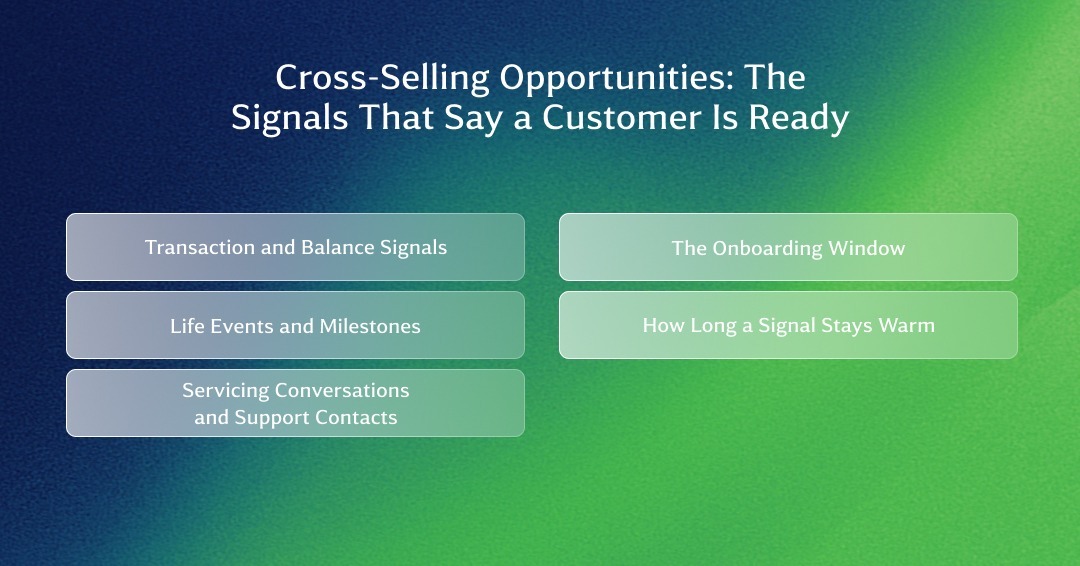
Your core transaction data contains most of what you need to detect cross-selling opportunities. The irony is that banks already have this data, but they still end up taking guesses.
Every time a customer makes a term payment for a competitor bank, that transaction appears as an ACH debit in yours. It's the clearest signal a bank has about one of its customers managing debt elsewhere. That's a moment to initiate a conversation about refinancing.
A large deposit that remains untouched for several statement cycles is an opportunity for the bank to talk about a savings account. This is also another signal that's easy to catch. Banking systems are already designed to flag balance thresholds for compliance purposes. You just have to use them for your cross-selling program.
Some customers transfer a small amount of their funds to another account every month like clockwork, usually after they receive their salary. It appears as saving toward a goal. Find out that goal, and offer the product attached to it.
Demographics are still used to match customers to banking products. Someone's age or income range helps identify the customers the bank should contact for cross-selling. However, that says nothing about when to contact them.
Compare that to an actual life event like a new address, a new joint account holder, or a business formation filing. Each one comes with a time frame.
For example, a newly added co-owner account holder is likely consolidating finances, which initiates a conversation about consolidating accounts or adding shared credit products within a specific timeframe (rather than during a marketing campaign).
Contact centers generate the most signals, but most banks just focus on the call and chat logs. Someone asking about wire transfer limits is essentially telling you that they're moving more money now than before, and their existing account capacity doesn't meet that.
Someone else asking about interest rates on time deposits or savings products is openly expressing their interest in a savings account. The same goes for a customer who's calling about their credit card being flagged (again) while traveling abroad.
Banks need a model that can separate intent from behavior. Customer service conversations reveal intent. But the only reason a bank might not act on it is that call transcripts or disposition codes remain on the contact center platform instead of feeding into whatever system actually triggers an offer.
Customers typically have a high adoption rate during the first weeks after opening their account. But this is also the period with the least transaction history for the bank to model from.
What banks should do is use the information the customer has already disclosed during onboarding. For example, someone opening a business checking account is almost guaranteed to be interested in a business credit card, or if they've opened a high-yield savings account for a down payment on a house, they've pretty much told you what they're interested in.
However, that information doesn't matter if the customer account doesn't survive long enough to generate any signals. What breaks during digital onboarding is usually the reason banks lose customers before the relationship even starts, and that's the precondition for any of these signals to exist in the first place.
We've already mentioned how customer moments send signals for banks to catch to improve their cross-sells within a specific timeframe. Hence, you also need to know how those signals decay at different rates.
For instance, someone calling your contact center for a fraud attempt needs to be dealt with instantly. These calls go cold within days. However, a business formation event stays relevant for much longer.
You can measure your own decay rates by tracking acceptance rates against days elapsed since the triggering signal. Do this for each signal type.
If a monthly campaign keeps running against a signal that decays in a week, the fault lies in timing, not the creative team. You fix that by matching how fast you move to how fast that particular signal fades.
The following list picks up after a bank has caught a signal and picked the timing. Here's what happens next:
A customer's behavior always beats their demographics. Someone who just increased their direct deposit by 30% is a more suitable candidate for a cross-sell than a customer who just fits a general profile for a savings account.
Behavior is a trigger in itself that tells the bank when to act. If you rely solely on demographics, you just have a list of customers your team needs to approach. We've already gone over the signal details and moments above.
The same customer can generate three different signals in a week. You can't just act on them all at once or in the sequence they were generated. Hence, banks need to establish a rule to prioritize which offer should go out first.
That rule should typically weight the offer against the need of the customer in the moment, not needs a model has guessed from adjacent behavior.
It should also determine whether the customer can receive another offer without the pitch starting to feel like noise. The product that paves the way for another product should always be picked first, even before one that's giving better margins.
Offering only one offer at a time is a smarter approach. Offering a menu of three options doesn't personalize the product; instead, it gives the decision-making power back to the customer and asks them to do the targeting the bank was supposed to do.
Every banking product comes with a price, but something more valuable is putting a price on the relationship itself. For example, interest rate offers linked to direct deposits are less costly than blindly offering the same rates. It actually rewards behaviors the bank wants to see. Similarly, tie fee waivers to combined balances in checking and savings accounts.
However, all of this only holds up when your offer comes with an actual number. A credit union member needs to know how much they're saving. They won't be moved when they hear they'll get "member pricing" on a product. But telling them they'll save $250 a year gives them something they can bring home and decide on.
Most cross-selling opportunities in banking involve products the customer already owns elsewhere. You're not exactly selling them something new. Your cross-sell is more about convincing them to choose you over others.
That angle changes your pitch entirely from "buy this" to "switch to this". You make your case on consolidation, simpler management under one login, or just keeping the money where it already lands every payday.
Each argument points to a cost the customer is paying right now without noticing it, and naming that cost is what moves the conversation.
Every channel isn't meant for every product. Their level of complexity and what verification is required determine the most appropriate channel. Credit card applications and upgrades can be done within a minute from the mobile app. The same takes longer if the customer has to call the office.
However, a mortgage requires human assistance, as does a conversation about getting a loan. These decisions involve too many variables for a customer to be comfortable with self-service.
Many banks actually allow customers to initiate a mortgage or loan application from the mobile app, but that's only to gather their information. A human agent still calls them back to lead that complex conversation and finalize the product. That digital journey feels much like a natural next step instead of a cold call.
Context is what gives every cross-sell conversation relevancy and meaning. If banking teams don't know what exactly triggered an outreach in the first place, they're just making generic cold calls that are never going to connect with the customer.
This happens when the signal that flagged the opportunity never reaches downstream to the people who need it. Some systems require another team to pull the necessary context for cross-selling agents. A complete lack of coordination, however, makes that process more difficult and messy than it should be.
Banks need solutions like WestCX to address that workflow gap. It creates a bridge between detection and outbound conversations so that the context actually travels with the customer instead of requiring the agent to chase it down.
Modern banks are using predictive models to identify when a customer is likely to need another product. However, that model only works when the data you're feeding it is reliable.
A customer's transaction history, account activity, life events, previous support interactions, and product usage all help paint an accurate picture that surfaces relevant opportunities. These signals enable banks to target specific customers in the moment, which always yields better results than making dozens of cold calls. Being pushy has never worked for cross-selling.
We've talked about signal detection that surfaces opportunities. It's now time to cover conditions that warrant stopping an offer from going out, regardless of how strong a signal looks.
Someone with an open dispute, a delinquency flag, or fatigued from too many offers is a sign to pause your outreach. An offer that lands during a hardship moment is never going to convert. Ignoring these situational flags is usually where cross-selling in banking loses more customers instead of winning them.
Most cross-selling strategies in banking are built around waiting for a specific moment. A customer mentions a new job or a house they’re saving for, and that's the cue for the agent to start pitching.
The problem is that those obvious moments are only a small part of the picture. Waiting for them to land on your desk means ignoring every other signal the customer has already revealed through their account history, digital behavior, support questions, as well as the context of the conversation.
These are the cues that never get said out loud but are more likely to convert. Banks need integrated systems that can spot those signals as they surface and act on them before the call ends.
It makes cross-selling more than just pitching a list of products or running a monthly campaign. WestCX Orchestrate is specifically built to bridge those moments. It reads intent during live interactions and connects it with the customer's journey, account context, and interaction history. It can identify when a customer may be receptive to an additional product or service and help determine what should happen next.
You don't have to wait for a weekly or monthly report to know what opportunities to act upon, because by then, most signals have already faded. You get to act upon the signal while it’s still relevant.
That timing matters. A customer asking about an upcoming large purchase may be a natural opening to discuss a relevant lending product. But that opening only creates value if the system can recognize the intent, match it to the customer's existing relationship with the bank, and bring the right offer into the conversation.
WestCX Orchestrate keeps that context from disappearing at the handoff. When an opportunity moves from an AI interaction to a live agent, or across another channel, the relevant context carries forward. The next person or system doesn't have to rediscover why the customer might be interested. They can continue from the signal that was already identified.
That turns cross-selling into part of the customer journey itself: detect the signal > understand the context > make the right offer while the conversation is still happening.
If you want to see how WestCX Orchestrate catches that moment for your own customers, book a demo, and we'll walk you through it.
Ever received a call from your bank trying to sell you an additional product or service? That's cross-selling, a sales technique that aims to...

Call deflection is a way to resolve customer issues through self-service channels. It improves your operations and lowers your costs because...
Credit unions usually think of customer service when someone asks about improving their member experience. That’s only one piece of the puzzle.
Credit unions usually think of customer service when someone asks about improving their member experience. That’s only one piece of the puzzle.
Call deflection is a way to resolve customer issues through self-service channels. It improves your operations and lowers your costs because...
It's not hard to convince banks that customer experience matters. Every financial institution already knows it does. The harder challenge is...