Effective Call Deflection Strategies to Reduce Repeat Calls
Call deflection is a way to resolve customer issues through self-service channels. It improves your operations and lowers your costs because...
9 min read
Call deflection is a way to resolve customer issues through self-service channels. It improves your operations and lowers your costs because customers are automatically routed away to resolve their own issues. However, that only works if customers actually get what they want. If they don't, they'll just call back, so you have only added another step in their journey.
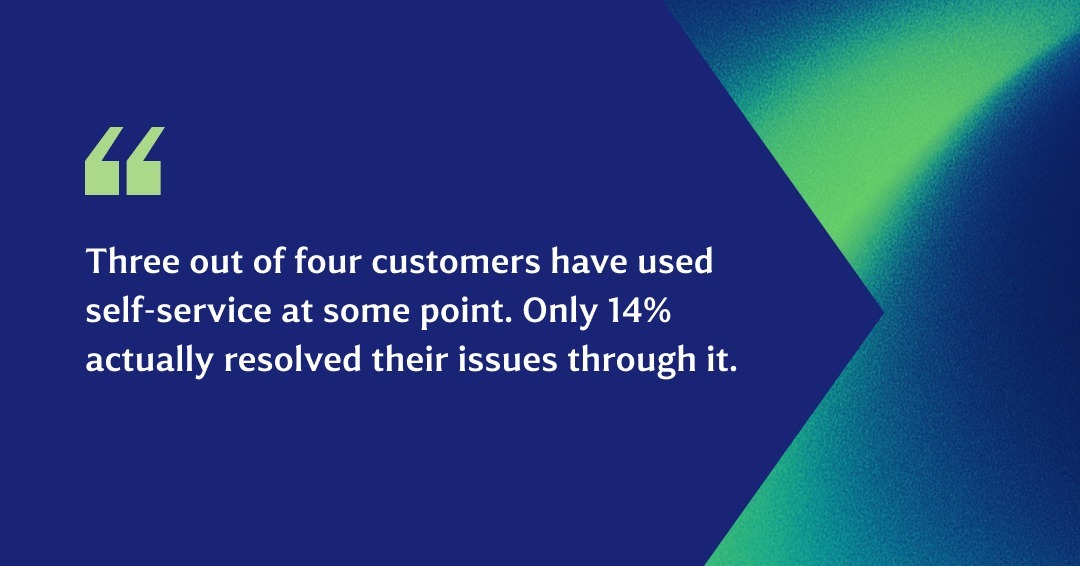
According to a Gartner survey, three out of four customers you come across have used self-service at some point in their lives. That sounds impressive until the same survey notes that only 14% actually resolved their issues through self-service. That's roughly one in seven customers for whom deflection worked.
This blog takes a closer look at what makes call deflection actually work, and how organizations can use it to prevent repeat contacts.
Mixing up both terms typically blinds contact centers to a major operational gap. The first one, call deflection, routes customers to a different queue than the one the live agent is handling. For example, redirecting customers to a chatbot, an IVR menu, or any other self-service channel instead of waiting for the agent to pick up.
Call containment is what happens next. It measures whether the routed customer actually solved their problem after being deflected. This is also something that usually gets ignored. High deflection numbers might look great on a dashboard, but they alone don’t prove anything. Customers bouncing from self-service to live support just means your self-service channels aren’t working at all, making deflection just a way to delay the eventual call.
You calculate your call deflection rate as the percentage of the total number of interactions outside a live call divided by the total number of potential calls.
Call Deflection Rate = (Deflected Interactions ÷ Total Potential Calls) × 100
If 1,000 customers contacted customer support in a month, and 400 of them resolved their issues through an IVR menu or a chatbot, the deflection rate comes to 40% for that month. However, as pointed out before, that 40% doesn't say whether those 400 customers were satisfied with the self-service channel.
Deflection queues are meant to take routine calls off the live team's plates. However, only 36% of customers actually leave with satisfied resolutions through self-service, as per Gartner's research. The rest fail because they either couldn't find a solution relevant to their problem or felt like the company had no idea what they were even asking.
Both failures trace back to how the self-service layer operates in isolation. It can't see the customer's history and therefore doesn't have the context to deliver a relevant solution. Integrating standalone chatbots doesn't help either because they only end up asking the same questions the customer has already answered in an online form before being deflected.
The fact is that most call deflection strategies fail long before a contact center checks their dashboard, and by then, they've already suffered a significant loss in customer retention, satisfaction, and revenue.
Suppose a customer calls support to ask for an update about a claim. They mention their account details, previous claim file, and reason for calling. The chatbot, however, still asks them why they're calling and what the claim is about.
If the customer is patient enough, they'll endure the questioning but leave with a highly dissatisfied experience. Usually, though, they'll just cancel the call after the first two interactions and call again, this time asking for a live agent and more frustrated than before.
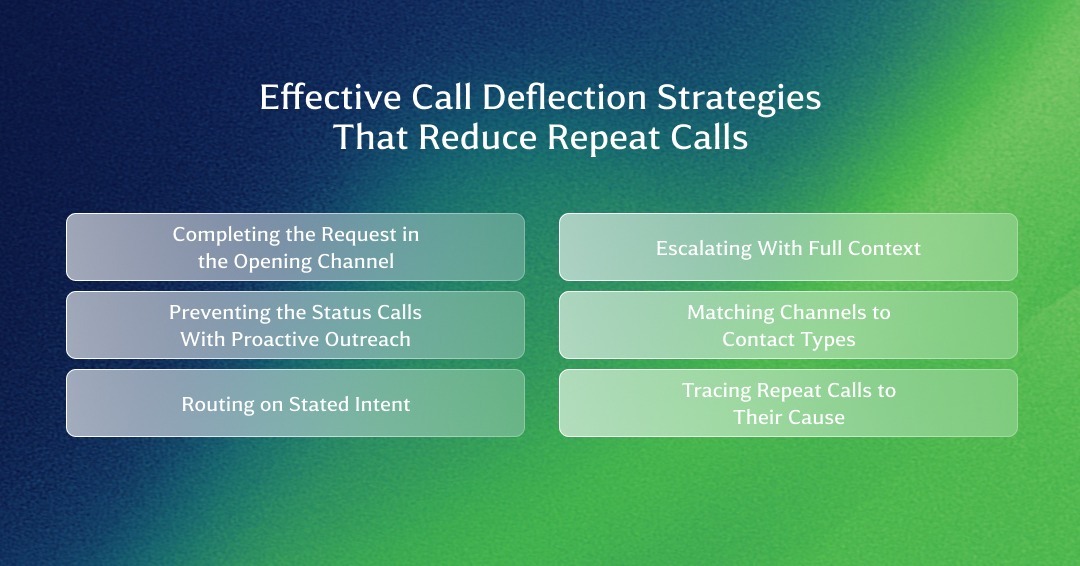
The only thing contact centers need to track here is whether customers completed their task or abandoned the self-service channel. Everything mentioned below revolves around that metric instead of raw queue volume.
Take a walk through your web pages, portals, and chat sessions to identify which steps are most likely to require a phone call. For example, appointment booking and rescheduling, account and status checks, file uploads, etc.
Any channel that's answering questions without actually completing the task is just delaying the inevitable call. This is pretty much the most direct way of reducing repeat calls.
Picture a customer who is told by an IVR menu to call a number for rescheduling. They’ve been forced to use two channels to complete the same task. That’s twice the cost that should have been spent.
Status inquiries are one of the most common reasons customers call, making them part of a predictable volume that can be eliminated via self-service and proactive messaging from the main queue.
You don't need a live agent to spend several hours of their daily routine to tell a customer about their order status or remind patients about their upcoming appointments. A system that automatically sends out those alerts removes the need for a customer to place the call in the first place.
Even if they do call, a self-service channel that's integrated with all existing systems can quickly pull up the latest status update to resolve their issue within seconds.
Hospitals are now sending RCS reminders with a one-tap confirm or reschedule button. It’s an excellent example of call deflection strategies in healthcare because nobody has to call and ask if their appointment is still happening.
That's all there is to it. Nothing gets deflected, because nothing gets generated in the first place.
The problem with IVR menus is that they rarely route customers based on what they actually need. It happens often that customers pick the option closest to their question, and then hope for a resolution that fits. If that doesn't work out, they're sent back to the start of the menu, from where they just decide to call the live support team instead.
A better call deflection technique is to let customers state their reason for calling in their own words, and then use natural-language models to capture intent. This gives far more accuracy in comparison and ensures the caller is always routed to the right department. The whole challenge of misrouting gets thrown out the door, meaning each contact doesn't turn into two or three.
Customers will still want to connect to a live agent, which is perfectly fine. What's not is escalating their case without any context. That includes what the customer was trying to achieve, what actions they have already taken, what information they've already given, and any other relevant detail from their history.
This allows the agent to jump straight into a resolution. If the customer has to start explaining the problem from scratch after a failed self-service session, the service cost will be higher than for a customer who called first.
Some channels are better suited for certain problems. Instead of bundling all your contacts across channels, it's more useful to have a decision framework to confirm the complexity of the task, the sensitivity of the data, the timeline, and whether the customer needs a record of what happened afterward.
For instance, short queries, such as estimated delivery times or business hours, work fine over SMS or chat. However, those same channels don't work for authentication or document reviews, which are too complex and sensitive in comparison.
Hence, correctly matching channels to tasks from the first try is crucial to preventing repeat calls.
Most repeat calls trace back to something minor that can be easily addressed. It could be a broken field in a form, a notification type duplicating itself over two channels, a confusing piece of instruction in a support email - these small fixes immediately eliminate all their resulting repeat calls downstream for all customers, not just the one who complained.
This is the key to reducing repeat calls in contact centers. It’s also the strategy that actually separates real demand reduction from channel shuffling. You address the problem at its source. You can integrate as many chatbots or automation solutions as you'd like, but it won't fix a broken field in the form.
Call deflection is meant for routine requests, which are typically in large volumes. Their predictability and simplicity are what make them prime candidates for automation. Just one virtual assistant or a well-designed self-service channel can absorb thousands of routine calls alone, leaving your live team to focus only on the complex cases that need their human judgement.
That, however, still leaves you with two challenges to overcome. Firstly, the AI should be smart enough to hold an actual conversation instead of delivering an IVR-like robo script. Conversational AI systems solve that with highly intelligent VAs that mimic human language and tone. Most customers aren't even aware that they're speaking with an AI.
Secondly, and most importantly, the AI system should be able to access the platform where the customer request originated and complete the task. That's a two-way street. If an AI agent can answer a question but can't update the records behind it, there's still a high chance of the customer calling back. Hence, AI-driven call deflection strategies mandate that the AI have both read and write access to the core system.
Below is a short checklist for you to consider when evaluating any call deflection platform:
General call deflection strategies don't work for regulated industries like healthcare and finance. While the main models of automating routine interactions and keeping humans for complex cases remain the same, what changes is defining which calls even qualify to be deflected in the first place. That's different from simply deflecting all routine cases. Your system needs to address varying constraints depending on the regulated industry.
Identity verification forms the cornerstone of every call deflection strategy in the banking and financial sector. Every interaction from mere balance checks to payment confirmations and claim intakes requires a full identity check. However, that's a constraint in itself because the average customer doesn't want to spend time verifying themselves just to know about their due date.
Card control changes require even more severe authentication before the request can be completed. Dispute resolution also has the same level of requirements, as does any interaction involving fraud.
Those security checkpoints are why most banking deflection systems are limited to interactions involving information gains. That's their way of stabilizing customer satisfaction unless there's a quick way of addressing authentication issues first.
Digital onboarding has the same constraints. Light digital channels can easily request and receive documents, but verifying whether the right person is submitting them remains a bottleneck.
A 2025 retail banking study from J.D. Power finds that only 66% of customers resolved their issues within one day, of which roughly two in five required more than one contact. That's the gap where call deflection strategies play a major role. They can either save the bank money or keep generating callbacks based on whether the digital layer can actually finish the transaction.
WestCX offers a seamless solution to plug that gap for banks and financial institutions. Its communication platform directly integrates with core banking systems from day one. That secure visibility allows automated interactions to move beyond basic information requests and complete more complex transactions without worrying about security or CX.
The healthcare industry is even more stringent. Every channel that involves patient data needs to comply with HIPAA. There also needs to be a signed BAA with the vendor to establish ownership. These requirements automatically rule out a lot of potential vendors before the deflection design work even begins, making automated solutions a bit more complicated to integrate without relying on your staff.
So call deflection strategies in healthcare have to account for where your staff time actually goes. A recent MGMA survey finds that eligibility and pre-authorization accounted for the largest share of phone time. That's 45%, while appointment scheduling came in second at 31%. All other metrics were in the single digits.
Those authorization checks still rely on payer systems that providers have no control over. This is why most AI healthcare systems easily deflect scheduling requests but not eligibility requests.
WestCX resolves that biggest time sink for healthcare providers by building automated processes around their own systems instead of bolting something on and brute-forcing the layers to work together. In other words, it doesn't just deflect the easiest calls; it orchestrates the systems and workflows behind the calls that consume the most staff time.
Your call deflection rate tells you how many calls never reached a live agent. That, however, doesn't reflect whether the customer's problem was resolved. A contact center showing high deflection numbers doesn't necessarily mean their self-service channels are working. Pair that with a high repeat contact rate and the system is simply closing conversations instead of resolving issues.
You fix that blind spot by tracking repeat contact within a set time window. 1-2 weeks is typically enough to identify requests that have returned via a different channel.
Combine that with CSAT for the deflected interaction. Most companies make a mistake here by using CSAT for the overall channel instead. That still leaves a gap because even a smooth interface is of no use if it's not giving customers the answer they need.
Round that up with the Customer Effort Score. How much work did the customer actually have to do (or how many steps they had to take) to get their problem resolved? This catches friction that the CSAT doesn't.
Together, these three call deflection success rate metrics show you the complete picture. You finally can answer that important question: is your tech even resolving issues and completing tasks, or is it just routing them off for someone else?
Call deflections work when the channel knows exactly what's happening with the customer and what they need in the moment. So it comes down to current context, not a snapshot of what happened yesterday. If your deflection setup is routing customers elsewhere without fixing the underlying fragmentation problem, the customer is simply moving to another channel that’s working from the same disconnected information that caused the call in the first place.
That's where WestCX comes in. We understand why healthcare and finance communication can't afford disconnected data, because one missed detail can quickly become a compliance risk. We address that gap with WestCX Orchestrate, our journey orchestration engine.
Routine calls are resolved instantly by the AI agent on the first contact because the system already has the customer data it needs. It doesn’t transfer them around or give generic responses that warrant a callback.
Proactive engagement ensures most of those calls never even happen. Status updates and reminders are automatically sent out through preferred channels before someone has to call the office.
Our AI-driven intelligence closes the loop from the other end by tracking repeat contacts back to their source, so your business gets a two-front solution: self-service deflection that actually works, and fixing the very reason contacts keep coming back.
Combined, you’re looking at an 80% call containment rate through our conversational AI agents. Your appointment scheduling alone sees a 40% drop in routine inbounds. That removes two of the biggest sources of routine workload from your staff. It’s the result you can expect when your channels actually carry context forward instead of running in isolation.
If you want to see what that looks like against your own call volume, run it through the WestCX ROI calculator. You can also jump straight ahead to schedule a demo to see how WestCX Orchestrate works against your own data.
Call deflection is a way to resolve customer issues through self-service channels. It improves your operations and lowers your costs because...
Credit unions usually think of customer service when someone asks about improving their member experience. That’s only one piece of the puzzle.
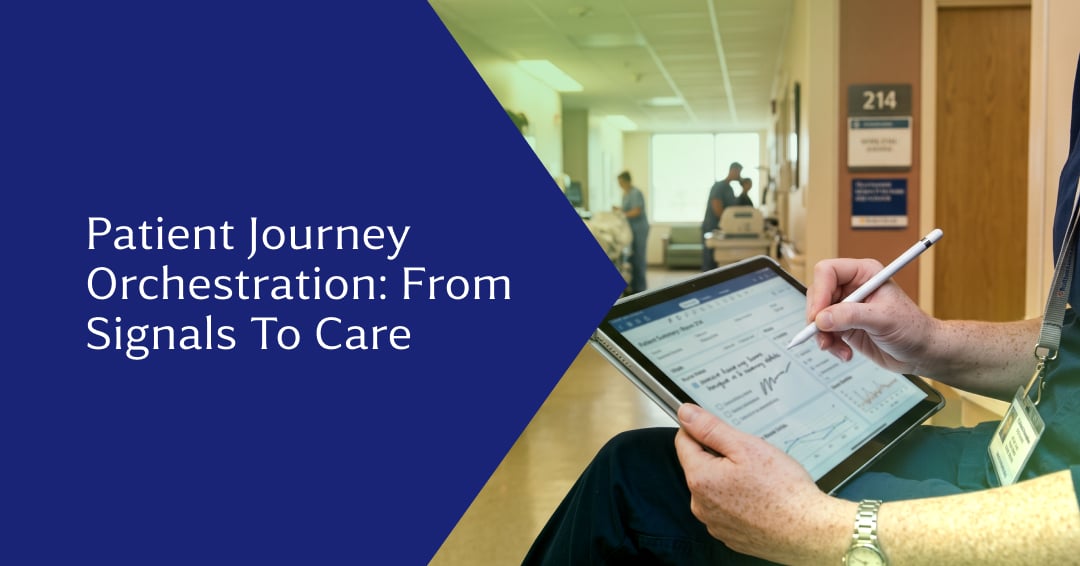
Healthcare systems are a maze of appointments, referrals, eligibility checks, intake forms, reminders, and follow-ups. However, they're often...
If you're running a call center for a healthcare organization, you've probably been asked to cut costs while handling higher patient volumes than...
In a way, customer service has always been built around supporting customers after they reach out. That approach creates unnecessary work and...

It's common for call centers to hire more agents or integrate self-service options to fix their high call volumes. Neither is a permanent solution...