Cross-Selling in Banking: Matching Account Signals to the Right Offer
Ever received a call from your bank trying to sell you an additional product or service? That's cross-selling, a sales technique that aims to...
9 min read
If you're running a call center for a healthcare organization, you've probably been asked to cut costs while handling higher patient volumes than ever. The challenge here isn't just to find ways to save the most money, but to do that without those savings showing up in ways your patients can feel them.
The good news is that reducing costs doesn't have to mean reducing service. The trick is to lower the cost of resolving each patient's need instead of simply trying to answer fewer calls.
This guide breaks down what actually drives healthcare call center costs, where the biggest savings come from, and how AI helps you spend less without patients noticing a decline in their experience.
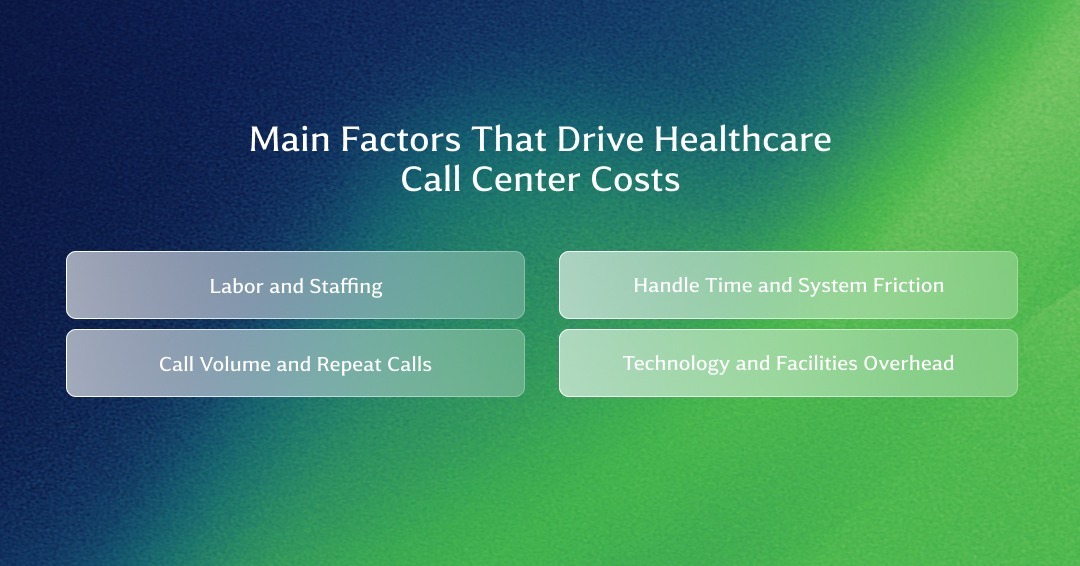
Take any healthcare call center as an example. It's made up of several moving parts, each adding to the overall budget.
However, not all of them are that easy to influence, so most cost-cutting advice starts with fixed overhead instead. It's the easiest expense to spot on a spreadsheet, but the reality is that it's also rarely the biggest money-saving driver.
The real money is often leaking through unnecessary call volume and repeat calls, yet those are the areas few healthcare organizations are actively monitoring.
Labor costs typically dominate a call center's budget, reaching as high as 95% across industries. That’s because those expenses go well beyond the recruitment phase, especially in the healthcare sector.
Every new hire has to be trained on the EHR, learn scheduling and other related workflows, understand payer requirements, and memorize escalation protocols before they can start handling calls on their own.
That makes turnover far more expensive than it should be. It also takes time to replace all that knowledge and experience, which means every empty seat continues to add to your operating costs until your new agents are ready. Hence, those productivity losses are often far more expensive than the recruiting costs themselves.
Repeat calls are one of the easiest ways for call center costs to balloon in the shadows. Your raw call volumes don't account for patients who had to call twice or thrice to resolve their billing dispute. That's also not some rare use case.
Most calls coming through a healthcare call center aren't complicated. They're routine requests tied to scheduling, reminders, refills, labs, billing, etc. If those routine calls aren't being closed the first time, the call center is just creating additional work without additional value.
Most people quickly blame live agents for long call times. It's rarely about their skill level and has more to do with disconnected systems.
Even a call about a minor update would take longer when agents have to jump between the EHR, scheduling tools, and billing platforms just to find the information they need.
Every extra click or tab switch adds a few more seconds. While that might not seem like much, multiply that across thousands of calls each month and those seconds become a significant driver of handle time and operating costs.
Remember when we mentioned how most cost-cutting plans start with fixed overhead? That's the cost of simply keeping the lights on. Utility and telephony bills, software licenses, office rent, IT support, and other maintenance expenses are easy to target because they're clearly visible to everyone.
The problem, and which most call centers realize late, is that there's only so much you can save by reducing these expenses. The biggest opportunities lie elsewhere.
Also, adding more disconnected touchpoints, like a new chatbot or reporting tool, won't just magically reduce operating costs. In most cases, it only makes the overhead worse.
It's common for call centers to prioritize clearing as many calls from the queue as possible in the shortest amount of time. That strategy might work well for improving handling rates, but it does next to nothing to ensure the patient's issue is actually resolved.
A call center's cost per call doesn't disappear when the interaction ends. If the patient has to call back again for the same issue, the healthcare organization ends up paying more to handle the same case. That unresolved issue can easily escalate into a missed appointment, delaying care that costs a lot more to fix later.
The same applies to call deflection. Shifting patients from the main queue to a portal, chatbot, or automated menu doesn't reduce costs if they still can't complete what they set out to do. They'll abandon the interaction and end up calling the call center anyway.
The biggest savings always come from resolving the reason patients are calling in the first place, either through a live agent or automation.
Each strategy below ties back to the cost drivers mentioned above. They're meant to work as one connected plan.
A healthcare call center's highest-volume interactions are also its most predictable. Scheduling appointments, sending reminders, processing prescription refills, and answering routine FAQs can all be automated to free your human agents for more complex cases.
That said, many organizations undermine those gains by only automating the call greeting or intake before handing the actual task to a human. That secondary queue doesn’t help in any meaningful way. Your agents still have to deal with the same workload as before.
So, how does AI reduce healthcare call center costs in a way that actually holds up? By automating the entire workflow for each patient. That means the AI should be smart enough to book appointments, confirm refills, verify information, and update records without any human intervention.
The goal here is to completely free live agents for clinical or high-value patient needs that actually require their expertise and judgment.
A patient who reaches the right department after two transfers costs the call center three times the cost of a call that is routed correctly from the start.
That's why intelligent routing matters. Modern AI systems use patient context, agent skills, availability, and triage to connect callers with the right person on the first try.
However, take note that those gains only happen when routing decisions are based on what the patient actually needs instead of how your organization is set up internally.
A live agent who has to switch between three different systems just to answer one question will naturally take longer to resolve the call. That shouldn't reflect on their skill. They've been handicapped from the start by disconnected tools and fragmented information.
Giving agents a unified view of all your systems and data means they have all the information they need on a single screen. Without having to dig for context, they can immediately start solving the caller’s problem. That not only reduces average handle time but also eases the frustration that contributes to agent burnout and turnover.
If you think about it for a moment, the cheapest call to resolve is the one that never reaches a call center. Proactive confirmations and updates, paired with self-service capabilities, empower patients to take charge of their healthcare journey. Someone who has already been sent a reminder this week won't call your office to confirm their upcoming visit.
However, understand that proactive outreach isn't the same thing as deflection. You're not pushing an existing call away. You're simply removing the "need" for the call at all.
Resolutions don't matter if the patient never knows their problem was solved. Consider someone who calls to reschedule an appointment. If the appointment is changed but they never receive a confirmation or reminder, they're likely to call back just to make sure the request went through.
That second call doesn't solve a new problem. It's just extending the original request and adding to your call volume because the loop was never closed.
The easiest way to prevent that is to automatically notify patients as soon as a task is completed on your end. Send appointment confirmations, refill updates, referral statuses, or any other relevant notifications without requiring the patient to ask.
It's the same principle as resolving issues instead of deflecting calls, except this time you're preventing repeat contacts after the interaction instead of during it.
Every healthcare call center has to find its own staffing model. Simply copying what your competitors are doing rarely makes sense because your call volume, interaction complexity, and clinical requirements may be completely different.
For my healthcare organizations, outsourced or overflow teams are one of the more common ways to handle predictable spikes, like after-hours calls or seasonal trends. Not having to increase headcount for demand that only appears a few weeks each year can significantly reduce labor costs. It’s a smart way to scale your operations.
AI and automation help in several ways, but we can trim that down to three concrete areas where you reap the most savings.
Firstly, AI systems automatically resolve routine interactions without pulling your live agents from their work. This doesn't mean patients are receiving generic responses. Modern AI considers the actual context of each conversation to deliver tailored resolutions, reducing the chances of patients calling back about the same issue.
Some calls still require a human specialist. AI ensures that the agent has all the information they need as soon as they pick up the call. Your teams don’t have to put patients on hold while they dig through different systems, or ask them to repeat themselves. They can immediately go straight for a resolution, reducing handle times and improving caller satisfaction.
Finally, AI makes it much easier to handle sudden call spikes. Maybe bad weather has filtered patients from two sites to the third, or winter has everyone calling in to ask about flu shots. You can easily add more AI virtual assistants to scale your operations during peak demand and scale back down when everything stabilizes. That flexibility is far more cost-effective than hiring additional staff to cover temporary peaks.
Gartner has actually put a number to AI-driven call center savings. Healthcare organizations are expected to save around $80 billion in labor costs by 2026. But that's not even the surprising bit. That projection comes from automating just one in ten agent interactions.
Considering that labor costs account for the largest share of a healthcare call center’s budget, it's astonishing that even a small-scale automation strategy can have a massive impact on a call center’s spend.
However, that doesn't mean you should start automating every available call to cut costs. The key takeaway here is to automate the "right" routine interactions without compromising patient care.
Your AI systems should never make clinical judgements or handle high-risk patients. Even though automated systems can be made to resolve billing disputes, the financial and stressful nature of the category means escalation should always be available.
Patients should never have to dig through multiple menus just to reach a live agent. That option should always be clear and easy to access.
The same logic applies to compliance. Every AI interaction involving PHI needs the same identity verification and consent checks a live agent would perform. HIPAA doesn't relax those requirements just because a bot is asking the questions instead of a human.
If your cost-cutting program is ignoring those safeguards, you’re just adding compliance risk to your savings.
Healthcare leaders often make the mistake of focusing too much on deflection rates instead of resolution. A call that gets routed away from an agent but doesn't actually solve the patient's problem doesn't just disappear into the void. It comes back as another call or another message. What healthcare organizations should be prioritizing is whether patients actually achieved what they called to do. Track that and you'll know for certain if your call center's workflows are helping patients or just hiding their problems somewhere else.
That same logic applies to the exit door. If a patient has to fight through a menu tree or explain themselves twice before reaching a human, that frustration sticks with them a lot longer than whatever the health system saved that quarter. Hence, patients need a clear, immediate way to ask for a human agent. That option shouldn’t be layered behind a "did this answer your question" loop built to keep people in the automated flow a little longer.
You also need to assign ownership for your automated systems. Somebody needs to constantly monitor access and abandonment rates. Right now, the average hold time is around 4.4 minutes against a target of 50 seconds. That gap was there before anyone added AI to the mix, meaning patients have already been waiting too long. Any cost-cutting push for a call center that isn’t watching that number can only make the wait worse instead of better.
Finally, some calls just need a human specialist regardless of what your automation roadmap says. Fast resolutions don’t matter that much for someone calling about a new diagnosis, a mental health crisis, or a death in the family. They need someone who can actually listen to their problem with empathy. Routing those calls to a bot might reduce your call center costs on paper, but you’ve made the worst moment of that patient's day even worse.
If your call center costs are staying high, the problem isn’t because you’re taking too many calls; it’s that most of those calls aren’t being resolved on the first attempt. Every time a patient has to call back or send a portal message about the same problem, that's where most of your money is actually going. WestCX offers to plug that exact leak.
Our intelligent virtual agents (IVAs) aren't like traditional chatbots. Ours uses conversational AI to actually finish tasks instead of just answering the phone. They book and reschedule appointments, process prescription refills, and confirm reminders in the same call instead of passing those tasks along for a human agent to pick up later.
When a call does need one of your live agents, our platform has already pulled the patient's complete record and history before the agent ever picks up, so your team simply resumes the conversation instead of asking the same three questions the patient just answered to a machine.
That means a good share of your calls never happen at all, because we reach the patient first. A reminder before they're overdue, a nudge before a no-show, or a proactive update gives patients the information they need before they ever think to pick up the phone.
But lower cost per patient and faster answers aren’t just the only gains here. That connected, automated patient journey is only possible through WestCX Orchestrate. We treat each interaction as part of the same journey instead of a series of disconnected events.
Our intelligence layer ensures that the IVAs remember what happened before, understand the context of what the patient wants now, and use historical pattern data to determine the best next course of action.
So a patient calling to reschedule an appointment isn't just handled and forgotten. If they're also overdue for a screening, WestCX Orchestrate raises that in the same call instead of waiting weeks for a separate campaign to catch it. That's a call center that's a step ahead of the patient, not just reacting to them.
The best part? You don’t even need to rebuild your tech stack. WestCX integrates easily and can be live within 90 days with zero disruption to your workflows.
If your call center is still measuring success by how many calls it moves instead of how many it finishes, we'd like to show you what the other way looks like. Schedule a demo with WestCX Orchestrate and see how we turn your setup into one that actually resolves what patients called about.

Ever received a call from your bank trying to sell you an additional product or service? That's cross-selling, a sales technique that aims to...

Call deflection is a way to resolve customer issues through self-service channels. It improves your operations and lowers your costs because...
Credit unions usually think of customer service when someone asks about improving their member experience. That’s only one piece of the puzzle.

No one gets into healthcare to spend hours chasing paperwork or fixing broken workflows. Yet that’s still how a large part of the day goes for many...

Every healthcare organization invests heavily in delivering quality care. But patients often experience only a fraction of that effort. The...

Healthcare organizations can do everything right clinically and still struggle financially. The reason most often is that they're bleeding revenue...