Cross-Selling in Banking: Matching Account Signals to the Right Offer
Ever received a call from your bank trying to sell you an additional product or service? That's cross-selling, a sales technique that aims to...
8 min read

Healthcare organizations can do everything right clinically and still struggle financially. The reason most often is that they're bleeding revenue due to broken internal processes.
A claim that went out with the wrong code or an insurance check nobody ran. Let's not forget the usual bill that lands in a patient's mailbox a month later with an amount they feel is higher than it should be.
Revenue cycle optimization closes those gaps before they turn into lost payments or delays. When the process works as it should, claims move through faster and staff spend less time fixing avoidable issues.
But when it doesn’t, the damage compounds through delayed reimbursements and write-offs.
That balance between stronger financial performance and a better patient experience is exactly why revenue cycle optimization matters.
Revenue cycle optimization refers to the process of improving financial performance in healthcare. It focuses on fixing the gaps that slow down payments or cause revenue leakages.
That optimization journey starts when a patient books an appointment and continues through registration, insurance verification, claims submission, denial management, and final payment collection. Every step affects whether providers get paid accurately and on time.
Those steps are also part of your revenue cycle management, which is closely related to revenue cycle optimization. So what's the difference? RCM is the overall framework that connects patient care to reimbursement. It covers all the administrative and clinical workflows tied to payments.
Optimization is about making that framework more accurate and faster. You're looking at your current workflows and fixing them to perform better. That could mean reducing claim denials, shortening reimbursement timelines or improving patient billing communication before they impact cash flow.
In simple terms, RCM keeps the financial engine running. RCO makes that engine run better.
Most revenue problems in healthcare are subtle. They often don't even feel that problematic at first because organizations look at them as isolated events.
For example, a small claim will get denied or a patient balance will be written off after crossing 90 days. Maybe a prior authorization that was never followed up or undercoding due to manual burnout.
These inefficiencies may seem minor but they collectively cost the healthcare system over $262 billion every year.
The good news is that those losses are preventable. But you're not closing those gaps with a simple software purchase. Revenue cycle optimization takes a sustained effort to make each step in that financial journey work the way it is supposed to.
Organizations that successfully optimize their revenue cycles see their cash flow become more predictable. This is because clean claims get paid faster. They also see their admin costs drop because staff spend less time fixing errors or chasing missing information.
Patients become beneficiaries as well. They have a better billing experience because the information they receive is clear and easier to act on.
This kind of RC improvement report double-digit gains in operating margins and cash flow, with up to a 300% ROI within the first year. However, that does not come from hiring more people. It comes from fixing the processes that bleed revenue before anyone thinks to look.
Revenue leaks are commonly buried in small errors and manual workflows that nobody owns. Here is where it consistently shows up.
Most claim denials originate at the front desk. Your staff will enter the wrong insurance ID or an outdated address. They'll also skip an eligibility check because of a busy morning and quickly move on to the next patient.
This quickly creates a backlog of denials that should never exist if the claim was correctly filed in the first place
The problem then moves downstream and lands on the billing team. They have to then review each case, chase payers, and submit appeals. That rework costs time and money that should be going toward actual patient care.
Every denied claim creates a second workload where someone has to review and figure out why the claim didn't go through. So you're not just looking at delayed payments. You're caught in a cycle where additional resources are being spent on two departments to do the same job.
The irony is that you're still not fixing the root cause. That's the "rework trap" we're referring to here. You're solving individual cases while the systemic issue keeps generating new ones. The coding errors and missed authorizations your billing team fixes today will return tomorrow.
Most healthcare organizations never verify if payers paid what they were supposed to. Underpayment happens when a reimbursement comes in below the contracted rate. This can sometimes be just a few dollars but add them up for a whole month of transactions, and you're looking at a sizable sum.
The core issue is that most billing teams process payments as they arrive. They also don't have the bandwidth to audit every remittance against contracted rates. Revenue cycle optimization involves analyzing each step in the cycle to identify areas where revenue is lost. Without that analysis, your underpayments will continue to go undetected.
Around 30% of collected revenue now comes directly from patients rather than insurers. Most billing workflows were designed when that number was far lower. This makes collection from patients much harder because they often do not know what they owe until a statement arrives weeks after the visit. By then, the urgency is gone and the likelihood of payment drops significantly.
That said, the collection problem starts at scheduling, not when the statement arrives. Patients never receive an estimate during registration. They also only come to know later in their journey that their coverage won't cover everything. That surprise bill can quickly turn an otherwise positive healthcare experience into a frustrating one.
Not to forget that 42% of providers still use paper checks even though most patients now prefer faster and more convenient digital payment options.
A lot of revenue leakage happens in the handoff between teams. One department assumes something was already handled, while another never even knew there was an issue to follow up on.
Add inconsistent billing workflows and disconnected communication between clinical and administrative staff, and the same mistakes start repeating themselves over and over.
These are system design problems that keep producing the same losses until the process is redesigned around clearer ownership.
You need to fix your processes first and then apply technology. Organizations jumping straight into tech only create more friction in their revenue cycles.
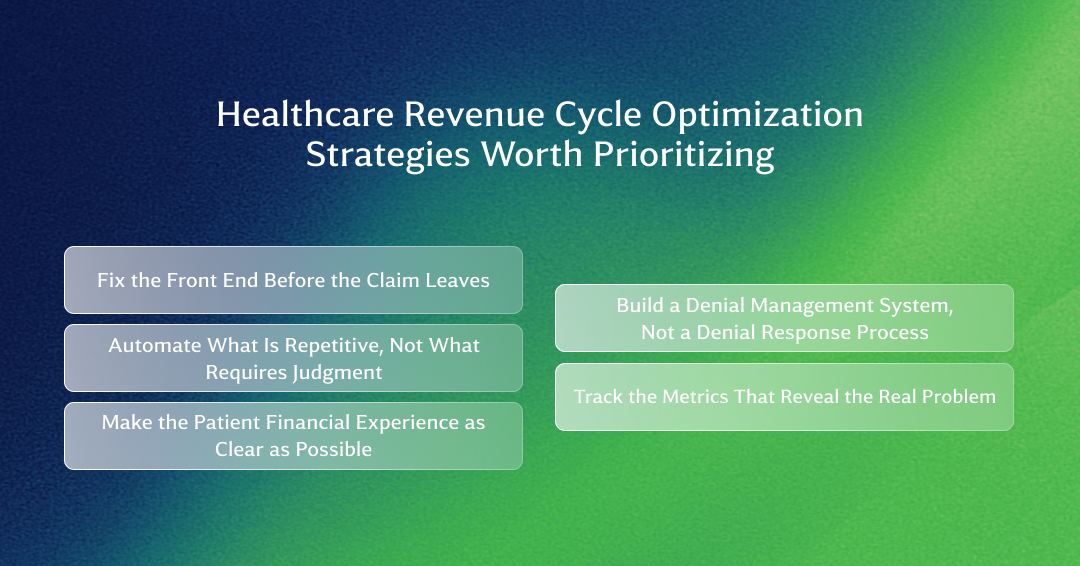
If there's one place that deserves your attention, it's registration. The front end delivers the highest ROI after optimizing your revenue cycle in healthcare. Accurate demographics, verified insurance, and prior authorizations before the patient even arrives — three steps that feel minor individually but collectively prevent a majority of denials from flowing downstream.
Eligibility verification used to mean a phone call. Now that's turned into automated checks that run at scheduling and again at check-in. That's a two-front approach to flag coverage changes before the patient is seen.
Automation also eliminates any chances of manual entry errors and saves valuable staff time that can be spent better on patients in the office.
Automation works best for tasks that follow clear rules and are in large volumes. That makes tasks like eligibility checks, payment prompts, and appointment reminders great candidates. Automation handles them consistently and at a scale no manual process can match when improving your revenue cycle optimization.
Understand that complex coding decisions and clinical denial appeals are different. They require human judgment, context, and documentation review. Automating such tasks without appropriate oversight only increases coding errors while dropping appeal quality. So you're creating more denials even with automation.
Patients who receive a cost estimate before their visit pay more reliably than those who receive a bill three weeks later. That’s why upfront cost transparency has become such an important part of modern revenue cycle management.
Your staff should be able to quickly verify coverage, estimate out-of-pocket costs, and flag any eligibility issues during registration, not after care is delivered.
Many providers now automate parts of that process by sending pre-visit estimates through texts. This way, patients have a fair idea of what they owe when they reach the billing department.
However, that's not saying you can completely ignore statements. They still need to be delivered in some cases. But use plain language that's easy to understand. A wall of complicated financial text has a higher chance of being ignored. It'll just confuse patients in understanding what they owe and why.
Make sure to also give them multiple payment options that fit their preferences. Digital transfers, online portal payments, text-to-pay, and payment plans — all reduce the gap between a collectible balance and actual payment.
These are all ways to improve your revenue collection while also improving patient experience.
A denial management system allows you to predict denials instead of responding to each case as they come in. The difference is data analytics. The system tracks denial reasons by payer, code, department, or other factors to identify patterns.
For example, a payer who consistently denies a procedure for missing documentation means you have to fix an upstream documentation workflow instead of wrestling with appeals.
These denial patterns are pushed back to your team to prevent similar cases from resurfacing. It leads to faster claim processing and shorter reimbursement timelines.
You cannot fix what you are not measuring. These are the metrics worth tracking when optimizing your revenue cycle in healthcare:
Technology alone does not fix a broken revenue cycle. But it does make your RCM faster and more accurate when applied to a well-designed process.
The biggest improvements in healthcare revenue cycle optimization usually come from tools that make better use of the data organizations already have.
You have eligibility verification platforms that pull insurance data in real time. There are denial management dashboards that surface patterns across thousands of claims without anyone creating a manual report. Patient-facing payment portals are becoming more common now to let people pay on their own terms.
RCM tools that incorporate automation, AI, machine learning, and predictive analytics further optimize the revenue cycle while improving the bottom line and supporting compliance needs. They score claims for denial risk before they’re submitted. They also automatically flag underpayments by comparing reimbursements against contracted rates. On top of that, they help forecast AR timelines based on real payer behavior.
The healthcare systems seeing improved results are not just buying technology to replace their current revenue cycle process. They are using the tech to run a better process, one where errors are caught early on and there's less manual intervention in every step from scheduling to final payment.
On that note, healthcare vendors are increasingly applying conversational AI directly to patient-facing revenue touchpoints. The system automatically handles pre-visit cost conversations and answers billing questions through AI-driven virtual assistants. That reduces the volume of inbound calls staff need to manage while also making financial communication faster and more consistent for patients.
A patient who gets a clear, immediate answer about their balance at midnight is far more likely to pay than someone who plans to call during business hours and never follows through. That small shift across thousands of monthly interactions turns into a meaningful improvement in collections.
Most revenue cycle problems don’t begin with claims. They start when patient communication breaks apart across scheduling, intake, billing, reminders, and support. One missed handoff creates delays, manual work, and lost revenue downstream.
WestCX is built to close those gaps by turning fragmented engagement into a single, continuous experience. You’re not just adding another disconnected tool. We layer orchestration across your existing EHR, CRM, and engagement platforms to keep every interaction connected from start to finish.
That continuity matters because revenue cycle performance depends on what happens between those touchpoints. A patient can receive an appointment reminder through SMS, confirm it during a phone call, and complete intake steps digitally without jumping between disconnected systems. They can also verify insurance information, ask billing questions, and make payments within the same connected journey.
Our platform solution also automates routine but high-friction tasks like appointment scheduling, insurance verification, billing notifications, balance reminders, copay collection, and follow-up outreach through conversational AI. Patients get what they need immediately while your staff spends less time chasing repetitive administrative work.
Most importantly, WestCX Orchestrate works with the systems you already use. You can improve patient engagement and revenue workflows without rebuilding your infrastructure. That approach has helped enterprise programs achieve +10x ROI by reducing friction and improving operational efficiency across the patient journey.
Schedule a free demo to discover how WestCX Orchestrate can help you optimize your revenue cycle.

Ever received a call from your bank trying to sell you an additional product or service? That's cross-selling, a sales technique that aims to...

Call deflection is a way to resolve customer issues through self-service channels. It improves your operations and lowers your costs because...

Credit unions usually think of customer service when someone asks about improving their member experience. That’s only one piece of the puzzle.

Healthcare data moves through every part of care delivery. However, it's often scattered and poorly controlled. That reality creates gaps in...

Imagine a patient who arrives at a hospital 10 minutes early, only to spend the next 15 minutes trying to find the right department. An intersection...

Most healthcare providers mistakenly believe that their patients are engaged when they're really not. Just because someone's showing up for a visit...