Cross-Selling in Banking: Matching Account Signals to the Right Offer
Ever received a call from your bank trying to sell you an additional product or service? That's cross-selling, a sales technique that aims to...
8 min read

Most healthcare providers mistakenly believe that their patients are engaged when they're really not. Just because someone's showing up for a visit and nodding along doesn't mean they're actively participating in their own care. They might miss their next appointment or skip their refill. You'll only get to know about this when the patient finds their way back into your office for readmission.
Measuring patient engagement gives you a clearer and more honest picture of each patient. It moves you from assumption to evidence. You get to know exactly where engagement is strong and which patients may need more support.
Today, we're diving into the key patient engagement metrics worth tracking and how to put them to work in your practice.
Higher patient engagement usually translates into fewer missed appointments. Such patients have a habit of asking questions during the visit to fully understand the treatment plan. They fill prescriptions on time and make sure to follow up when something doesn't feel right.
Those who don’t actively manage their own health do the opposite. They tend to rely more on emergency departments and get readmitted more often. The cost for this is also significantly more in comparison.
That's why measuring patient engagement matters so much for providers. In a value-based care environment, engagement affects clinical outcomes as well as quality scores and reimbursements. You can't improve what you don't track.
Consistent patient engagement metrics give providers a much clearer view of what’s really happening after a care plan is set. They help identify which patients are starting to drift away and where communication is falling apart. Clinical decisions start relying on guesswork instead of evidence when that visibility is missing.
A single data point can never tell the full story. You need to track patient engagement metrics across multiple dimensions. These include behavioral, clinical, and digital aspects that actually tell you how patients are interacting with their care.
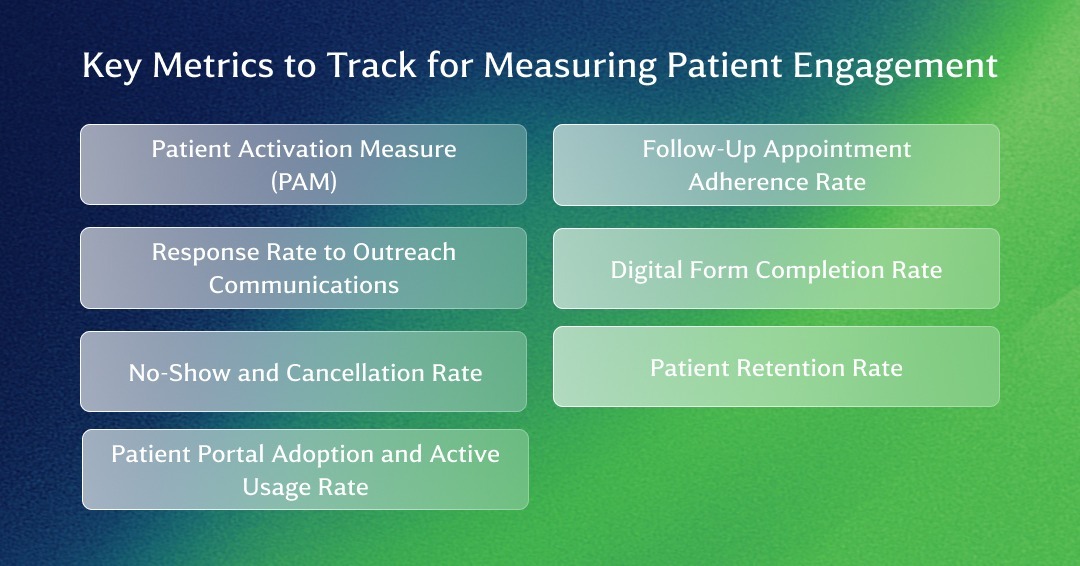
Here are the metrics that matter most.
PAM is a validated 100-point scale that measures a patient's preparedness to manage their health. It categorizes patients along four levels: believing their role in healthcare matters, having the knowledge and confidence to act, actively taking steps to improve health, and maintaining those steps even under stress.
PAM is administered as either a 13-item or 22-item survey, and the resulting score tells providers a great deal. Patients with higher PAM scores tend to have fewer hospitalizations. They also show better chronic disease outcomes and lower overall costs. Patients at the lower end, however, are more likely to skip their care plans and preventive screenings.
The practical value of PAM is in how it gets used. Most providers apply PAM scores to risk stratification. This helps identify which patients need more intensive support. A patient at level 1 who doesn't yet believe managing their health is their responsibility needs a different approach than a patient at level 4 who's already self-managing.
Your outreach isn't measured by how many campaigns you run or how many reminders you sent. It's the percentage of patients who actually respond that tells you how well your attempts are landing.
Tracking response rates at the channel level matters here. A patient who ignores email reminders may respond promptly to SMS. Someone unreachable by voice may engage through a patient portal message.
However, low response rates don't automatically mean a patient is disengaged. They often mean the outreach channel doesn't match the patient's preference. It may also be the timing.
Breaking down response data by channel and message type shows exactly where the problem lies in your messaging. That distinction shapes how outreach strategies get adjusted.
Missed appointments are one of the clearest behavioral signals in healthcare. These often lead to patients having unmanaged chronic conditions and unfilled prescriptions. Such patients are also likely to have care gaps that eventually push them toward expensive, emergency care. All that translates to lost revenue for providers.
Where this patient engagement metric gets more useful is when you layer it against communication data. A patient who missed an appointment and never opened their reminder is a different problem than a patient who confirmed and still didn't show. The first might be a channel mismatch. The second might signal a motivation or access barrier.
Overlaying outreach response data with no-show patterns reveals the exact issue so providers can immediately move towards a fix.
Here's how you can calculate your no-show rate: (Missed appointments ÷ Total scheduled appointments) × 100
Most providers make the mistake of limiting their portal metrics to just the total number of users. That number is almost always misleading. This is because a patient who registered once for your portal but never returned holds no value. You can actually look at them as missed engagement opportunities.
The metric that actually matters is active usage rate. This tells you how often patients log in and what they're doing when they're there.
Behaviors like reviewing lab results, booking appointments, and reviewing visit summaries after logging in are your actual meaningful engagements. These actions indicate that a patient is using the portal as a working tool, not just a dormant account.
When measuring patient engagement at the portal level, login frequency, self-scheduling volume, secure message initiation, and lab result views are the numbers worth watching.
It's also worth being honest about access and digital literacy. Patients without reliable internet or who aren't comfortable with digital tools may show low portal usage for structural reasons that have nothing to do with motivation. Those patients may need alternative channels or better support to reach similar engagement levels.
A good patient engagement metrics analytics vendor will help you identify those segments so you're not treating a systemic access problem as an individual behavior problem.
This metric carries significant weight in chronic care management. Patients who skip several of their monthly visits in a row are at a high risk of developing complications.
But low adherence rarely stands on its own. It usually reflects a communication breakdown. The patient either didn't understand that the follow-up was necessary or the scheduling process created too much friction.
Follow-up adherence is one of the strongest leading indicators of readmission risk and care gap accumulation, particularly in high-risk, high-need populations. It tells you who's staying connected to their care and who's quietly falling off.
This metric rarely appears on standard patient engagement dashboards, but it belongs there. It measures the percentage of patients who complete pre-visit intake forms before their appointment.
A patient who fills out consent forms and updates their health history from home saves time and reduces friction in the process for themselves. They’ve already engaged before setting foot in the office. That's a behavioral signal that correlates with patients who arrive on time and follow through on post-visit instructions.
This metric also surfaces access issues. A low completion rate may indicate that forms are too long or that the patient portal interface is confusing. Some providers also have to deal with digital literacy as a barrier for a significant portion of their patient population.
Retention measures the percentage of patients who return to the same provider over a defined period. Here's the formula: [(patients at end of period − new patients gained) ÷ patients at start of period] × 100.
Think of retention as a trailing indicator. It doesn't tell you what's happening right now. It tells you what happened across every touchpoint a patient experienced over the past period.
A low retention rate is usually because of several smaller breakdowns in engagement. appointment prompts that were ignored, reminders that never reached, a portal that is difficult to use, or a visit experience that didn't build enough trust to bring someone back.
The average five-year new patient retention rate sits around 43%. Providers that actively track and act on the metrics above tend to outperform that benchmark. This is because they've addressed the upstream drivers before they compound into attrition. Retaining a patient also costs significantly less than acquiring a new one.
Individual metrics are useful on their own, but they tell a far more complete story when you connect them. Keep in mind that tracking a dozen numbers in isolation is never the goal. You require an actual system where each data trend leads to workflow changes. That also gives you accountability for acting on what the data actually shows instead of guessing how patient engagement is faring after recent changes.
Here's how to put that system together.
Start by aligning metrics to specific care goals. For example, a provider managing a high volume of diabetic patients should weigh heavily on follow-up adherence, PAM scores, and portal messaging. However, a specialty practice focused on post-surgical care might lean harder on form completion and no-show rates.
Then establish baselines before benchmarking. You can find plenty of industry averages for context, but what really matters is whether your organization is improving over time. Know where you're starting before you worry about where the industry is.
Create feedback loops between data and workflows. Tracking a metric is only useful if the data changes how something gets done. High no-show rates? Someone needs to check the reminder system. Low form completion rates? Someone should audit the portal's UX. That someone is assigned ownership and is responsible for reviewing and initiating action when the numbers start falling.
Map metrics to operational goals. A simple reference table like the one below can anchor this work.
|
Operational Goal |
Metrics to Track Together |
|
Reduce no-shows |
No-show rate + outreach response rate + self-scheduling rate |
|
Improve chronic care continuity |
Follow-up adherence + PAM score + portal message rate |
|
Reduce check-in friction |
Digital form completion rate + portal active usage |
|
Identify at-risk patients earlier |
PAM score + follow-up adherence + portal login frequency |
|
Improve long-term retention |
Retention rate + outreach response rate + no-show rate |
Set a review cadence that matches each metric's pace. Monthly reviews work for metrics like no-show rates and portal adoption. Retention and PAM trends make more sense quarterly. Annual reviews should look at the whole system and whether any new signals have emerged that deserve a dedicated metric of their own.
Healthcare providers who get the most out of tracking patient engagement metrics treat measurement as an operational discipline instead of just a reporting task. Think of it like a simple chain where data shapes decisions and then those decisions adjust your workflows. That's what leads to better outcomes over time.
You'd better have a structured approach before pulling reports. Metrics simply don't have that much value if you don't have a system that collects, reviews, and acts on them. Here are five practical ways to do that right.
1. Align your metrics to specific care goals
Don't track data just because it's available. Every metric on your list should tie back to something specific. Maybe you're looking to increase portal adoption or reduce missed appointments. Basically, if you can't answer why a number matters, stop tracking it.
2. Establish baselines before drawing conclusions
You need to know where you stand before making changes. That's how you know whether your changes had a positive impact or not. You can also compare your standings with industry benchmarks to confirm meaningful improvements in both care continuity and revenue.
3. Break down data by channel and patient segment
One overall engagement score tells you almost nothing. You need to break down your data across channels, demographics, condition types, etc. This helps you spot gaps specific to certain groups rather than treating all patients as one uniform population.
For example, older patients may show low portal usage but high appointment adherence. Younger patients may do the opposite.
4. Assign clear ownership for reviewing metrics
Unowned data gets ignored. It's that simple. Assign specific people to specific metrics on a set schedule. When someone owns the number, they're also more likely to flag problems early and propose solutions rather than waiting for issues to accumulate.
5. Close the loop between data and workflow changes
This is the part most providers skip. Someone's pulling reports and even looking at the numbers. However, there are still no improvements. It's because there are no clear protocols for what to actually do when numbers start to fall outside a target range. That might mean retraining staff on communication or updating how post-visit instructions are delivered.
Most patient engagement efforts fail because no one can clearly see what’s working and what's not across the entire patient journey. That’s where WestCX Orchestrate comes in. We bring your engagement efforts and your measurement under one roof, so you’re no longer guessing which touchpoints are actually driving results.
Our AI-powered platform ensures that every call, message, reminder, or digital outreach is captured and analyzed. This gives you a clear view of how patients are responding at each step.
From there, we help you connect those interactions into something meaningful, so you start seeing patterns instead of treating engagement as a series of disconnected actions. You can identify where patients drop off and what actually moves them to take action.
However, WestCX Orchestrate doesn’t just show you the data. It also actively helps you improve it by automating key interactions like appointment reminders, scheduling, and follow-ups, while continuously learning from patient behavior.
That’s what turns engagement metrics into something useful. You’re not just tracking numbers anymore. You’re using them to refine how you communicate, close gaps in the patient journey, and steadily improve outcomes over time.
Book a demo now and see for yourself how WestCX Orchestrate’s patient engagement solution fits into your workflow.

Ever received a call from your bank trying to sell you an additional product or service? That's cross-selling, a sales technique that aims to...

Call deflection is a way to resolve customer issues through self-service channels. It improves your operations and lowers your costs because...

Credit unions usually think of customer service when someone asks about improving their member experience. That’s only one piece of the puzzle.

Most healthcare providers already have tools designed to help patients stay on their medications. Reminder texts and patient portals aren’t exactly...

Healthcare providers are expected to keep every patient informed, but most of the day is spent just trying to keep up with communication. There are...

Healthcare data moves through every part of care delivery. However, it's often scattered and poorly controlled. That reality creates gaps in...