Cross-Selling in Banking: Matching Account Signals to the Right Offer
Ever received a call from your bank trying to sell you an additional product or service? That's cross-selling, a sales technique that aims to...
6 min read
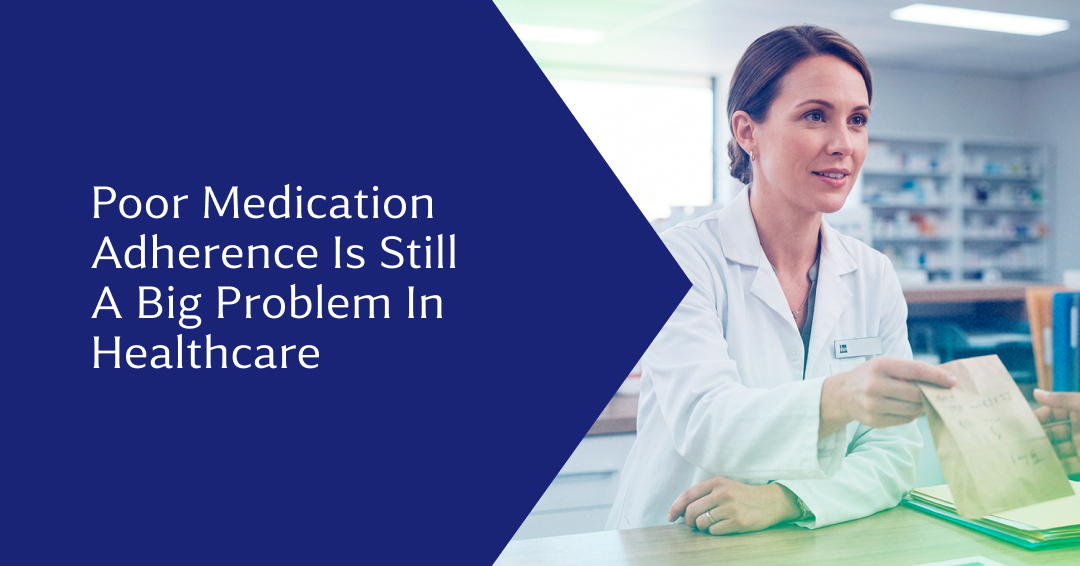
Most healthcare providers already have tools designed to help patients stay on their medications. Reminder texts and patient portals aren’t exactly new. But look at the numbers and the picture doesn't change. Adherence rates for most medications prescribed for chronic conditions like diabetes and hypertension still fall in the 50-60% range, even among patients who have good insurance and drug benefits
So tools exist but the problem remains? Let’s look at why and what a medication adherence solution actually needs to do differently to move that number.
The numbers are hard to ignore. Non-adherence contributes to around 125,000 preventable deaths and over $500 billion in avoidable healthcare costs each year in the United States.
What makes this worse is that these numbers aren't new. Researchers and health systems have known about this problem for decades. But we’re still treating medication adherence as a patient problem rather than a physician or health system responsibility.
Most healthcare providers are completely aware of this. They’re already using various tools to fill these adherence gaps. The problem is that awareness and tool adoption haven't translated into better outcomes. Those gaps are still there.
Non-adherence isn't just a blanket term that covers all types of patients who fall off track. It actually comes in two forms and each one requires a completely different response.
Unintentional non-adherence is what most people picture first. This is where a patient typically forgets a dose or misreads dosing instructions. They actually want to comply and follow through, but life and a lack of reminders get in the way.
Intentional non-adherence is different. A patient makes the decision to skip or stop taking their medication. That decision is usually based on something they read online, like side effects or the simple fact that they can't afford the refill. Whatever the reason, they've made a choice that simple reminders aren't going to undo.
Most tools are built for one or the other. You have a reminder system that handles forgetfulness and a cost-assistance program that helps with affordability. But a patient who is quietly avoiding a medication due to side effect concerns won't respond to an SMS reminder. That mismatch is why so many medication adherence programs show limited results at scale. They treat the problem as uniform when it isn't.
Reminders have been the most common approach to adherence for a long time. They also work quite well in isolation. However, they tend to break down quickly when used as a standalone strategy.
For starters, single-channel outreach misses large portions of patient populations because you're technically hoping for patients to act. Older patients might not respond to SMS and younger ones tend to ignore phone calls. Every channel has a population it doesn't reach, and leaning on just one means accepting that some patients will always fall through.
Then there's the issue of timing. Most reminder programs are built around fixed intervals. A message will go out on day three after a prescription has been written and another one will follow after 30 days. That schedule doesn't adapt if the patient stops taking their meds on day nine. It doesn't know that a patient is already two weeks into a lapse when the next reminder goes out. The system just keeps firing reminders while providers keep their fingers crossed.
Finally, and it happens often, a patient who never intends to fill their prescription will never be caught by a refill reminder. This matters because 20-30% of prescriptions are never filled at all. That's a significant portion of every patient panel walking out the door with a prescription they have no intention of using. Traditional outreach doesn't catch this. It just assumes the prescription was filled and works backward from there.
The common thread across all of these failures is the same: providers find out too late. By the time the workflow catches a gap, the clinical window for an easy intervention has often already closed.
Patients prefer communication from their healthcare providers that feels relevant to them. That means each message should speak to their current situation. If patients notice generic messages that could have been sent to anyone, chances are that they'll just stop engaging.
The mismatch between patient expectations and the tools most providers use is one of the core reasons old medication adherence strategies no longer hold up. Patients are no less willing to follow their treatment plans than they were a decade ago. The problem is that the systems designed to support them haven't adapted to how patients actually communicate and make decisions.
Modern engagement has to start from that assumption. Personalization, responsiveness, and meeting patients where they are are no longer optional features for any medication adherence solution that aims to work at a population level.
There's no single feature that's magically going to improve your adherence rates. What actually works is combining capabilities that fill all gaps that they can't cover alone.
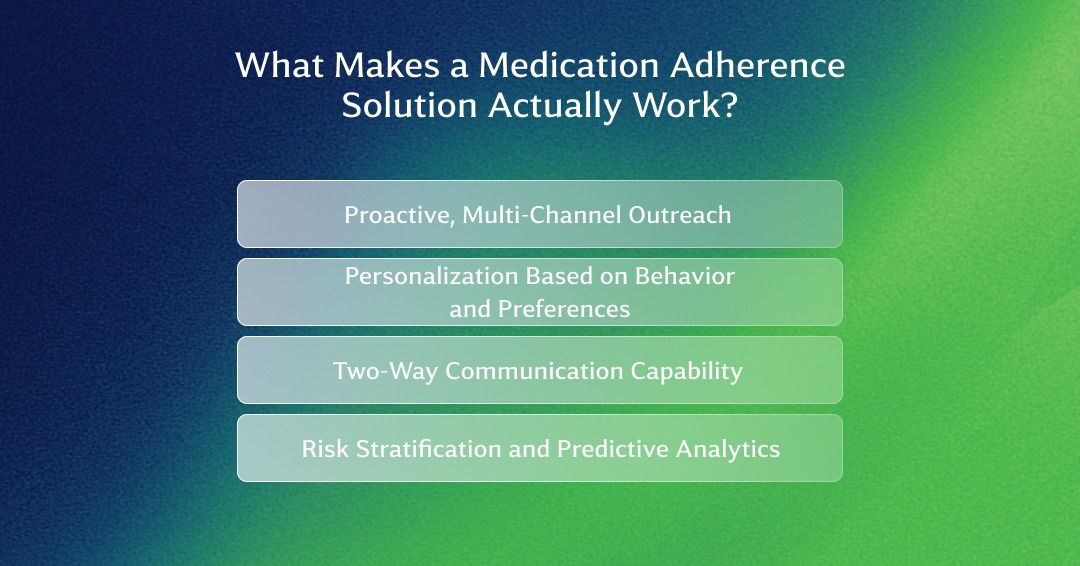
The moment a prescription is sent is critical in the adherence timeline. That's when a patient is still connected to the conversation they had with their provider. Waiting until a refill window to start engaging means missing the window that matters most.
Early outreach catches intention problems before they become adherence problems. That's a fundamentally different posture than the standard "refill due" reminder.
But outreach only works if it actually reaches the patient. SMS is great for some populations. Others need a voice call. Some patients are more responsive to email; others to RCS.
A medication adherence solution that operates through a single channel is making a bet that everyone in the patient population behaves the same way. That never pays off.
A fixed schedule applied to everyone is a shortcut that costs more than it saves. It treats every patient as if they have the same needs and barriers. They don't. Providers end up producing outreach activities that don't translate into meaningful engagement.
Real personalization looks different. It factors in when a patient wants to engage and when they should. It remembers their concerns from previous interactions and what channels they actually respond to. Something as small as adjusting the time of day an outreach message goes out can change whether it gets acted on or ignored.
However, personalization at this level requires behavioral data. It also requires a system designed to act on that data rather than ignore it.
Most outreach systems are designed for one-directional communication. That means it only sends messages. The provider has no way of knowing whether the patient even received the message or responded to it in any way.
Two-way communication changes that. Patients can reply to confirm they've picked up their meds. They can flag a concern about side effects or ask questions about their regimen. The provider now knows who responded and who didn't. They know what barriers are coming up in their patient population. Hence, they can act on real information instead of guessing.
From the patient's perspective, being able to respond makes the interaction feel different. It makes them feel heard and shows that their providers are monitoring their concerns. This builds trust over time that improves patient engagement at every point.
Reactive follow-up is one of the most persistent failures in medication adherence management. It's more about damage control than adherence. In this model, providers learn that a patient hasn't been refilling because the patient ends up back in their care. This is an expensive sequence for both the patient and the health system.
Risk stratification flips that sequence. The system doesn't wait for a lapse. It flags patients who are showing early signs of going off track via a missed refill, a flagged cost concern, or any other pattern of not engaging with outreach. That's the window for a timely intervention.
Modern healthcare organizations rely on predictive analytics to support this kind of proactive management. They use various tools that use patient data to surface risk signals early. The goal isn't to follow up on everyone equally. It's to direct attention toward the patients who are most likely to need it before they become a more serious case. That's the difference between a medication adherence solution that manages populations and one that just processes them.
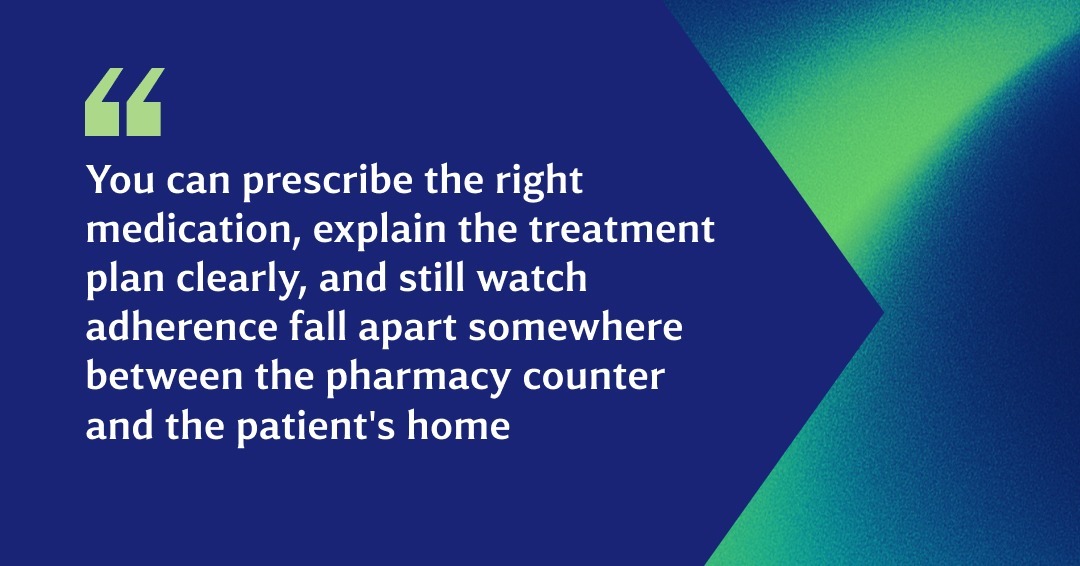
You can prescribe the right medication, explain the treatment plan clearly, and still watch adherence fall apart somewhere between the pharmacy counter and the patient’s home. It happens more often than most providers expect, driven largely by fragmented communication that’s delayed or easy to ignore.
WestCX Orchestrate helps you close those gaps by orchestrating patient communication across voice, SMS, RCS, postcards, email, and chat. This single coordinated approach ensures that every message reaches the right patient at the right moment.
But the WestCX Orchestrate platform isn’t just designed to send reminders. You can automate routine patient interactions using WestCX Orchestrate’s conversational and agentic AI. Our intelligent agents handle your common patient questions, refill requests, and prescription updates without any manual oversight. Hence, your team spends less time fielding repetitive calls and more time supporting patients who actually need attention.
Book a demo today and see how a smarter patient communication system can help you keep more patients on track with their medications.

Ever received a call from your bank trying to sell you an additional product or service? That's cross-selling, a sales technique that aims to...

Call deflection is a way to resolve customer issues through self-service channels. It improves your operations and lowers your costs because...
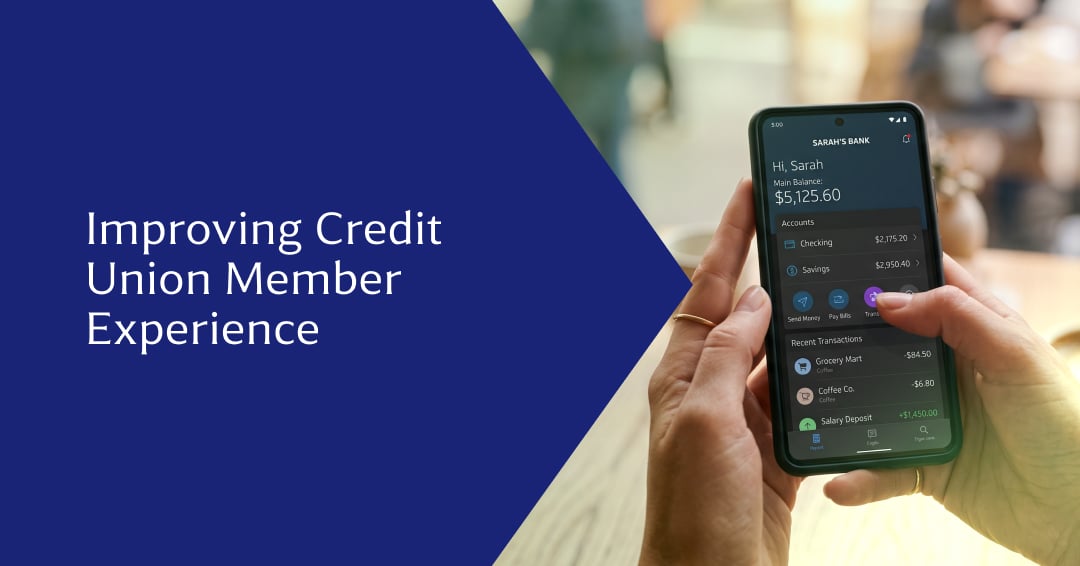
Credit unions usually think of customer service when someone asks about improving their member experience. That’s only one piece of the puzzle.

Your full schedule doesn’t mean much if it doesn’t follow through. Patients will always cancel at the last minute and appointments easily run late....
.png)
Hospital readmissions don’t just happen all of a sudden. They build up in the days after discharge and are not always a clinical issue. It often...

Healthcare data moves through every part of care delivery. However, it's often scattered and poorly controlled. That reality creates gaps in...