Cross-Selling in Banking: Matching Account Signals to the Right Offer
Ever received a call from your bank trying to sell you an additional product or service? That's cross-selling, a sales technique that aims to...
6 min read
Healthcare providers are expected to keep every patient informed, but most of the day is spent just trying to keep up with communication. There are just too many patients and not enough staff and hours to call and text each one of them. So even smaller updates get pushed aside, even though they matter.
But patients can't be expected to understand how stretched your front desk is. They still want timely reminders and answers without chasing your staff. Patient broadcast messages fill that gap by sending the same message to an entire group of patients within seconds.
This blog breaks down how broadcast messaging improves patient communication, where it actually fits into your workflow, and how to use it in a way patients will pay attention to.
It's the ability to send a single message to a large group of patients at once. That group could be an entire patient panel or a specific segment like all patients over 65 years of age. The criteria can further be filtered by diagnosis or appointment date.
Patient broadcast messaging is different from two-way conversations, though. There are no one-on-one exchanges. Patients who receive a broadcast message can't reply back. The purpose is to only inform patients during key moments in their journey.
Think of a front desk that needs to alert 400 patients about a lab delay. Calling each one isn't realistic. The staff can instead send a single broadcast message that only takes minutes.
That's the distinction. Keep two-way messaging for individual care conversations where patients have questions. Use patient broadcast messaging when you need to inform a group at scale without burdening your staff.
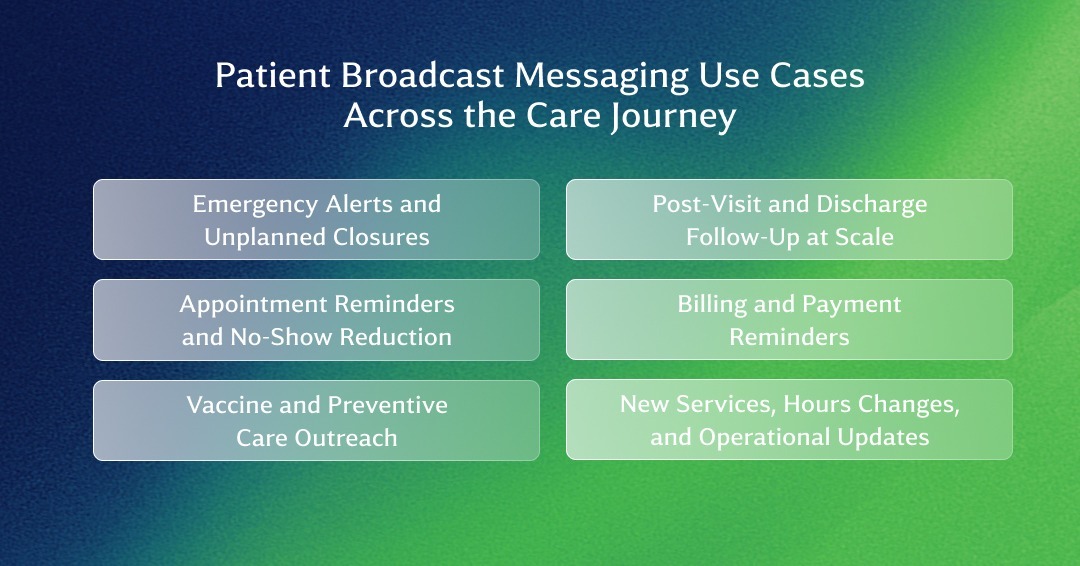
Broadcast messaging applies to nearly every stage of the patient relationship. Here's where it makes the biggest difference.
Unexpected closures are where slow communication does real damage. Maybe a provider called in sick or there's a maintenance emergency due to a pipe burst. Your staff now needs to call all the patients to delay their appointments. Calling each one individually won't work even with a large team. But grouping all the patients scheduled for that day and sending them a single alert ensures no one makes a wasted trip.
During the 2019 pandemic, several providers used mass SMS broadcasts to alert millions of patients at once about nearby vaccine availability and testing facilities in real time. Phone calls wouldn’t have been fast enough here.
Broadcast messaging can be automated to send reminders at set intervals without pulling your staff. You can filter patients by appointment type, date, provider, location, etc. Each of those filters creates separate groups that ensure patients receive relevant messages for their visit.
That targeting comes directly from your EHR data. There's no manual sorting or chasing down contact details. Even a basic broadcast system can help providers reduce no-shows to improve their revenue margins.
This is one of the strongest uses of patient broadcast messaging. Providers have to remind hundreds of thousands of patients every year to get their flu shot. A single broadcast message here does the job in minutes.
That same approach works for other preventive outreach like children who haven't been vaccinated or diabetic patients due for their A1Cs. The key is that these messages aren’t generic. They’re targeted to the right patients at the right time. So parents in a whole neighborhood can receive a message about the nearest vaccine center. The message can also include a secure link to book an appointment straight away.
That filtration ability is what turns broadcast messaging into a clinical tool that improves adherence rates. You’re nudging entire patient populations at no extra cost in staff time.
Follow-up communication is another area where providers benefit from patient broadcast messaging. This is a small window where patients need clear instructions and reminders or else they fall off track.
Someone recovering from a procedure may need reminders about wound care. Another patient managing a chronic condition may require regular check-ins about medications. These post-visit messages need to go out at the right time to have any effect. However, that’s difficult to manage manually at scale.
Patient broadcast messaging solves this by delivering the same structured follow-up to an entire patient cohort.
For example, all patients discharged after a specific procedure can receive their discharge instructions within hours. Patients who haven’t scheduled a follow-up can be prompted to book, while those with pending results can be directed to their patient portal.
Outstanding patient balances often sit unresolved because chasing them down takes time. Not to mention that staff feel awkward calling patients about the money they owe. Patients themselves don't love receiving those calls.
A broadcast message cuts through that friction. Patients with an open balance receive a simple text with a secure payment link. There are no uncomfortable conversations here. Patients get a neutral prompt to take action.
Providers that send consistent payment reminders this way collect more and faster. They also free up their billing staff to focus on actual matters like insurance issues, etc.
Patients should know when providers change their hours, open a second location, or add new specialties. These aren’t always major enough to justify personal phone calls. That would mean calling up a thousand patients just to tell them your lab changed their phone number. This still falls under clear communication and why patient broadcast messaging gives you a direct channel to deliver such updates.
Sharing operational news also keeps patients engaged with their provider. Someone who doesn't know you now offer Saturday appointments, will schedule elsewhere next weekend.
Informed patients tend to stay with their provider, so look at broadcast messaging as more of a revenue tool than just an admin task.
One concern providers have about broadcast messaging is that it feels impersonal. That's true to an extent but it doesn't have to be. The fix to that problem is segmentation and personalization.
Segmentation means you're not spamming everyone with the same message. You're targeting specific groups of patients. One message may only go out to patients in a certain age range. Another might be meant for patients with a particular diagnosis or condition.
Token personalization goes further. Most platforms use your EHR data to insert personal details like the patient's name, provider name, or appointment date directly into the message. You're still sending messages in bulk but each patient receives a version tailored for them specifically.
These two approaches combine to close the gap between mass communication and individual outreach.
SMS is the default channel for most broadcasts. It's also highly effective due to its high open and read rates. But texts are not always the right channel for every patient. Older patients tend to respond better to a phone call. A growing number of younger patients engage better with RCS messaging due to its interactive features.
An effective broadcast messaging strategy routes each message through the channel each patient actually prefers. Most platforms built for healthcare let you capture those preferences at intake and apply them automatically. The message content stays the same while the delivery adapts.
Here's a rough channel preference breakdown by demographic as a starting point:
|
Patient Segment |
Preferred Channel |
|
18-34 |
SMS/RCS |
|
35-54 |
SMS/Email |
|
55-64 |
Email/Voice |
|
65+ |
Voice |
Again, these are just starting points. Your patients' historical data is always going to be more reliable.
Something else to consider here is timing, especially if you’re building a multichannel approach. A reminder at dawn might work for some patients but most will ignore it. The same reminder sent at 10 AM gets acted on the most.
You need to test your send times by channel and patient population. Track what actually drives responses and make adjustments to your communication.
Yes, it's completely legal under HIPAA and federal laws. However, there are certain conditions that must be met.
HIPAA requires that any message containing PHI be sent through a compliant platform. Most reputable patient broadcast messaging tools meet this standard, but you still need to verify before committing to any new vendor.
The simplest way to stay safe is to keep sensitive patient information out of any message body. That means a billing reminder with the patient's diagnosis or account balance becomes a violation if sent via an unencrypted SMS.
TCPA (Telephone Consumer Protection Act) governs SMS and voice calls. It requires that all providers get a written consent from patients before sending them any marketing messages.
However, transactional and informational messages like appointment reminders and billing notices are fine. This sometimes can be a blurry line. If your messages have to promote services or encourage new appointments, best to involve legal counsel before hitting send.
Give patients opt-outs and honor them immediately. Every text message should mention a clear way to stop receiving any future broadcasts. The moment a patient replies STOP is when they should be removed from your outreach. Don't wait for the end of the week or month.
Platforms designed for healthcare handle this automatically. It's another reason not to use generic marketing tools for clinical outreach where your staff has to chase each patient individually.
Document your consent. Keep records of when and how patients agreed to receive communications through each channel. If a complaint or audit surfaces, that documentation is your first line of protection.
You don't need another tool to send more messages. You just need a system that keeps your communication moving forward without constant oversight. WestCX Orchestrate makes that happen by giving you a single platform to reach all your patients across SMS/RCS, voice, email, and chat channels. More importantly, the AI system decides how and when those messages should go out without your staff managing every step manually.
Our orchestration layers are designed to intelligently handle your entire communication workflows. They route messages based on timing, patient behavior, and priority, so nothing important slips through or goes out at the wrong moment.
WestCX Orchestrate’s AI-native architecture analyzes data across every interaction to make future interactions more accurate. That means the system sends messages that adjust to how patients respond, what they engage with, and when they’re most likely to act.
Hence, you stay consistent without adding more to your team’s workload, and your patients actually stay informed instead of missing updates. If that’s the kind of communication you’ve been trying to keep up with, it’s worth seeing how WestCX Orchestrate works in practice. Request a free demo now and take a closer look.

Ever received a call from your bank trying to sell you an additional product or service? That's cross-selling, a sales technique that aims to...

Call deflection is a way to resolve customer issues through self-service channels. It improves your operations and lowers your costs because...
Credit unions usually think of customer service when someone asks about improving their member experience. That’s only one piece of the puzzle.

You can deliver excellent care and still lose patients in the gaps between interactions. Those gaps are where expectations have quietly changed in...

Your full schedule doesn’t mean much if it doesn’t follow through. Patients will always cancel at the last minute and appointments easily run late....
.png)
Hospital readmissions don’t just happen all of a sudden. They build up in the days after discharge and are not always a clinical issue. It often...