Cross-Selling in Banking: Matching Account Signals to the Right Offer
Ever received a call from your bank trying to sell you an additional product or service? That's cross-selling, a sales technique that aims to...
7 min read
Healthcare providers want to collect payments faster but patients often don't know what they owe or how to pay. This is a common problem in healthcare billing. Paper statements arrive weeks after a visit and get buried in a stack of mail. They also leave patients confused about what they have to pay and what's being covered by their insurance. Providers eventually need to follow up but by then, the balance is already overdue.
This gap costs practices real money. It extends AR cycles and puts providers in the uncomfortable position of chasing payments that patients may not even realize are outstanding.
Automated payment reminders sit right in the middle of that problem and actually solve both sides of it. They send the right message at the right time, through channels patients already use, with a direct link to pay. For patients, it removes the confusion. For providers, it shortens the time to payment without adding administrative work.
Most patients who skip paying their medical bills aren't trying to avoid them. They just miss them for three entirely predictable reasons: confusion, forgetfulness, and friction.
The fact is that healthcare billing is notoriously hard to follow. A bill can arrive a month after the appointment, long after the insurance has processed the claim and left a balance the patient wasn't expecting.
That bill also arrives in a mailbox alongside EOBs, insurance summaries, and other documents that look nearly identical. Sorting through all of it takes effort most people don't have. They simply put the bill aside for "later" and then forget about it.
Even when patients want to pay, the process gets in the way. Logging into a patient portal, locating a bill, entering payment details, and worse, doing it all over again from scratch because they exited the app midway. Each extra step is a point where someone drops off.
Here's a worrying statistic: the national average for collecting payments takes longer than a month for 74% of healthcare providers. Balances that hit 90 days have a significantly low collection rate. Many of them are written off entirely or handed to collection agencies, which costs money and tends to end the patient relationship for good.
Meanwhile, the billing staff spends hours each week on manual follow-up. They're diving through spreadsheets of who owes what. They're calling patients and leaving behind messages, and doing it all over again the next week.
Paper statements add printing and postage costs on top of that, and the collection window stays long while the results stay unpredictable.
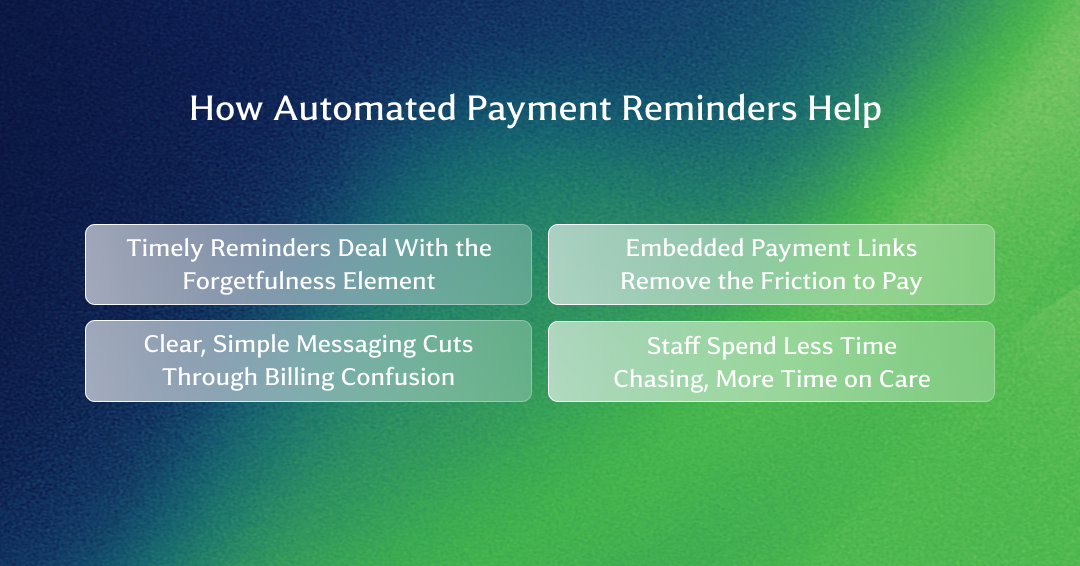
Providers that switch from manual to automated payment reminders see a significant reduction in the number of paper billing statements sent. That's a direct cost savings. It's also a signal of what happens when outreach moves to digital channels with clear payment links attached.
The chances of a bill being paid reduce with time. That means a bill statement showing up at a patient's house three or four weeks later is already too late. Their visit is a distant memory by then and they start wondering if the bill amount is even accurate.
However, a text message sent within a few days of the balance posting is a different kind of outreach. The visit experience is still fresh for the patient. The billing amount also makes sense in context.
That timing is what makes the difference. That said, patient payment reminders are more about catching patients while the context is still fresh than just spamming nudges.
A reminder message that reads like a paper statement creates the same problem. Patients read the message, get confused by the long lines of code and insurance language, and set the message aside for later.
Good healthcare billing reminders tell patients exactly three things: what they owe, who it's from, and what to do next. That's it. There are no codes or financial jargon. The message reads like a note from the front desk.
Personalization matters here too. Using the patient's name and the exact dollar amount makes the message feel specific. That specificity is what turns a skimmable text into something a person actually stops and reads.
Reading a reminder and paying a bill are two different actions. Most patients drop off in the steps between them.
If paying means opening an app, resetting a password, finding the billing tab, and manually entering card details, you've already lost the patient.
A payment link embedded directly in the text or email removes all of that friction. The patient doesn't have to open any apps or remember any passwords. They just tap the link to open a secure payment gateway, enter their card details and be done.
The link also removes a psychological barrier. Patients who weren't sure where to go or who to call now have a clear, immediate option. That clarity drives action.
Manual follow-ups are both slow and expensive. You're actually paying someone to track down patient accounts who haven't paid their dues. This usually involves a ton of paperwork and bill copies. That team then has to reach out to each of those patients and document each attempt. For large healthcare organizations, that's hours of work every week dedicated to communication that could run on its own.
Automation handles the entire sequence on its own based on rules set once at the start. Patients who pay are removed from the queue immediately. Those who don't keep receiving reminders and final notices without anyone having to track them manually.
Knowing what a system can do and knowing how to configure it well are two different things. Here’s what determines whether a healthcare billing reminder system performs or falls flat:
You need to hold a compulsory compliance conversation before sending any healthcare billing reminders. These regulatory requirements ensure that you don't have to face penalties and fines down the road.
HIPAA is the primary concern. Any communication that contains protected health information needs to go through a secure channel. This includes messages that contain balance amounts, personal details, medical history, etc.
A standard SMS or an unsecured email doesn't clear that bar. Providers need to confirm their platform is HIPAA-compliant and that a Business Associate Agreement is in place with any third-party vendor touching that data.
Then there's TCPA or the Telephone Consumer Protection Act. Automated texts require documented patient consent. That consent needs to be on file and auditable. You can't just assume because a patient gave you their cell number during registration.
State regulations add another layer and are worth independent reviews. Some states have specific rules about how frequently billing communications can be sent. Others require certain disclosures in the message itself. What works in one state may create a compliance issue in another.
Here are a few things worth auditing before your automated reminder system goes live:
One of the most underused aspects of automated reminders is the data they generate. That's a missed opportunity because the data tells you exactly what's working and what isn't.
Start with response rates by channel. Not every patient behaves the same way. Text reminders tend to get opened faster. But email and digital outreach may work better for younger patients. Knowing which channel drives action for your specific patient base lets you make the right adjustments to your communications.
Look at payment rates by cadence day. A reminder that goes out on day 3 post-statement might consistently underperform compared to one sent on day 10 or day 14. Pulling payment completion data at each point in the sequence shows you where patients actually respond. Build the schedule around that.
Propensity-to-pay scoring takes it a step further. Some platforms let you segment patients based on past payment behavior. That kind of segmentation lets you route high-propensity payers toward a frictionless digital experience. Those with lower scores are sent to more intensive options like a staff call or a payment plan. It's a smarter use of both automated and human resources.
Portal abandonment is one more thing to track. Patients might be clicking the payment link in your reminder message but still leaving before they complete the transaction. This means the problem lies in the payment portal itself. Check to see if there are too many steps involved or an interface that's too confusing to navigate. Analytics that show where patients drop off tell you exactly where to fix things.
It's clear that automated payment reminders remove friction on both sides of the fence. Patients get the clarity to move forward and providers receive faster collections as a result of that.
But reminders alone aren't a complete strategy. They work best when they're part of a connected financial experience.
That means patients understand their balance before they leave the office and receive timely notifications afterward. They can pay through a consistent portal and access flexible payment options when they need them. Even a well-designed reminder sequence will underperform when any of those pieces are missing.
If you're looking to build that kind of connected billing experience, WestCX Orchestrate offers communication solutions built specifically for regulated industries like healthcare.
Our Orchestrate framework is designed to guide every interaction. The system captures data across billing events, patient behavior, and prior interactions to understand what’s happening in real time.
On top of that, orchestration logic applies rules around timing, compliance, and patient preferences. We're not just automating your reminders. We're sending them to the right patient at the moment it's most needed across voice, SMS, email, and chat in a way that feels consistent and easy to act on.
This happens on the back of our AI-driven platform that meets the compliance requirements healthcare providers operate under. You can schedule a demo right now and see how WestCX Orchestrate fits into your existing billing workflow.

Ever received a call from your bank trying to sell you an additional product or service? That's cross-selling, a sales technique that aims to...

Call deflection is a way to resolve customer issues through self-service channels. It improves your operations and lowers your costs because...
Credit unions usually think of customer service when someone asks about improving their member experience. That’s only one piece of the puzzle.
If you think about it, most collection teams inherit problematic accounts that could have been prevented much earlier. Hence, loan delinquency is...

Healthcare has spent nearly two decades moving away from fee-for-service models to value-based care. CMS actually plans to have all Traditional...
Healthcare providers are expected to keep every patient informed, but most of the day is spent just trying to keep up with communication. There are...