Reduce Healthcare Call Center Costs Without Compromising Care
If you're running a call center for a healthcare organization, you've probably been asked to cut costs while handling higher patient volumes than...
6 min read

If you think about it, most collection teams inherit problematic accounts that could have been prevented much earlier. Hence, loan delinquency is closer to a communication problem than a collections problem.
That's because the conversations taken days or weeks before a missed payment usually determine whether a borrower gets back on track or falls further behind.
Pressure tactics and cold messaging only make the situation worse. They're usually a sign that the best opportunity to prevent delinquency has already been missed.
This article explores how financial institutions can make those earlier interactions count and prevent more accounts from ever reaching the collections stage.
Loan delinquency doesn't have a single cause, so any outreach without understanding what actually happened is of little use.
Some borrowers genuinely forget or mishandle their cash flow. They just need a simple reminder or clarification. Then there are borrowers who've taken more than they can return. They're either seeking jobs or going through a health or personal crisis. No amount of reminders will change the fact that they just can't pay.
Given that finances are the biggest source of stress for roughly 73% of Americans, a cold or harsh notice to a borrower is only going to make your recovery more difficult.
Hence, it literally pays to understand that all delinquent accounts are not the same. A response that works for one fails another. Every recovery should start with the reason first. Everything else follows from that.
Proactive strategies form the cornerstone of timely repayments. Find the root cause of delinquency and then pair it up with the right prevention and recovery strategy. Here are the most effective ways to do exactly that.
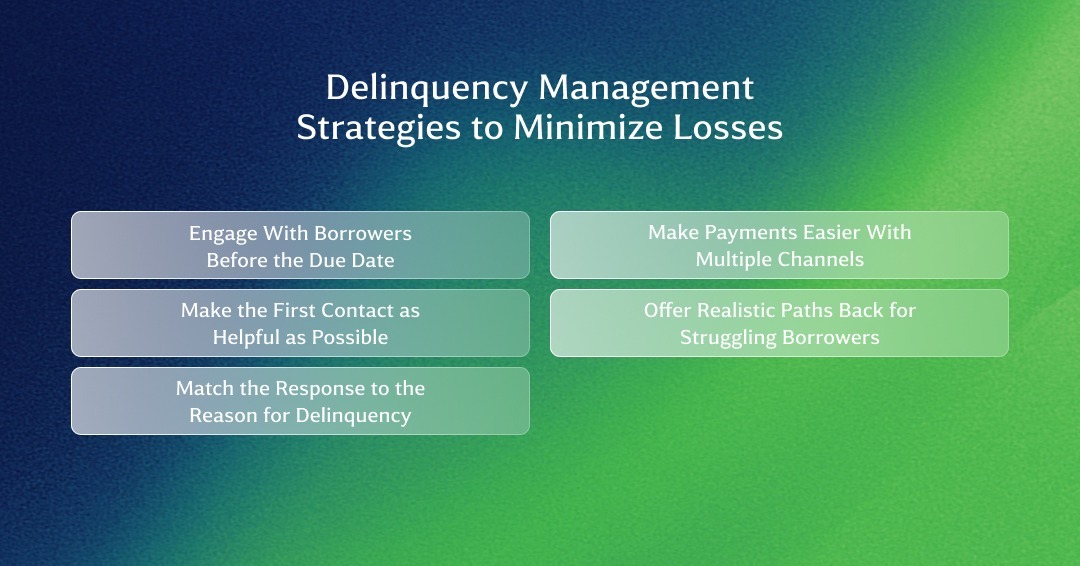
Let's start with the most basic and obvious way to minimize loss. Always act before the payment date. Sending a simple reminder costs almost nothing to make sure the borrower doesn't forget.
Autopay does even more. A borrower who schedules payments to go out around their payday doesn't even have to remember them in the first place. This is something you can bring to your borrower's notice with every friendly reminder.
Some companies take this further with upfront engagement. They keep borrowers updated with their progress. For example, how much they've paid so far or how their credit score looks. It gives payments momentum instead of keeping them as an obligation.
This kind of engagement is often the most underused delinquency management strategy in the industry. It costs less than any collection touchpoint and protects the relationship before any stress has a chance to build.
The first message sets the bar for your recovery chances. Someone who missed a payment will never be open to a conversation if you send them a threatening notice.
Instead, go for a warm and supportive tone that tells them that you're here to help. Show them a clear and easy path to resolve the situation. That can be anything from a direct link to pay or a brief mention of other options they can avail.
Borrowers need to feel respected. Putting them under pressure or cornering them will only make them go on the defensive, and that makes recovery much more harder.
Using the same script for every account won't get you far. Many institutions now use AI-driven delinquency management tools that make it possible to segment borrowers into different categories. That way, your outreach can tailor responses based on risk level, cause, etc.
Taking a common account case as an example, a borrower with a strong payment history just needs a nudge. But someone who has missed two payments in a row might need messaging that outlines a payment plan. Someone else who has completely stopped paying after a year might be dealing with a crisis that your team needs to hear about.
Grouping accounts this way makes your outreach more effective. It also helps you stop wasting resources on purely volume-based messaging. There's no point in sending a carefully elaborated message with different payment options if all the borrower needed was a simple reminder. That's just wasting time that could be better spent on a higher-risk account.
Sometimes a borrower just needs an easier way to pay. They remember what they owe and are willing to make the deposit, but step back due to friction standing in their way. For example, a confusing phone tree that they're not in the mood to deal with at night or a clunky app that's crashing during payment.
Good loan delinquency management removes that friction. You should always strive to let borrowers pay from where they are. That could be a one-tap payment link sent as a text message, a tidy website with clear details for a bank transfer, a friendly mobile app, or even a quick phone call. The goal should be to give borrowers more than one payment method. Make sure there are no extra steps between deciding to pay and actually paying.
What's the point of putting pressure on a borrower who genuinely has nothing to give? What actually works here is carving a new path for them to move forward.
Most institutions have policies in place that allow their frontline teams to modify payment plans based on what the borrower can actually afford. That also includes changing due dates to align with their pay schedules.
These recovery options cost you less than a full default. It also keeps the borrower engaged long enough to collect what's possible.
Most recovery teams use outreach strategies that make borrowers feel chased. They engage only after a payment is missed and the first interaction seems like anything but a collection attempt. For borrowers, even a genuine conversation seems like pressure tactics in disguise. Hence, neither side gets what they want.
The problem with that approach is timing. Calling a borrower after a missed payment makes them go on the defensive. Stepping in early with helpful repayment options proves that you value the relationship. That signal matters more than most institutions realize.
This is the core argument for rethinking how loan delinquency gets handled. Borrowers who feel supported are less likely to disappear. They'll stay engaged and communicate even when they're struggling to keep up with payments.
Traditional collection methods are too rigid (and often counterproductive) to deliver consistent results. Early engagement helps prevent the problem entirely before it escalates and that too at a lower cost.
You've understood the importance of early engagement and have built a loan recovery framework around that reality. The next gap to address is the execution. Personalized, proactive communication becomes a real challenge when you have hundreds or thousands of active accounts. No amount of manual effort will ever help you achieve consistent results.
Self-service tools help, but only to an extent. They still rely on borrowers taking the first step, which you can't expect from high-risk accounts. The same goes for budgeting apps and financial literacy content. They all rely on the borrower to seek help.
What actually works is a delinquency management system that does the same work at scale but without overwhelming your recovery team or requiring borrowers to initiate.
Automated outreach - this is the first layer in your tech stack. Have a system in place that automatically delivers simple payment reminders through preferred channels.
An even smarter approach is to tie those reminders to specific triggers or account behavior. For example, a pattern of late payments or a sudden lapse in payments. It allows your messaging to be more targeted without involving any human agent.
Predictive risk scoring - creating risk profiles is how you know how early to initiate a call. Use decisioning tools and AI-driven predictive models to flag accounts based on their account data.
That stops you from being reactive and shifts your recovery communication to preventive. That means your team can start prioritizing outreach based on who actually needs it now rather than making their way downward on a list.
Flexible payment options - make sure your app or account portal lets borrowers sync payment schedules with their paydays. The entire payment experience should be easy and frictionless. Reduce as many steps as possible to ensure borrowers follow through.
Don't wait to offer hardship support - even the best repayment programs are of no use if they're only offered after payments have been missed. Your system should be able to identify the right accounts and trigger the right offer while the borrower is still engaging. That's a core part of an effective loan delinquency management strategy.
A missed payment doesn't need to become a missed opportunity, but that's easier said than done when you're collecting at scale. On an enterprise level, a single week can feel like trying to catch thousands of falling payments before they hit the ground. WestCX builds a safety net just for that. We ensure you catch every borrower in time.
WestCX helps banks and credit unions turn their fragmented channels and workflows into a continuous borrower journey. Why wait for problems to pile up when our AI can monitor all your accounts for early signs of risk? Our platform even triggers targeted campaigns at the right moments that are more useful than the noise most borrowers hear from manual outreach.
We're not talking about automating generic payment reminders. WestCX Orchestrate actually coordinates outreach at the borrower level. It shows your engagement teams the borrower's complete payment history, recent interactions, and other behavioral data while they're still on the call.
Our engagement and intelligent layers also use collected insights to help coordinate the next best action. That means the system automatically governs and tailors outreach based on the borrower's responses and situational context, such as sending a direct payment link via RCS without any unnecessary handoffs or promising follow-ups.
That kind of live orchestration keeps the conversation moving and makes resolution more likely while the borrower is still engaged. That's how WestCX enables financial institutions to tighten their collection cycles and lower delinquency rates without adding headcount.
From frontline agents to executive leadership, WestCX Orchestrate gives every role the tools to deliver better member engagement and measurable results.
Schedule a demo to see how WestCX Orchestrate can help your team prevent delinquency and recover collections faster.

If you're running a call center for a healthcare organization, you've probably been asked to cut costs while handling higher patient volumes than...

It's not hard to convince banks that customer experience matters. Every financial institution already knows it does. The harder challenge is...

In a way, customer service has always been built around supporting customers after they reach out. That approach creates unnecessary work and...

Getting someone to open an account is only half the job. The harder part is giving them a reason to 'not' treat your credit union as just another...

Healthcare providers are expected to keep every patient informed, but most of the day is spent just trying to keep up with communication. There are...

Managing chronic conditions often feels like trying to keep track of a conversation that keeps getting interrupted. You have patients coming in for a...