Cross-Selling in Banking: Matching Account Signals to the Right Offer
Ever received a call from your bank trying to sell you an additional product or service? That's cross-selling, a sales technique that aims to...
9 min read

HCAHPS scores are no longer something hospitals can treat as a background metric. They're now central to how healthcare organizations are seen and measured. Those scores are publicly visible to patients and directly tied to reimbursement through value-based purchasing programs.
That visibility matters even more now that CMS has changed how patient experience is captured and reported. It's another layer hospitals have to keep up while improving their HCAHPS scores.
This blog walks through what HCAHPS scores actually measure, how CMS calculates them, what has changed in the latest update, and what hospitals can realistically do to improve them over time.
HCAHPS stands for Hospital Consumer Assessment of Healthcare Providers and Systems. It's a standardized survey that captures how adult patients experienced care during a hospital stay.
Built by the CMS and AHRQ, the survey launched nationally in 2006 and is now filled by more than 7,000 patients daily across the nation.
Any healthcare provider that operates under the IPPS is required by law to support HCAHPS scores. Not doing so means delaying or reducing their Medicare payments.
In summary, HCAHPS is a public platform where patients can review their providers. Each survey covers the following areas:
Ratings are done through three checkboxes: positive, neutral, and negative. The results are posted every quarter on the Care Compare website.
The HCAHPS survey has 32 questions. They're organized into seven domains and four standalone measures, each targeting a specific part of the inpatient experience.
The seven domains break down like this:
1. Communication with nurses
Patients are asked how often nurses explained things clearly and treated them with respect. It's one of the most closely watched domains because nurses are the staff patients interact with most throughout their stay.
2. Communication with doctors
It's similar to the nursing domain but now targets physicians. CMS treats this domain as central to patient trust and informed decision-making.
3. Responsiveness of hospital staff
Did patients get help when they needed it? This domain tracks how quickly staff responded whenever a patient needed help.
4. Communication about medicines
Did the staff explain what the medication was for before giving it to the patient? Were any side effects discussed? Those conversations matter because medication confusion is a common source of patient frustration and can also lead to problems once patients return home.
5. Discharge information
The shift from hospital to home is a high-risk window. Patients answer whether they received written instructions and whether they felt prepared for recovery at home.
6. Care transitions
This one goes a step further than discharge instructions. It asks whether staff accounted for the patient's preferences. It focuses specifically on continuity, as in what happens after a patient leaves.
7. Cleanliness and quietness of the hospital environment
How often was the room cleaned? How often was the area quiet at night? These questions measure the physical environment and how well it supports rest and recovery.
Then there are the following four standalone measures:
CMS uses two primary methods to calculate scores from the survey data.
This is the most widely cited method. For each question, CMS takes the percentage of patients who selected the most positive response. That means taking only "Yes" from "Yes/No" questions or "Always" from "Never/Sometimes/Always" items. In the case of numbered ratings, CMS takes only 9s and 10s.
So a top-box score of 75% means 75 out of 100 patients gave the highest answer. That number goes into public reporting and national comparisons.
This method assigns a number to each response option and averages them across all respondents. Unlike top-box, it doesn't ignore patients who said "Usually" or "Sometimes" - it factors in every response.
Linear scoring gives a more complete view of performance. It's used in the Hospital VBP Program to calculate a hospital's Total Performance Score for its Medicare reimbursement.
Those linear mean scores are then converted into a 1-to-5 star rating using a clustering algorithm. Hospitals are grouped into five clusters based on score distributions and assigned stars from there.
That means a hospital's star rating reflects how it performs relative to other hospitals. There's no fixed standard. Two hospitals with nearly identical raw scores can sometimes receive different star ratings depending on where the cluster lines fall in that reporting period.
CMS publishes new HCAHPS results every quarter using data from the most recent four quarters combined. That means every time a new quarter is added, the oldest quarter is removed from the calculation.
This creates a rolling average that keeps the results stable instead of letting them swing sharply from one quarter to the next. But it also means meaningful score changes take time to appear online.
Hospitals tracking their progress against national benchmarks need to plan around that quarterly update cycle. A change made in Q1 won't fully surface in public data until several quarters have passed.
HCAHPS scores are one of several factors that influence the reputation of a healthcare organization. High scores aren't just about how comfortable a patient's stay was. They affect payments as well as clinical quality.
The Hospital VBP program ties a portion of all Medicare payments to performance. CMS sets aside 2% of each IPPS hospital's payment and then awards those funds back based on four domains:
That last domain is built entirely from HCAHPS data. It accounts for roughly 25% of a hospital's total VBP score. So a provider with higher HCAHPS scores gets a larger share of that withheld 2% returned. Hospitals that don't perform well get less or nothing.
These aren't just patient satisfaction metrics on a report card. They directly influence how much revenue a hospital ultimately receives. In 2019 alone, $1.9 billion in value-based payments was available to hospitals for inpatient care. The hospitals with the highest scores across VBP domains received the most. Those at the bottom received financial penalties.
People actually refer to HCACHPS results to compare hospitals before making care decisions. It's similar to browsing through seller reviews on a public retail site like Amazon.
The scores influence patient choices as well as referral patterns and insurance relationships. Not to mention the community trust that builds over time through consistent high scores. A hospital's public score eventually becomes its identity in a way that's hard to ignore.
Hospitals with high HCAHPS scores consistently show fewer readmissions and stronger clinical outcomes. It's because every metric and behavior the survey measures is the same thing that supports quality care.
Clear communication, consistent staff responsiveness, coordinated discharge planning, clean environments - all shape how well patients understand their care and follow through after they leave the hospital.
Note that the survey doesn't directly measure clinical quality but the conditions under which quality care either happens or doesn't.
There's no short fix here. Improving HCAHPS scores requires an ongoing operational commitment. Providers have to invest across multiple areas at once. Their staff also has to learn to see patient experience as a core part of delivering quality care.
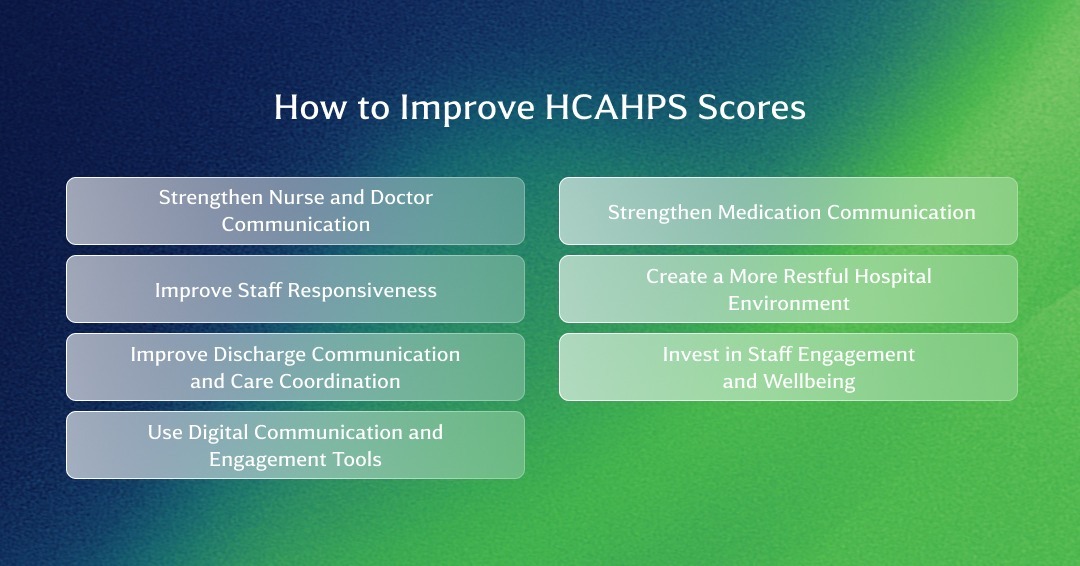
HCAHPS asks whether your staff “always” communicates well with patients. That single word raises the bar in a very practical way.
One of the ways hospitals try to meet that bar is through hourly structured rounds. Staff checks on four basics: pain, position, personal items, and personal needs.
When followed consistently, patients don't have to keep pressing the call button for routine requests. They also start to feel a steady rhythm of contact and attention.
The challenge is consistency. Many hospitals do it well during the day but lose momentum at night. That inconsistency shows up in the “always” responses.
For physicians, the improvements are often smaller in action but significant in impact. Sitting down instead of standing signals presence. Using plain language instead of clinical terms reduces confusion. Asking patients to repeat back what they understood helps confirm clarity. These are behaviors that actually shape how patients experience communication in the hospital.
Patients don't appreciate wait times. Even something as simple as waiting several minutes after pressing the call button can ruin an otherwise good clinical experience.
Proactive rounding addresses patient needs before they escalate into requests. Role clarity matters just as much. A non-clinical request like an extra blanket gets resolved faster if it's routed to the right person. Nurses shouldn't be pulled from their clinical care just to adjust the room temperature. Poorly defined workflows only slow down response times across the board. Patients don't care about that. They only care about how quickly a staff member shows up to help them.
Patients leave hospitals with a lot of new information that they're expected to process while still physically and emotionally depleted. The solution is structured discharge education that covers both verbal and written fronts.
Patients aren’t just handed a generic packet. Their set of printed instructions is tailored to their specific condition. The information is also organized in a way that’s easier to follow at home - what symptoms to watch for, how to manage their meds, and when to call.
That said, even the clearest instructions have limited value if patients misunderstand them. That's why many providers use teach-back verification as part of the discharge process. Patients are asked to repeat the instructions in their own words to show they've actually understood them. The process often reveals concerns that patients may not have raised otherwise.
The new Care Coordination domain entering VBP in 2030 takes this further. It measures whether patients felt the care team worked together and whether staff seemed informed about their individual needs. That requires consistent communication and coordination between clinical teams to ensure patients are properly briefed on their care plan.
Medication communication has its own scored domain in the HCAHPS. Patients review whether the hospital staff explained what their new meds do or described any potential side effects.
The reality is that there's a wide gap between what providers think they communicate and what patients actually retain. Using plain language is a good start. Verbal confirmation before discharge along with written medication cards, is significantly helpful as well.
You can reinforce your discharge instructions further with a follow-up call or text within 2 days. That might sound basic but it makes a particular difference for patients managing multiple new prescriptions at once.
Restfulness is going to be a scored VBP domain from 2030 but it's already measured in HCAHPS today. Patients rate whether the area around their room was quiet at night and whether the room and bathroom were clean.
Noise reduction isn't as easy as it sounds. It envelops multiple sources like equipment sounds and alarms, staff conversations near patient rooms as well as other patients or visitors making noise nearby.
Designating quiet hours and setting clear behavioral standards for those hours produces measurable results. But it has to be a managed standard. You can't just expect visitors to be quiet around wards.
Cleanliness complaints often come down to coordination gaps rather than a lack of effort. A dirty meal tray sitting in a patient room or a bathroom that wasn't cleaned on schedule is hard for patients to forget. Tighter coordination between environmental services and food services closes those gaps before patients start keeping score.
An exhausted staff will never perform at the level the HCAHPS surveys measure. Meaningful engagement doesn't stop at recognition programs. You have to manage patient ratios and administrative burden.
The frontline staff also needs to be given a voice in how your improvement efforts are designed. They can't be sidelined and then expected to follow new protocols.
This is the foundation everything else sits on. Communication scripts and rounding tools don't hold up if the people delivering care are burned out.
Large hospitals can't expect to manually engage every patient or communicate every message on time. Automation significantly helps to absorb those volumes but it shouldn't be at the cost of replacing human connection. You're looking to extend your human staff without burning them out.
Automated reminders and outreach systems keep patients informed and connected to their providers. Post-discharge messages and check-ins help reinforce instructions and confirm adherence. The consistent communication surfaces concerns and issues before they become complaints to damage your HCAHPS scores.
Multilingual messaging matters in communities where English isn't the primary language. A patient who couldn't understand their discharge instructions won't rate communication favorably regardless of how much care went into delivering them.
You also have patient feedback tools that gather information in real time. One area where most high-scoring hospitals excel is their nursing teams' response to patient feedback before patients leave with a bad experience.
Two-way communication channels tie up your entire engagement program. It reduces friction and gives hospitals earlier visibility into problems that would otherwise only appear weeks later in survey data.
Improving HCAHPS scores often comes down to something as simple as making sure patients feel informed and connected throughout their care journey. That becomes difficult when communication is scattered across different systems and channels.
WestCX addresses that challenge through an orchestration layer that combines every interaction into a single coordinated journey.
We offer healthcare organizations an AI-driven platform to automate their routine outreach and personalize patient engagement across voice, SMS/RCS, and digital channels. WestCX Orchestrate's intelligence layer listens and understands intent to guide the next best action based on where a patient is in their journey. That's a communication workflow that's designed to drive your HCAHPS scores.
Automated post-discharge follow-up campaigns help keep patients engaged with care plans after they leave the hospital, while ongoing reminders and outreach can support continuity of care.
Multilingual communication across more than 100 languages makes it easier for patients to receive information in the language they are most comfortable using.
Two-way conversations give patients a direct path to get answers and complete tasks without waiting for the next appointment.
Care coordination efforts also benefit from journey-aware communication that adapts based on where a patient is in their healthcare experience and what action needs to happen next.
WestCX Orchestrate doesn't wait for the conversation to end to start working. It's already coordinating across every channel while a conversation is still active. That could be anything from routing an RCS message with a consent form to a payment link directly to the consumer's phone in real time. That kind of two-way coordination is what turns a transactional interaction into the kind of experience a patient actually remembers when a surveyor calls.
WestCX has helped health systems see 35% fewer patient no-shows, a 41% lift in preventive screening completion, over $9.8 million in annual revenue retained per health system, and approximately 2,000 staff hours saved per month. Those are the kind of numbers that show up in your HCAHPS domain scores.
You don't even have to worry about any service disruptions. We sit on top of your existing systems without any lengthy IT overhaul. Schedule a demo right now to see how WestCX can support your patient engagement goals.

Ever received a call from your bank trying to sell you an additional product or service? That's cross-selling, a sales technique that aims to...

Call deflection is a way to resolve customer issues through self-service channels. It improves your operations and lowers your costs because...
Credit unions usually think of customer service when someone asks about improving their member experience. That’s only one piece of the puzzle.

Healthcare data moves through every part of care delivery. However, it's often scattered and poorly controlled. That reality creates gaps in...

Higher containment rates have long been seen as a winning self-service strategy. Every call resolved without involving an agent naturally reduces...
.png)
Hospital readmissions don’t just happen all of a sudden. They build up in the days after discharge and are not always a clinical issue. It often...