Cross-Selling in Banking: Matching Account Signals to the Right Offer
Ever received a call from your bank trying to sell you an additional product or service? That's cross-selling, a sales technique that aims to...
9 min read

Healthcare has spent nearly two decades moving away from fee-for-service models to value-based care. CMS actually plans to have all Traditional Medicare beneficiaries in accountable care relationships by 2030. That makes VBC a growing reality for providers across the country.
The appeal is easy to understand. A provider that focuses on prevention and coordination is more likely to achieve better outcomes while controlling costs.
Putting that into practice is where things get complicated. Many organizations are still finding their way around the challenges that come with moving away from a volume-driven model.
This blog breaks down the biggest VBC challenges healthcare providers face today and explores practical ways to address them while building a more sustainable path forward.
A fee-for-service model is purely transactional. A patient comes in, receives care, and pays on their way out. What happens before or after those visits doesn't factor into payment.
Value-based care flips that logic. Providers are paid based on the quality of care they deliver and the outcomes of their patients. Appointment volumes or the number of procedures billed hold no value here. Reimbursement is purely tied to things like readmission rates, preventive screening completions, and patient satisfaction scores.
That shift changes what healthcare providers are actually responsible for.
A patient discharged from the hospital still falls under a provider's performance umbrella. A patient who doesn't fill their prescription or skips a recommended screening affects the quality metrics that determine reimbursement.
Proactive care management stops being optional in a VBC environment. High-risk patients need to be flagged before they land in the ER. Care gaps need to be closed before a performance period ends. Patient populations need to be continuously monitored instead of waiting for them to walk in with their health concerns.
These are core operational functions that ensure a provider gets paid. That makes quality metrics like HEDIS, star ratings, and CAHPS scores all the more important.
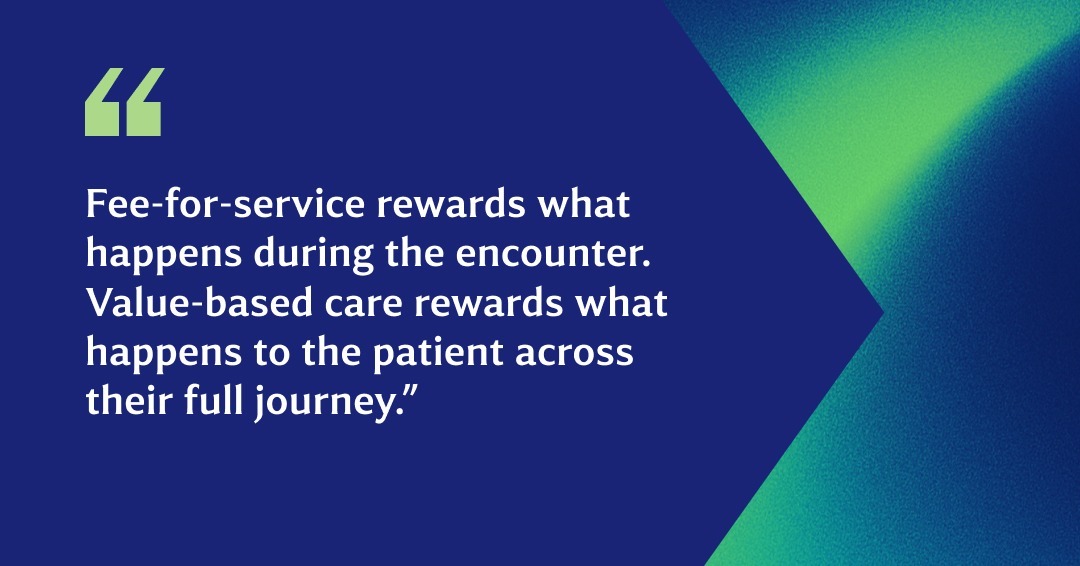
That's the ground reality of what VBC demands. Fee-for-service rewards what happens during the encounter. Value-based care rewards what happens to the patient across their full journey.
Too many organizations see the straightforward VBC goals and assume they're easy to achieve. They're not. Every challenge requires careful planning that must hold across the entire journey.
It's often that a patient sees their primary care physician as well as several specialists within the same month. All those different providers run their own EHR systems. So the patient's lab results are in one platform, imaging in another, and medication history somewhere else.
That disconnected journey is frustrating but manageable in a fee-for-service model. But the same becomes a structural problem in value-based care.
Population health management requires a complete picture of each patient. It should be clear early on who's at a high risk for readmission or who missed their follow-up appointment after discharge. None of that is possible when the data is siloed across disconnected systems.
A primary care team can't issue a follow-up call when they can't see that their patient was just hospitalized. No access to recent labs means the care manager doesn't know about a deteriorating condition.
The downstream effect of this is significant. Fragmented data creates blind spots that affect whether patients get the right care at the right time. That's what makes it one of the most consequential value-based care challenges providers face.
VBC shifts financial accountability from payers to providers. How much risk transfers depends on the contract structure. In upside-only arrangements, providers can earn a share of savings without being penalized for overspending. But this limits both the risk and the reward. Two-sided risk models go further by holding providers accountable for excess spending while also giving them a greater opportunity to benefit from better outcomes and lower costs.
Most providers are actually running fee-for-service and value-based contracts side by side. That creates a cash flow problem as they collect their fee for services delivered but VBC payments come much later.
Smaller and independent practices face this most acutely. The return on VBC investment plays out over years. Any organization that enters into these contracts without a clear picture of its financial exposure and runway often finds itself in trouble before the model has a chance to pay off.
VBC holds providers accountable across the entire care continuum. Their responsibility doesn't end when a patient leaves the clinic. It extends to specialist referrals and even how well patients manage chronic conditions at home.
The problem is that the healthcare system wasn't designed for that kind of continuity. Primary care practices and specialists operate as separate entities. They have their own workflows and communication systems. Transitions between these settings are where patients most frequently fall through the cracks.
Patient engagement is central to how the VBC model works. A patient who shows up for their appointments and follows their care plan at home is far more likely to contribute to positive quality performance.
That health management relies on consistent engagement. But the problem is that reaching patients between visits is genuinely difficult.
Competing life priorities pull attention away from health. Patients with low health literacy don't know when a symptom requires attention. Transportation barriers make follow-ups easy to skip. Some patients might even have a deep distrust of the healthcare system and disengage after any friction point.
On the provider side, communication after the visit is often minimal. A patient leaves with discharge instructions and maybe a referral slip. No one follows up if they don't fill the prescription or call to schedule the specialist because that requires manual effort from staff who are already stretched thin.
The consequences show up directly in VBC quality metrics. Missed follow-ups, unfilled prescriptions, skipped screenings — each one is a quality measure that goes unmet. HEDIS scores, star ratings, and CAHPS results all depend on whether patients follow through after they leave the office. When they don't, performance numbers decline and so does reimbursement.
Value-based care adds more to your existing clinical responsibilities. Quality reporting, outreach, risk stratification, performance documentation, and more are all activities that require staff time. That extra time comes from the same care managers and front desk who are already managing full workloads.
The VBC challenge here is that it's designed to rely on a care strategy that burns out staff faster. The model requires proactive engagement, which requires capacity. That drives up the upfront VBC investment costs as organizations need to look into more staff or better tools to combat the administrative burden.
This is a challenge that can't be solved with just a software purchase. FFS models reward volume. More visits = more services = more referrals. VBC, however, rewards outcomes. Your lower patient volumes don't matter as long as their outcomes are positive.
Both models require different workflows and a fundamentally different way of thinking about what good performance looks like.
A primary care physician who spent decades in an environment where productivity was measured in RVUs doesn't automatically shift to outcomes-focused care just because the payment model changes.
Frontline nurses and care managers don't automatically embrace new documentation requirements without understanding why they exist. They all have to come together and hold up over years, not quarters.
Organizations that approach VBC as a purely technical implementation consistently underestimate the cultural gap. The technology is often the easier part. Getting the entire care team to understand and sustain a fundamentally different model of care delivery is the work that takes the longest and matters the most.
All the challenges mentioned above have one thing in common. They're all revolving around a communication gap.
The importance of communication can also be derived from how HEDIS measures, star ratings, and CAHPS scores don't reflect what happens inside the clinic. They reflect whether patients received timely information or felt connected to their care team after the visit. Whether they completed screenings or filled prescriptions.
It wouldn't be wrong to say that communication forms the operational layer in value-based care. It's the deciding factor that either holds everything together or lets it fall apart.
Many of the most persistent challenges of value-based care don't require entirely new clinical models to address. They only need better patient communication.
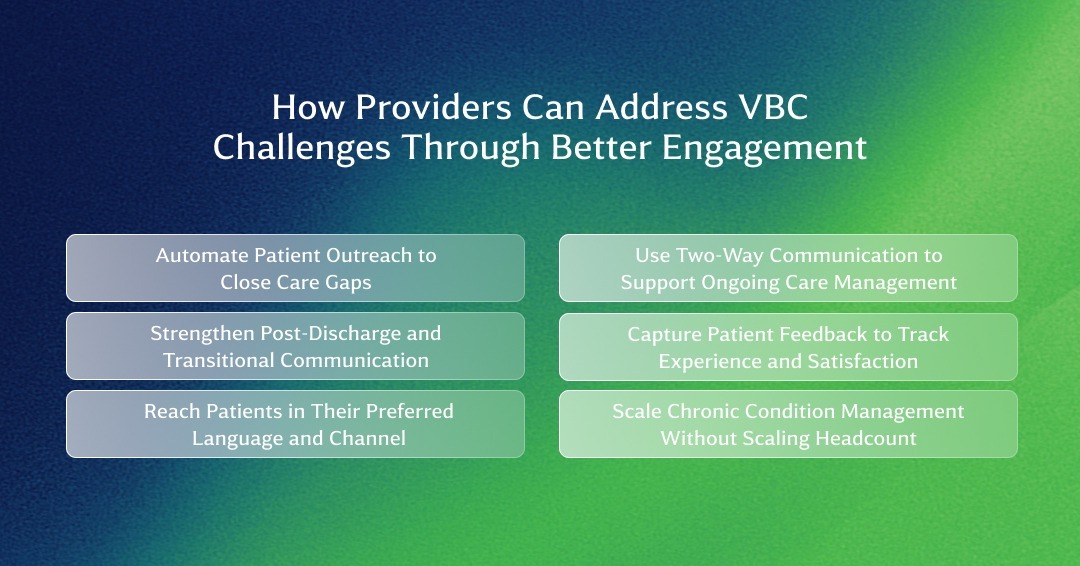
It's not realistic to reach every patient who needs manual outreach. Neither is expecting your staff to absorb that volume on top of everything else they're already doing.
An automated multichannel outreach program lets providers contact large patient populations without adding to their staff's plates. The system automatically pulls data from EHRs and other connected engagement platforms to identify patients who need manual outreach. Someone due for a screening receives a message prompt to schedule an appointment without a staff member going through a list.
The care gap gets addressed automatically without requiring a care manager to make individual calls. This directly supports quality measure performance in HEDIS, star ratings, and CMS program metrics.
The window right after discharge is when care coordination fails the most. Timely automated follow-ups change that. The system knows which patient was recently discharged because it's connected to your EHRs, CRMs, and patient data systems. This allows it to automatically check in and either confirm follow-up appointments or discharge instructions.
A patient who shows confusion or a new symptom is flagged for a care coordinator. The proactive approach catches issues before they turn into readmissions. It also directly addresses one of the most costly breakdowns in the care continuum for measurable outcomes.
The same goes for patients transitioning between specialists and physicians. Their medical journey carries forward with them so that each touchpoint knows what labs the patient has already done and where they are in their care journey.
A patient who receives health instructions in English but is more comfortable in Spanish is less likely to act on them. They're also not going to respond to a voicemail if they only use texts.
Multilingual outreach and channel flexibility close engagement gaps for large patient populations. You're respecting your patients' language and channel preferences to ensure they follow their care plans.
That directly supports SDOH and health equity goals. It helps providers perform better on the equity-focused metrics that payers and CMS are increasingly including in VBC programs.
One-way messages only tell patients what to do. Two-way keeps them active in their own care. It gives them a voice (or channel) to confirm and reschedule appointments. They can ask questions or flag concerns between visits. That's a critical kind of patient engagement that makes patients feel like participants in a care journey instead of passive recipients.
Two-way communication is especially important for chronic patients. Their outcomes depend on what happens between visits. An ongoing connection reinforces self-management behaviors that show up in both clinical results and quality performance. It also plays into CAHPS patient satisfaction scores, which are often tied to reimbursement in many value-based care contracts.
CAHPS surveys and satisfaction data feed directly into star ratings and program performance metrics. Waiting until scores are published to understand where the problems are is waiting too long.
Automated post-visit surveys sent via text or voice collect feedback at scale and surface problems early. If a specific site is generating low satisfaction around wait times or communication quality, that's actionable information before it affects annual performance.
Consistent feedback collection also satisfies the continuous quality improvement standards that CMS and payers build into VBC program requirements.
Managing large panels of patients with diabetes, hypertension, heart failure, or COPD is one of the core activities in VBC. It's also one of the most resource-intensive. The workload quickly exceeds what any care team can sustain manually.
Automated, condition-specific outreach keeps patients engaged in their care plans between visits without requiring staff to make individual calls for every touchpoint. Someone with diabetes gets a reminder to schedule their next A1c lab draw, while a patient with heart failure gets a daily weight-monitoring check-in.
These routine touchpoints happen consistently without bothering the care management staff. The workforce strain challenge and the chronic disease management challenge both get addressed through the same approach, which is exactly the kind of compounding efficiency that makes value-based care challenges manageable rather than paralyzing.
Managing a large patient population is one thing. Keeping thousands of people engaged in care plans that stretch across years is something else entirely.
Value-based care depends on what happens between appointments, not just during them. Patients living with diabetes, hypertension, heart failure, and other chronic conditions need ongoing support to stay on track. Trying to coordinate all of that through manual outreach quickly becomes unsustainable as patient volumes grow.
WestCX solves that coordination problem at scale. We add a unified orchestration layer across your existing systems to ensure patient engagement doesn't stay trapped inside silos. Our communication platform turns your patient data into automated, condition-specific outreach that runs continuously across large patient populations.
A diabetic patient is approaching their A1C lab window? WestCX Orchestrate identifies the opportunity, determines the best channel to reach them, and sends a personalized nudge before you even have to think about it.
A heart failure patient hasn't logged a follow-up since discharge? The same layer triggers an automated check-in campaign based on exactly where that patient is in their care journey.
Every interaction feeds into a connected journey that adapts over time, creating continuity that is difficult to maintain through manual processes alone.
Your teams spend less time chasing routine tasks while patients receive the consistent engagement that value-based care demands. No one on your team had to build the list, draft the message, or make the call.
Providers already using WestCX are seeing 41% lifts in preventive screening completion, a 35% reduction in no-shows, and over $9.8M in annual revenue retained per health system. Those numbers reflect what happens when a structured patient population finally has a communication infrastructure built to match it.
Schedule a demo to see how WestCX Orchestrate helps healthcare providers coordinate patient engagement at scale and turn value-based care goals into measurable outcomes.

Ever received a call from your bank trying to sell you an additional product or service? That's cross-selling, a sales technique that aims to...

Call deflection is a way to resolve customer issues through self-service channels. It improves your operations and lowers your costs because...

Credit unions usually think of customer service when someone asks about improving their member experience. That’s only one piece of the puzzle.
.png)
Hospital readmissions don’t just happen all of a sudden. They build up in the days after discharge and are not always a clinical issue. It often...

HCAHPS scores are no longer something hospitals can treat as a background metric. They're now central to how healthcare organizations are seen and...

Higher containment rates have long been seen as a winning self-service strategy. Every call resolved without involving an agent naturally reduces...