Reduce Healthcare Call Center Costs Without Compromising Care
If you're running a call center for a healthcare organization, you've probably been asked to cut costs while handling higher patient volumes than...
11 min read

Healthcare data moves through every part of care delivery. However, it's often scattered and poorly controlled. That reality creates gaps in compliance risks and patient decisions made on incomplete information.
Some organizations see data governance as more rules to add. It's actually about making sure the right data is accurate, accessible, and secure at the moment it’s needed.
This article breaks down what that actually looks like in practice. It explores how structured frameworks and AI-driven solutions can bring order to the chaos.
It also looks at how WestCX helps healthcare organizations turn data governance into something that works quietly in the background to support compliance and improve patient confidence.
Healthcare data governance is a set of policies, roles, processes, and standards that determine how health data is collected, stored, accessed, and protected.
It's not a single tool or platform. It's the operating agreement your entire organization follows when it comes to data. That’s how you create clear accountability and consistent rules for how data is handled as soon as a patient is registered.
Healthcare organizations operate under regulatory pressure that most other sectors never face. A miscategorized diagnosis code in healthcare is very different from a miscategorized transaction in retail. The latter is an inconvenience. The former can seriously harm a patient. Hence, clinical accuracy and legal compliance have to coexist. But both depend on how well data is governed.
Every HIPAA violation carries financial penalties that depend on the severity. That amounted to more than $6 million in 2025 alone, and that doesn’t even include the reputation damage.
Over 167 million Americans had their healthcare data exposed in cyberattacks in 2023. The affected providers had to make an official announcement, as per the law. That’s a large amount of trust and confidence lost from a single breach that will take years to rebuild.
The clinical stakes are just as high. Providers working from incomplete or inaccurate records make poor decisions. That leads to wrong prescriptions and medical errors that contribute to over 300,000 deaths annually in the States.
Unlike fee-for-service models, value-based care rewards outcomes instead of volume. That distinction puts a much higher demand on data quality.
Health systems are expected to accurately measure and report on clinical outcomes, readmission rates, patient satisfaction, and cost efficiency. Those reports go to payers and that’s followed by reimbursement.
A strong governance framework is required here so that the organization can trust its data. Otherwise, they can't contract confidently with payers who base reimbursement on performance.
Interoperability equally matters here. Coordinating care across hospitals, specialists, and labs only works if data moves cleanly between systems with consistent terminology and formatting. Governance establishes the standards that make that possible.
If there’s no data governance in healthcare, every system would have its own version of the patient. The care team would have no choice but to work from an incomplete picture.
Healthcare organizations aren't waiting around to use AI. Many modern providers have already deployed AI tools for clinical and admin support. This includes automating outreach and documentation, and even using predictive risk scoring to flag issues early on. Each tool, however, creates new governance obligations that have to be met immediately.
The most basic issue is training data quality. An AI model learns from the data it's given. That means any bias or inconsistency or gaps will produce poor results that impact patient safety.
There's also the question of consent. Patients have rights over how their data is used. You can't use patient records to train an AI model without their specific consent. Organizations that don't track consent at an individual level don't have a defensible answer when a regulator or a patient asks how that model was built.
Algorithmic accountability is the third issue. Who approved this tool? What data did it use? Can the organization explain why it made a specific recommendation? These are governance questions, and health systems that are deploying AI without answers to them are taking on real liability.
Healthcare data operates inside a strict regulatory environment. Federal law sets the floor. State laws add more requirements on top of it. There are also international regulations when patients cross borders. Understanding how these layers interact is foundational to any governance strategy.
HIPAA watches over the core requirements for protecting patient data. It defines how PHI can be used and shared. HIPAA also requires organizations to notify patients and HHS when a breach occurs.
HITECH extends HIPAA's reach. It ties EHR adoption incentives to privacy and security compliance, raising penalties across all violation tiers and extending enforcement obligations to business associates.
Both regulatory bodies create the foundation for healthcare data governance in the United States. The levels of access controls granted for each role, audits, encryption, and breach responses all trace back to these laws.
Healthcare organizations that treat patients from the European Union must comply with GDPR regardless of where they're based. It requires explicit consent for most data uses. Patients must also be able to access and delete their records.
The United States' privacy laws have also been updated to fill gaps that HIPAA doesn't address. California's CCPA gives patients rights similar to GDPR. Other states like Virginia and Colorado have passed similar laws in recent years.
The overlapping frameworks make it mandatory for healthcare governance to be built around consent documentation and structured data requests that vary by jurisdiction.
The 21st CCA requires health systems and health IT developers to make patient data accessible via FHIR APIs. It also prohibits information blocking, which means a provider has to have a solid reason to deny or delay access to electronic health information.
The penalties for information blocking are pretty severe. IT devs can face up to $1 million in fines, while providers' Medicare and Medicaid participation can be affected.
Organizations need audit trails that prove patient data is being shared appropriately. Policies need to be in place that clearly define who can request data and under what conditions. Any instance where access needs to be limited should be documented and justifiable under the CCA watch.
The Telephone Consumer Protection Act governs patient communication in healthcare. That includes every outreach from automated phone calls and texts to billing reminders and promotional messages.
TCPA requires patients to give their consent before receiving any automated message. Patients also have the right to opt out of receiving any communication at all. Getting that consent and giving patients a clear option to unsubscribe are all governance responsibilities.
Organizations that treat communication compliance as separate from data governance often end up with consent records in one system and outreach execution in another. That gap is where TCPA violations happen. A well-structured healthcare data governance framework closes it.
The case for governance is easy to make but the execution is harder. Healthcare organizations face a specific set of obstacles and most of them don't have clean solutions.
Fragmented data across disconnected systems - patient data sits in different systems like EHRs, billing platforms, lab systems, CRMs, etc. So clinicians working from different records often reach different conclusions.
Keeping up with regulatory changes - organizations that built their programs around the regulations of five years ago are already behind. This is because governance requirements are changing every day.
Staff accountability and training gaps - governance policies only work if the people responsible for data actually understand them. That means ongoing education and training for clinical and administrative staff.
Balancing data access with security - a middle ground needs to be found between locking down patient data too tightly and granting open access. The latter is a big violation. The former creates workflow bottlenecks that slow care delivery.
Governing AI tools that process patient data - many health systems are deploying AI tools without governance structures in place to oversee them. They don’t realize they’re sitting on a big pile of violations waiting to explode.
Health systems aren't dealing with a single policy or platform. A data governance framework is made up of several connected pieces. These see people, processes, standards, and controls working together for the same goal.
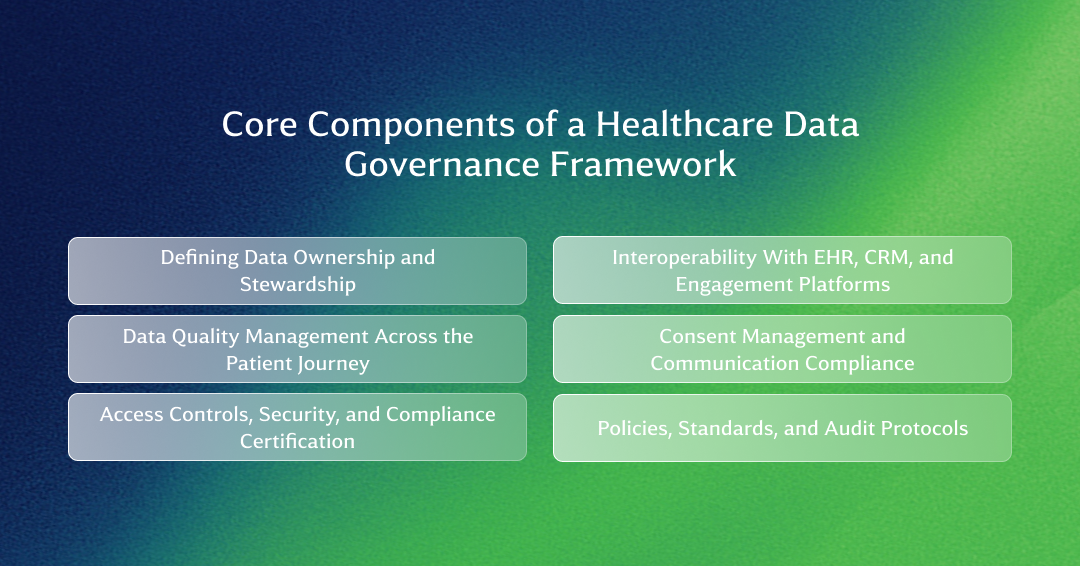
Every dataset needs a clearly accountable owner. For example, a CMO for clinical records or a CFO for financial data. They set policies, approve changes, and take responsibility for the integrity of their domains.
Clinical stewards relate to nurses, physicians, and your admin/IT staff. It's their job to keep patient records accurate and complete.
Such a structure is necessary or else data quality issues go unaddressed because nobody knows who owns the problem.
A healthcare system's data quality is a set of ongoing requirements at every stage of the patient journey. Intake documentation, clinical notes, discharge summaries, billing codes, etc, all need to be accurate and timely. They can't afford any inconsistency or else the entire database becomes unreliable.
This is where the benefits of data governance in healthcare become most tangible. Organizations with structured quality management catch errors before they reach their destination. They identify duplicate patient records and produce analytics that give governance teams visibility into where problems are building.
Role-based access control (RBAC) is the foundation of data security in healthcare. It limits staff to the data that their role requires. So a billing coordinator only sees data that's required for claims instead of clinical notes or the patient's symptom history. These RBAC permissions are reviewed regularly to ensure everyone has access to do their jobs without the possibility of any regulatory violation.
Strong security governance adds a few more layers on top of RBAC. That includes multi-factor authentication to verify who’s logging in and encryption to protect data both at rest and in transit. An audit trailer further highlights what data was accessed by whom and when.
Compliance certifications provide external validation that controls meet defined standards. They matter for regulatory defensibility and for vendor relationships, where business associates increasingly require proof of compliance before signing a BAA.
As we've already pointed out earlier in the blog, patient data lives in different systems. You have EHRs that hold clinical records. Your CRM manages patient outreach. There are also patient engagement platforms that specifically handle scheduling and communication.
A data governance framework in healthcare has to account for all of these systems working together. It standardizes terminology across systems and resolves duplicate records before they reach downstream systems.
Without that level of integration, a single patient might have multiple data versions sitting in each system. So a reminder might be sent to an outdated number and care reports contradict each other because they're drawing from data that was never reconciled.
Patient consent is not a one-time checkbox. It's an ongoing governance responsibility that spans multiple regulatory frameworks and multiple communication channels.
HIPAA states that patients have rights over how their PHI is used and disclosed. GDPR expands those rights to include the right to delete their records. TCPA adds documented consent for automated calls and text messages. State privacy laws layer on top of all of this with requirements specific to jurisdictions.
Governance defines the process and assigns accountability for making all that happen consistently. So when a patient opts out of SMS reminders, that preference automatically updates the CRM, the scheduling platform, and any third-party vendors.
Governance without written documentation is just an informal agreement that doesn't hold up in an audit. Healthcare data policies need to be written, approved, versioned, and accessible to their respective ownership. They should answer who can access this data and under what conditions. For how long should they have access, and what happens when something goes wrong?
Technical standards like HL7, FHIR, and LOINC define how data is structured and exchanged across systems. Governance committees maintain these standards and communicate updates to the teams that implement them.
Audit protocols close the accountability loop. Regular audits of access logs, data quality metrics, consent records, and policy adherence create the documentation trail that regulators expect to see.
They also give internal teams early warning when a potential violation is in the making. Organizations that audit consistently are also better positioned to respond quickly when a breach happens.
That last point matters more than most organizations realize. A healthcare data governance framework is only as strong as its enforcement.
A governance strategy only holds up when it's built around how your organization actually operates. A generic policy document hidden away in a folder that no one can read is of no use. Here's what implementation actually looks like.
You can't design a governance program without knowing where you're starting from. Most healthcare organizations are somewhere in the middle. They have some policies and accountability already running. But they also have more gaps than they'd like to admit.
Ask the hard questions first. Are your data policies consistently followed or do different departments do things differently? Do the people listed as data owners and stewards actively carry out those responsibilities? Do clinical and IT teams coordinate on data decisions or do they operate independently?
Most organizations answer "no" to at least a few of those. That's your roadmap. Knowing where your gaps are tells you where to invest first and what risks to address before you try to scale anything.
Your objectives need to connect directly to what your organization is actually trying to achieve. Track data error rates, audit readiness scores, and the time to access clinical records. See how many patient records meet your defined completeness standards.
Don't waste time on vague goals like "building a better data culture." Concrete numbers that tell you whether governance is working are all that matters.
Governance policies fail when no one is accountable for following them.
Clinical data stewards are responsible for making sure patient records are accurate and complete. Technical stewards from IT handle how data is handled and secured. Data owners set policies for entire datasets and must answer if the data isn't reliable.
That clarity into who is responsible for what data is critical or else your data governance framework will just sit unused.
The most common implementation mistake is designing governance as a parallel program that runs alongside clinical operations. It should be embedded in them.
That means governance policies should map every stage of care: intake, registration, clinical documentation, medication management, lab result handling, discharge, and post-care follow-up.
It's important that data quality checks happen at the point where data is created. Access controls should reflect how care teams actually work, not how someone imagined they'd work.
A governance policy that's more like an add-on just allows your staff to find ways around it. Your data-handling framework only holds when it's part of the process.
Technology matters but only if you choose platforms that were designed for healthcare compliance from the start.
Every system that handles data needs to be compliant with HIPAA and HITRUST. They should support standards like HL7 and FHIR so that data stops losing structure or meaning.
A data catalog connected to your healthcare data governance framework is one of the best investments you can make here. It gives you a centralized inventory of what data you have. It also shows who owns it and how it flows. It's exactly what you need to enforce policies consistently and walk into any compliance audit with confidence.
Regulations change. Systems get replaced. New data sources get added. Your governance needs to be an ongoing process because gaps that didn't exist a year ago will exist next year.
Set up ongoing monitoring using your defined KPIs. That tells you whether your governance is holding up. Run regular audits to ensure policies are being followed or if they need to be updated.
Organizations that treat governance as a continuous cycle are the ones that avoid costly compliance failures. They also maintain the data quality that their clinical programs depend on.
Staying compliant is only one reason to take governance seriously. There are a lot more benefits to reap from that in healthcare.
Fewer clinical errors - the quality of your data impacts health outcomes. Outdated contact information or fragmented records create patient risks that governance directly reduces.
Lower operational costs - healthcare organizations lose around $15 million annually due to poor data quality. Governance addresses that by centralizing data management and removing manual reconciliation that burns staff time and budget. That’s the difference between managing five different systems and managing only one.
Faster decisions with more confidence - your staff operates faster when they can trust their data. They don’t have to double-check patient information from two different systems. Leadership gets reliable reporting as well, instead of three conflicting versions of the same metric.
Reduced compliance exposure - strong governance controls who accesses what and how. That data protection policy reduces the chance of any breaches.
A foundation for AI and research - governance ensures that data used to train AI tools is accurate and reliable. It also creates the trust and access controls needed to share data with research partners ethically and legally.
Healthcare communication starts to fail the moment messages, rules, and data lie in separate systems. What looks like coordinated outreach on the surface often falls apart once it moves across channels, teams, and compliance requirements. That gap is usually where patient experience and regulatory risk begin to drift apart.
WestCX Orchestrate is designed to close that gap by placing governance directly inside the communication flow. It brings structure to how regulated interactions are delivered, managed, and measured across healthcare environments.
We do that by running everything through a single, layered system, instead of relying on disconnected tools. Here’s how:
This orchestration changes everything. Messages are no longer something you send and hope it works. Your communication system becomes something you can control, measure, and improve over time to align with HIPAA and federal requirements.
Schedule a demo now and see for yourself how WestCX Orchestrate ensures effective and compliant data governance for your patient communication.

If you're running a call center for a healthcare organization, you've probably been asked to cut costs while handling higher patient volumes than...

It's not hard to convince banks that customer experience matters. Every financial institution already knows it does. The harder challenge is...

In a way, customer service has always been built around supporting customers after they reach out. That approach creates unnecessary work and...
.png)
Hospital readmissions don’t just happen all of a sudden. They build up in the days after discharge and are not always a clinical issue. It often...

Regulated industries are already operating under heavy scrutiny. But data security concerns have only raised the stakes further.

Healthcare organizations should have fast and easy access to a patient's complete medical history. They shouldn't have to switch between different...