Cross-Selling in Banking: Matching Account Signals to the Right Offer
Ever received a call from your bank trying to sell you an additional product or service? That's cross-selling, a sales technique that aims to...
8 min read
Managing chronic conditions often feels like trying to keep track of a conversation that keeps getting interrupted. You have patients coming in for a visit and receiving a care plan. They’ll then skip their next appointments and unknowingly create major care gaps. Visibility into the patient’s condition eventually drops off and small issues that could have been caught earlier build into bigger ones.
Closing those gaps takes more than reminders and basic outreach. It requires a connected patient journey that carries the care plan forward between visits. This ensures patients stay engaged between visits and problems get addressed before they turn into setbacks.
Chronic condition management isn't one of those standard care plans that you set up and walk away. It's an ongoing commitment to monitor and support patients living with long-term conditions like diabetes, heart disease, and COPD.
These are conditions that don't resolve on their own. Progress depends heavily on how consistently patients stay on track with their care.
What sets it apart from standard care is continuity. Chronic management isn’t limited to a patient's visit. It requires care teams to stay connected with patients even between appointments.
This is because chronic patients need consistent supervision as their condition evolves. Regular labs, follow-ups, medication adjustments — everything depends on engagement. Without that, the whole care plan falls apart.
Hence, managing chronic diseases becomes a continuous process of staying ahead of change. It’s about keeping patients stable and informed so that their providers can intervene as early as possible.
Most care delivery models treat each stage of a patient's journey as its own event. That might work for most patients but those with chronic conditions often slip under your radar.
Chronic condition management requires continuity. Someone with diabetes scheduled for a heart bypass is not just a cardiac patient. Their blood sugar, kidney function, and medication all directly matter in how they respond to that procedure. Treating these pieces in isolation means critical context gets missed at almost every stage.
Most pre-procedure workflows focus on surgical clearance. They'll check the labs, consent, and even a risk clearance for the procedure itself. What they don't consistently do is look at the bigger picture for a patient managing chronic conditions.
That means spotting care gaps before they escalate into serious issues. Is the A1C where it needs to be? Are medications current? Have they seen their primary care provider recently?
These are clinical questions that shape procedural risk and recovery outcomes. Skip them and your team has already created a care gap before the procedure even begins.
The previous stage was about what's missing going into a procedure. That now shifts to what's getting lost on the way out.
Data collected during a procedure is often stuck in the procedural record. It doesn't reliably move further to reach your care teams.
So someone managing post-op care may not see the full notes. The patient's primary care physician almost certainly won't, at least not quickly. That gap in data transfer can mean the difference for a patient with a chronic condition.
Discharge gets treated like the finish line. For patients managing chronic conditions, it's one of the most critical moments in the entire care journey.
There's a real difference between handing a patient a discharge summary and actually setting them up for what comes next. A summary tells them what happened. A proper care transition plan tells them what to do, who to call, and when to schedule follow-up. It also shows how their existing chronic care program connects to their recovery.
Most patients just leave with the summary.
The 30 days after discharge are when readmissions happen. This risk is exceptionally higher for chronic patients because there's no structured program waiting for them on the other side of that door.
When a patient leaves the hospital without an active chronic condition management plan, they go home to figure it out largely on their own. Their symptoms start building. Medications often get missed. It all leads to more questions that no one's around to answer. Hence, the next stop for such patients is the emergency department.
This is the readmission cycle and it's not random. It's the direct result of care that ends at discharge instead of continuing through it.
A chronic condition management plan isn't a document patients take home. It's a living process that keeps patients connected to their care team and informed about their condition.
Each core component below matters for that purpose. They're what make chronic care work for the long term.
Care coordination is the foundation. Patients with chronic conditions routinely see multiple providers. Each one works from a partial view because there's no coordination. There needs to be a way for data to be shared between all those providers. That's how they can see care gaps and make decisions with a full picture.
Follow-up and monitoring keep the process moving between visits. This includes scheduled check-ins, remote monitoring where appropriate, and structured outreach at key intervals. The last one is especially needed in the weeks following a procedure or hospitalization. The goal is to catch problems before they require acute care.
Medication management is one of the highest-impact areas when it comes to primary care. Most chronic conditions are controlled by medications that need regular review. Missed doses and refill lapses are among the most common drivers of preventable hospitalizations.
Patient education closes the loop. Patients who understand their condition know what to watch for and what to do when their health changes. Such patients are more likely to follow their care plan.
That said, education isn't a one-time event at diagnosis. It's an ongoing part of care. It needs to be delivered at the moments when it's most relevant and in formats patients can actually use.
Each component mentioned above relies on coordination. That's where most health systems struggle. The information exists but it's in disconnected systems.
A unified patient engagement platform addresses that directly. It's what keeps data, communication, and care continuity moving from pre-procedure through long-term chronic care.
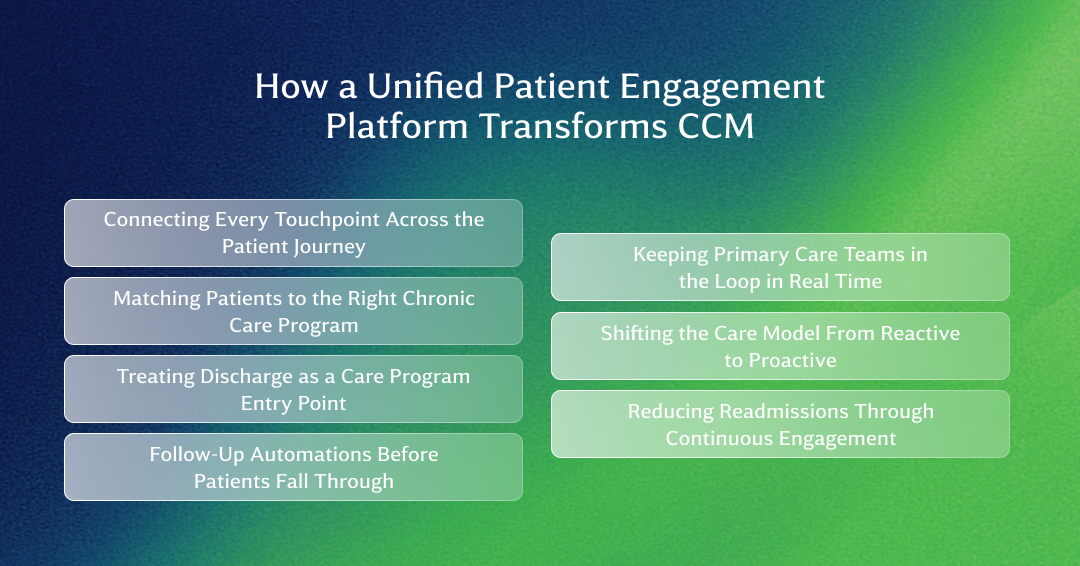
A chronic condition management platform that operates in silos produces the same gaps as the care model it's supposed to fix. That's the core problem with point solutions. They solve one piece without seeing the whole.
A unified platform changes the operating logic. Everything from patient data to care plan alerts and communication history follows the patient from stage to stage. That continuity is what makes coordinated care possible. Your team always sees a complete record of the patient after opening their chart.
Not every patient with a chronic condition belongs in the same program. A well-designed chronic condition management platform uses clinical signals to match each patient to the most relevant care pathway. Their recent diagnoses, labs, medication, and hospitalization history — all act as data points. You end up delivering a structured process that identifies who needs what and routes them accordingly before they fall through the cracks.
Most discharge processes are designed to close a loop. A connected platform treats that moment differently.
Patients are enrolled in the appropriate chronic care program before they're discharged. Their next appointments are scheduled and medication instructions are confirmed before they leave for home. So the patient doesn't just leave with paperwork. They have an active care plan already in motion.
A unified platform automates outreach at defined intervals. For example, it will send a check-in message 2 days after discharge and then a symptom survey after a week.
Any concerning response is automatically flagged and routed to the right care team member. You stop relying on the patient to know when to call because it's being replaced by a structured outreach that surfaces the problem first.
Information lag is one of the most consistent breakdowns in primary care for chronic condition management. A patient will be admitted, treated, and discharged, and their primary care physician will only find out days later or perhaps not at all.
A connected platform closes that gap. The primary care team immediately receives a notification when a chronic patient under their care is admitted. The team also stays coordinated with specialists and hospital staff without chasing records or relying on the patient to relay what happened.
All of this is a massive administrative lag when done manually. That’s why AI and automation step in to keep information moving in real time.
Traditional chronic care is built around the visit. You're basically relying on a patient to know when it's time to come in. But even when they do, the days between visits become a blind spot so the care team has no idea of how the patient is actually doing.
A platform built for chronic condition management changes that. Continuous monitoring through remote devices, patient-reported outcomes, and digital check-ins gives care teams an ongoing view of each patient's status.
For example, the system sends an automated alert if blood pressure readings become too high. Someone who has started skipping refills? The system triggers an immediate outreach. So intervention happens before the crisis.
This proactive approach is one of the most direct paths to fewer hospitalizations and better outcomes.
Patients who stay engaged with their care team between visits show better adherence to care plans and lower rates of avoidable hospitalizations. A unified platform maintains that engagement. It creates a steady line of communication (reminders, check-ins, alerts, etc) for patients to easily reach out when something feels off.
That kind of ongoing connection becomes critical under value-based care. When patients stay engaged after discharge via a chronic management platform, providers reduce the risk of readmissions while protecting both outcomes and reimbursement.
There's no shortage of frameworks for building a chronic condition management plan. What's harder to find is practical guidance on what actually holds up once it meets the realities of daily operations.
Personalize care plans from the first visit - two patients with the same chronic condition still have different needs. Their lifestyles and even barriers to adherence require personalized plans if you're looking to achieve better outcomes. So tailor your goals for each patient. Build engagement around the patient's preferences instead of just the diagnosis.
Move to a team-based care model - no single provider can manage chronic conditions alone. You need a whole team of coordinators, physicians, pharmacists, and specialists that's operating from a shared view of the patient. Otherwise, you have fragmented care, which is one of the primary reasons patients with multiple conditions feel confused and disengaged from their own treatment.
Automate communication between visits - automation makes consistent engagement easier. Appointment reminders, check-ins, surveys, bookings — every touchpoint is handled by the system on its own without overwhelming the care team. However, make sure to include trigger events so that care teams receive instant alerts if a survey response flags a concerning symptom.
Use your data to catch problems early - a chronic condition management platform uses your patient data to highlight patients trending in the wrong direction.
Set the right thresholds for each patient and activate triggers for each touchpoint. Lab results, patient-reported outcomes, remote monitoring data, etc, should all feed into the same system so that you have the right data to catch issues early.
Measure outcomes and act on what the numbers show - collecting data without acting on it is just documentation. Track readmission and adherence rates, clinical outcomes, care plan compliance by condition. Use those numbers to identify which parts of the workflow aren't performing and adjust accordingly.
Treat social barriers like part of the care plan - missed visits, poor adherence, and other gaps usually come down to real-world issues like cost, transportation, or confusion. Set up your workflows to catch those signals early and point them somewhere useful like a referral or a support resource. This gives care teams a way to act in real time instead of letting the care plan fall apart.
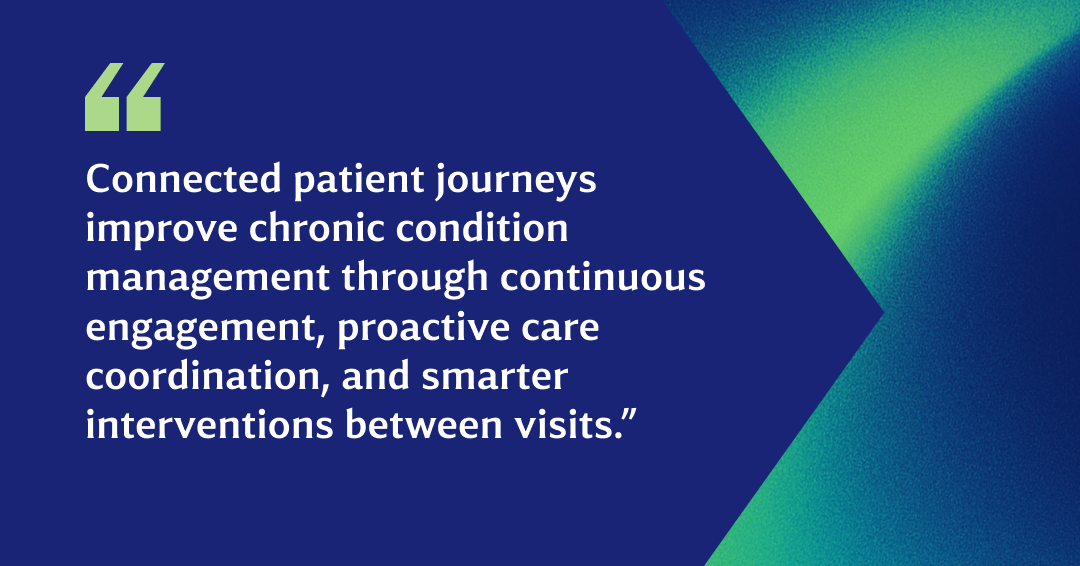
Most organizations think adding more touchpoints is the way to scale chronic care. That approach only creates more friction because your patient journey is still a disconnected journey stretched across different tools.
WestCX offers a scalable solution to this problem. We ensure consistent engagement by moving your patient data along with the patient at every step. What used to be isolated outreach becomes a coordinated journey that adapts in real time without adding complexity for your team.
We do that through our orchestration layers. The platform automatically pulls together every clinical, behavioral, and historical patient data to decide what should happen next and when. Communication starts feeling like a guided experience because WestCX Orchestrate is designed to carry context as well. That means patients receive relevant reminders and updates when they most need them to move forward.
This is what intelligent healthcare communication looks like in practice. Messages are sequenced, adjusted, and aligned with where each patient is in their care plan. A delayed refill or missed follow-up doesn’t go unnoticed. The system flags it early and routes the right next action, so your team can step in before gaps turn into setbacks.
That same intelligence carries across the entire journey through scheduling, referrals, discharge instructions, surveys, etc. Patients never have to repeat themselves and your team never has to spend time piecing together fragmented information. Everyone moves forward with clarity.
The entire engagement process is automated but it doesn’t feel that way to patients. Conversations happen through intelligent virtual assistants that answer questions and guide next steps 24/7.
That’s what keeps outreach feeling responsive and continuous instead of robotic or transactional. It’s the difference between generic communication and true care orchestration, and it’s what allows chronic condition management to scale without losing the human side of it.
The entire engagement process is automated but our conversational AI ensures that outreach feels human, responsive, and continuous instead of robotic and transactional. That’s the difference between generic communication and care orchestration, and it’s what allows chronic condition management to actually scale without losing the human side of it.
Schedule a demo if you want to see how WestCX Orchestrate can improve your engagement workflows.

Ever received a call from your bank trying to sell you an additional product or service? That's cross-selling, a sales technique that aims to...

Call deflection is a way to resolve customer issues through self-service channels. It improves your operations and lowers your costs because...
Credit unions usually think of customer service when someone asks about improving their member experience. That’s only one piece of the puzzle.
Regulated industries are already operating under heavy scrutiny. But data security concerns have only raised the stakes further.

Most customer platforms were originally built to only store information. They kept records clean, searchable, and compliant, but they didn’t do much...

You can deliver excellent care and still lose patients in the gaps between interactions. Those gaps are where expectations have quietly changed in...