Cross-Selling in Banking: Matching Account Signals to the Right Offer
Ever received a call from your bank trying to sell you an additional product or service? That's cross-selling, a sales technique that aims to...
5 min read

Most customer platforms were originally built to only store information. They kept records clean, searchable, and compliant, but they didn’t do much beyond that. However, that passive nature started to break down as CX leaders began pushing for systems that could actually respond to interactions in real time. The expectation shifted from keeping records to driving outcomes. That’s where the idea of a system of action starts to take hold.
AI is what made that shift practical. It turned what used to feel theoretical into something teams can rely on day to day. A single AI framework can take in data, make sense of it instantly, and trigger the next step without waiting on manual input. Decisions now move across the customer journey instead of sitting in dashboards.
That’s a different kind of engagement that changes how teams think about customer relationships and what their systems should be able to do.
It's like the names suggest. A system of record holds information, while a system of action reads that stored data and determines what to do next.
Take EHRs and CRMs as notable examples of systems of record. They log clinical history and track interactions. But they're primarily designed to organize and preserve data from various sources.
A system of action (automated workflows or Agentic AI) moves that data across channels without waiting for someone to manually trigger the next step.
However, the difference between the two isn't just complexity. It's about purpose. A system of record will answer questions for you like "what do we know" right now about this patient. A system of action tells you "what should we do right now" for that patient and through which channel.
Three major factors are influencing organizations and businesses to make the move toward a system of action. The first is expectation. Patients and customers no longer accept generic outreach. They want timely and relevant communication layered on seamless digital support, the same kind they receive from their favorite subscription service or retail store.
A generic appointment reminder sent three days after a patient has already cancelled suggests their provider is not paying attention. Such patients are more likely to ignore any further messages.
The second is capability. AI has made intelligent decision-making possible at scale. LLMs can interpret behavior, classify intent, and determine next best actions for thousands of patients/customers at once. That same level of outreach no longer requires a whole team of analysts.
The third is compliance, probably the biggest driver out of the three. It’s what puts the most pressure to move from passive systems to ones that actually drive action. Regulated industries like healthcare can't afford poorly targeted messaging. That becomes an instant liability that leads to fines and penalties under HIPAA and other regulatory groups. Every communication needs to be contextually appropriate. But that level of precision requires an intelligent system of action instead of a basic automated calendar.
Better automation undersells what a system of action actually does. There are five specific behaviors that separate it from systems of record as well as engagement tools most organizations already run.
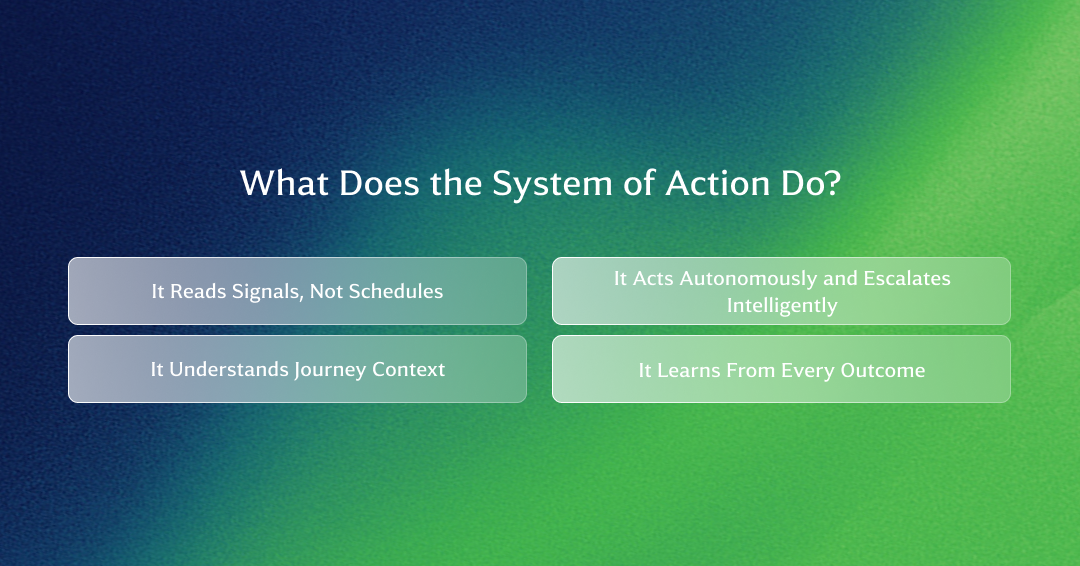
Most engagement tools follow schedules. They'll send a message on Friday and another reminder three days later. That logic treats every person the same regardless of where they are in their journey or their past interactions.
A system of action actually accounts for behavior across every touchpoint. A patient who has already confirmed their appointment will receive preparation instructions instead of another reminder.
Signal-based decisioning outperforms schedule-based outreach every time because it tracks reality. The latter assumes everyone moves at the same pace in the journey. The former responds to how each person is actually moving. That difference alone creates a gap large enough to affect engagement rates.
Every person interacting with an organization or business does so from a different point in their relationship. A customer may be in their first week with a product or nearing churn. Someone else might be reaching out to a provider for readmission.
A system of action holds that context and uses it to filter what is relevant right now. It does not send a satisfaction survey to someone who was discharged 48 hours ago and still has not received discharge instructions. A customer who just initiated a refund process does not receive a discount offer for that same product.
This context is what prevents irrelevant outreach, which eventually damages trust.
Autonomous execution still requires guardrails. A system of action runs defined workflows across channels while knowing its limits. A frustrated customer or a patient showing concern is automatically escalated to a human agent.
This escalation is baked into the system based on clear criteria. Organizations define severity thresholds, highlight specific keywords, or include response patterns that indicate a situation requires human judgment.
The combination of autonomous execution and intelligent escalation is precisely what makes a system of action safe to run in regulated industries.
A system of action also doesn't stop at execution. It tracks what happens after sending a message or reminder, and uses that data to refine future decisions.
Did the customer open the message? Maybe their read rates are better when outreach is done through a specific channel. Someone else might only respond to phone calls on the weekend.
This feedback loop improves channel selection, timing, the content itself, for a given population over time. Outreach starts to become more relevant and escalation login becomes more accurate as the system identifies which signals most reliably indicate when a human needs to be in the conversation.
The system of action running six months in is not the same one that launched. It has learned from every interaction it has had.
The most common objection to adopting a system of action is infrastructure. Organizations assume that they need to replace their current EHRs or CRMs. They actually don't.
A system of action sits above your existing systems as an orchestration layer. It reads from them to pull necessary data before acting through engagement channels without ever touching the underlying infrastructure.
In other words, your EHRs and CRMs stay as they are. The system of action just connects above them to handle the decisioning and communication layer, which those systems were never designed for.
That said, not everything marketed as a system of action actually is one. The platform should respond to behavioral signals without a human triggering the workflow. It should hold and apply the journey context. Finally, the system should refine its own logic over time based on what outcomes it observes.
If a platform cannot do all three, it is just an engagement tool with better automation. That's still useful, but it's not a system of action.
There's a reasonable concern that any system capable of acting autonomously will eventually replace the people currently managing those interactions. It's something worth addressing directly.
In regulated industries, humans are required by governing laws to be included in the loop. It's a legal and ethical obligation.
A system of action is not designed to replace your core team. It's meant to handle the high volumes and routine tasks that are currently eating up most of their time.
Picture a human staffer who automatically receives the right information at the right time to make an informed decision. In healthcare, that might mean a care coordinator who has to intervene early because the system flagged a patient with a chronic condition.
The human conversation that follows is better informed because the system of action handled the upstream work. Your staff is in a stronger position than they would have been otherwise.
Your system of record already knows what’s happening. It just doesn’t know how to act on it at the right moment. WestCX is exactly designed to close that gap at scale.
We integrate a system of action on top of your existing stack, so your EHR, CRM, and engagement tools don’t sit in silos waiting on manual follow-ups. Our three-layer orchestration connects conversations, campaigns, and data into a continuous flow to guide the next best action in real time based on where the customer actually is in their journey.
You stop managing fragmented touchpoints and start coordinating outcomes. That means every interaction feeds into the next, every signal triggers a response, and nothing gets lost between systems.
WestCX Orchestrate takes this further with an AI-driven communications layer that listens, detects intent, and adapts engagement across channels in real time. It learns from every interaction to improve how it responds, when it engages, and what it prioritizes next.
We're not just offering a way to automate your tasks. We're connecting actions and completing them, so customers or patients are naturally guided to the next step in their journey.
Scheduling, reminders, follow-ups, payments—all handled in the moment without waiting on staff intervention. Importantly, your existing systems stay intact. We just make them move as one.
Schedule a demo to take a closer look at how WestCX Orchestrate turns your system of record into a system of action that actually delivers outcomes.

Ever received a call from your bank trying to sell you an additional product or service? That's cross-selling, a sales technique that aims to...

Call deflection is a way to resolve customer issues through self-service channels. It improves your operations and lowers your costs because...
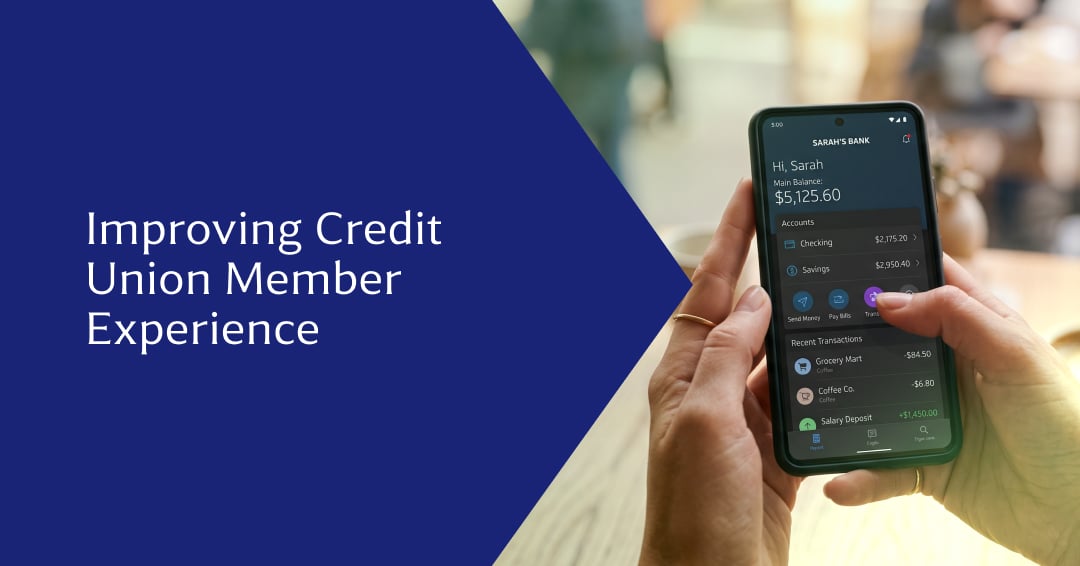
Credit unions usually think of customer service when someone asks about improving their member experience. That’s only one piece of the puzzle.

Regulated industries are already operating under heavy scrutiny. But data security concerns have only raised the stakes further.

You can deliver excellent care and still lose patients in the gaps between interactions. Those gaps are where expectations have quietly changed in...
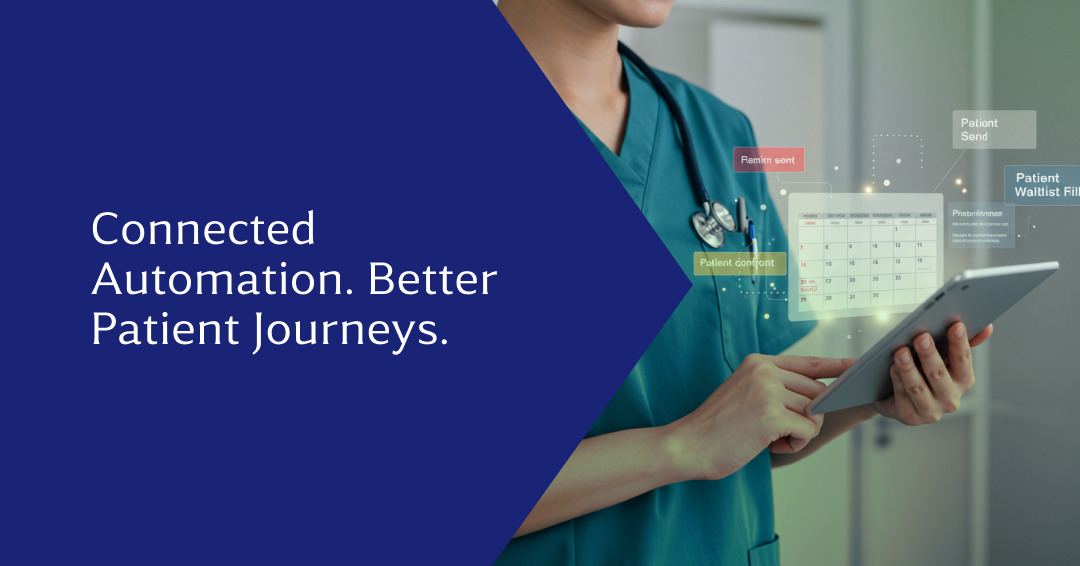
No one gets into healthcare to spend hours chasing paperwork or fixing broken workflows. Yet that’s still how a large part of the day goes for many...