Reduce Healthcare Call Center Costs Without Compromising Care
If you're running a call center for a healthcare organization, you've probably been asked to cut costs while handling higher patient volumes than...
13 min read

You can deliver excellent care and still lose patients in the gaps between interactions. Those gaps are where expectations have quietly changed in the past decade. Patients are still comparing you to the other clinic down the street. But they're now more comparing you to every smooth, responsive service they use every day.
So a missed reminder can easily turn into a no-show. Confusing instructions? You're pushing them towards non-adherence. A delayed response can make a patient feel ignored. None of these feel like major failures on their own, yet they add up fast.
This is where omnichannel patient engagement becomes necessary. You start creating one connected conversation that follows the patient throughout their journey. That same conversation adapts to their behavior based on engagement data and makes it easy for them to stay on track.
Omnichannel engagement is a model where healthcare organizations unify all their communication channels. Patients receive the same quality experience regardless of whether they're texting, calling, or using an online portal to book a visit.
Context is carried forward at every touchpoint because every patient's data is shared among all the channels. Hence, patients don't have to repeat themselves.
They can ask about a billing concern on chat and then call the office to continue the same conversation. The front desk (or even care team) can instantly move towards a resolution without having to start the conversation from scratch.
That might sound like a small thing. It isn't.
Most health systems currently run multichannel care, which is different from omnichannel. A multichannel approach gives patients options. An omnichannel connects those options so that the experience carries to the next step.
Here's a practical example. A patient books an appointment through an app, receives a text reminder, checks in via a portal, and then follows up through live chat. That's four separate systems in a multichannel setup. In an omnichannel setup, they're one continuous interaction. The patient's preferences, history, and care status are available at every step.
Disconnected communication significantly impacts patient satisfaction but it doesn't stop there. Poor engagement eventually circles back to create operational and financial liabilities for your organization.
Consider a patient who endures long wait times just to book an appointment over the phone. The confirmation message comes by text but the reminder follows up as a separate email. The billing notice then lands in the online portal.
You can’t expect the patient to feel engaged during this journey. Your staff also has no shared view of what the patient has already been told. That means the patient has to repeat themselves at every step. They'll eventually drop off because of poor communication, forcing your care team to track them down manually.
No-shows are a clear result of such a fragmented approach. Each empty slot is revenue lost every single day. That’s along with the trust of the patient.
Staff time is another cost center. Manual outreach requires care coordinators to spend hundreds of hours every week confirming appointments and chasing paperwork for intakes and billings. That time has a dollar value and it's being spent on a problem that coordinated outreach would largely eliminate.
Then there's patient retention. 69% of global patients will gladly switch providers due to poor communications. That number is even higher for Millennials and Gen Z who expect fast resolutions.
Language barriers compound all of it. Patients who don't receive instructions in their native language are far more likely to disengage or mismanage a medication. This carries both clinical and compliance implications.
Omnichannel communication has several implications. It spans every stage of the patient journey, not just appointment reminders—something it’s often mistakenly thought to be limited to.
Scheduling is often the first moment a patient forms an opinion about your organization. It's also where fragmentation is most immediately felt.
Consistent communication matters here. A coordinated approach means the channel a patient used to initiate contact is tracked and carried forward. So someone who booked a visit through the app receives a reminder alert through that app instead of a phone call. Any other communication, such as a potential delay because the doctor called in sick, uses the same channel.
This ensures patients are kept informed because they don't always reach out to confirm their appointment. They'll just show up. Using their preferred channels also means patients don't face any friction in having to explain their situation during every interaction.
The window between scheduling and arriving is where most health systems lose patients. It might be because a patient didn't receive clear instructions or because they think their insurance won't cover the visit.
Not knowing how to prepare or what they'll owe upon arrival are good reasons to cancel or delay. These problems are actually solvable through automated outreach.
Omnichannel engagement ensures that insurance verification prompts and co-pay notifications actually reach the patient through their preferred channels. The same goes for appointment reminders and intake instructions. It doesn’t give the patient the chance to disengage.
Active care is where omnichannel engagement proves its value. Patients move beyond basic reminders. They start interacting with telehealth systems, intake tools, mobile apps, support chat, etc. Each of those touchpoints needs to feel connected.
The channel used to book should naturally carry through the rest of the experience. It should shape how patients check in, complete forms, and receive updates. That continuity keeps patients focused on their care instead of figuring out what to do next.
Real-time support plays an equally important role once care is underway. Questions tend to come up in the moment about wait times, prescriptions, or next steps. Quick answers here make a noticeable difference.
Omnichannel systems allow those responses to happen instantly through chat, SMS, or digital tools already in use. Patients get help without chasing it, while staff avoid being pulled into repetitive queries.
The patient engagement cycle doesn’t stop at discharge. It simply moves into a phase where consistency matters even more. This is highly critical for patients managing chronic conditions.
Recovery and dosage instructions, reminders, follow-ups, etc, only work when patients actually receive and act on them. That only happens when outreach goes through the right channel, at the right time, with the right information. Organizations rely on such coordinated post-visit communication to improve their adherence rates.
Preventive care relies on constant communication between visits. Wellness reminders, annual screenings, even flu vaccination outreach have zero impact if you're only reaching out to patients after they have booked an appointment. The whole point is to convince them for a visit that they're most likely to skip or ignore in the first place.
Most organizations do not maintain this kind of ongoing contact. Patients who do not hear from their provider between visits are easier to lose to a competitor that does.
Organizations that maintain this relationship through a coordinated omnichannel patient experience see higher retention and stronger preventive care completion rates.
It’s all about consistency that turns a transactional relationship into a trusted one.
Not every channel works for every patient. Personal preferences always weigh heavily on your engagement strategy. Here's what the data shows about how different channels actually perform.
SMS leads the pack for speed and action. It has the highest open and read rates among all channels, primarily because patients don't have to download any apps or log into any portals. Every health system uses texts for appointment reminders and updates. That high adoption rate is due to around 80% of patients being more likely to take action after receiving a text.
Voice till matters for complex or sensitive interactions. Older patients in particular prefer phone calls because they often have questions about diagnoses or care plans. They want answers within the same conversation instead of sending a message and waiting for a response. Automated voice calls also do well as a secondary touchpoint when text or email has not gotten a response.
Email works for delivering detailed information. A PDF with dozens of pages showing a patient's physio routine can't be sent through text. Email is also the top channel preference for healthcare content that patients would like to reference later. However, it holds only a 22-25% open rate compared to nearly all texts. There's also another catch. Your email can easily get buried in a crowded inbox or the spam folder.
Live chat is preferred for resolving simple things that don't require a phone call. Over 80% of patients expect their providers to have a live chat feature on their website or portal. It's perfect for sorting billing questions or appointment concerns without having to wait on hold. The growing demand is why many organizations are now using AI chatbots to handle these routine interactions at scale.
All that said, none of these channels comes out as a clear winner. Age, language, habits, and digital literacy all shape how a patient engages. You need to pick the channels that work for the patient and the only way to know that is to track it.
The benefits of omnichannel are not limited to any single touchpoint. Providers see improvements for the entire patient journey. You see improvements in appointment rates, staff workloads, satisfaction scores, and revenue. Here's what it looks like when you break it down.
Continuity across the entire journey - the single most common frustration patients report is repeating themselves. An omnichannel model makes sure they don't. Patients can jump from one channel to the other without your staff losing context.
Think about a patient who starts booking a specialist referral on an app but leaves it midway. They then call the office later on to finish. Your agent won't have to restart that interaction from scratch. They'll already see what the patient started and where they left off. Your office no longer has to rely on a stack of disconnected tools.
Communication that matches how they actually want to be reached - not all your patients want a text or a call. Respecting their preferences is how you drive response rates. For example, SMS reminders have the highest open rates for appointments and updates. It alone can net you a 25% increase in customer satisfaction.
Access outside of office hours - an omnichannel experience with self-service options allows patients to resolve their issues any time they want. They can schedule an appointment late at night or clarify discharge instructions on the weekend.
The system empowers your patients to take charge of their own healthcare. The thought of not having to call the office or wait on hold might seem minor but it significantly drives patient engagement without adding to your admin plate.
Better support between visits - omnichannel systems don't stop tracking patients just because they've left the office. The system keeps tabs on who's overdue for a visit and who might be falling off track.
A patient who isn't responding to your outreach triggers an automated alert for a care coordinator to make a manual call. Just confirming whether the patient is following your discharge instructions maintains engagement and builds trust at the same time.
This works far better than just sending the same reminder to everyone on a list. You identify patients, choose their preferred channel, and continue the conversation there at the right moment.
Fewer no-shows - this is one of the clearest and most direct revenue impacts. Automated omnichannel reminders identify preferred channels based on past interactions. Someone with a history of showing up after a phone call won't be sent a text reminder.
WestCX Orchestrate reports a reduction of 20-30% in no-show rates by using automated omnichannel. That's a significant revenue you stop leaking.
Higher patient retention and lifetime value - keeping a patient costs less than finding a new one. Omnichannel models ensure that patients consistently experience easy and relevant interactions. They start to trust the healthcare system when they're being guided along every step. That trust shows up in higher retention rates and increased patient lifetime value. The return on engagement shows up in reduced churn, not just new volume.
Staff relief through automation - you can't expect your staff to manually manage multiple channels. Even a single channel proves cumbersome in large hospitals. Automating routine outreach through an omnichannel model changes that. The reduction in manual tasks eases staff workload while patients benefit from a personalized care experience through timely reminders and clear guidance at every step.
Better clinical outcomes through coordinated follow-up - An omnichannel healthcare strategy closes the loop after visits. You use automated programs for chronic disease management, surgical recovery, and medication adherence to keep patients on track between appointments.
Consistent engagement here highlights which patients are skipping their doses and which are staying compliant. That stacks up to improve clinical outcomes as well as patient experience.
Technology creates the conditions for omnichannel to work. But several specific foundations determine whether an organization actually delivers on it.
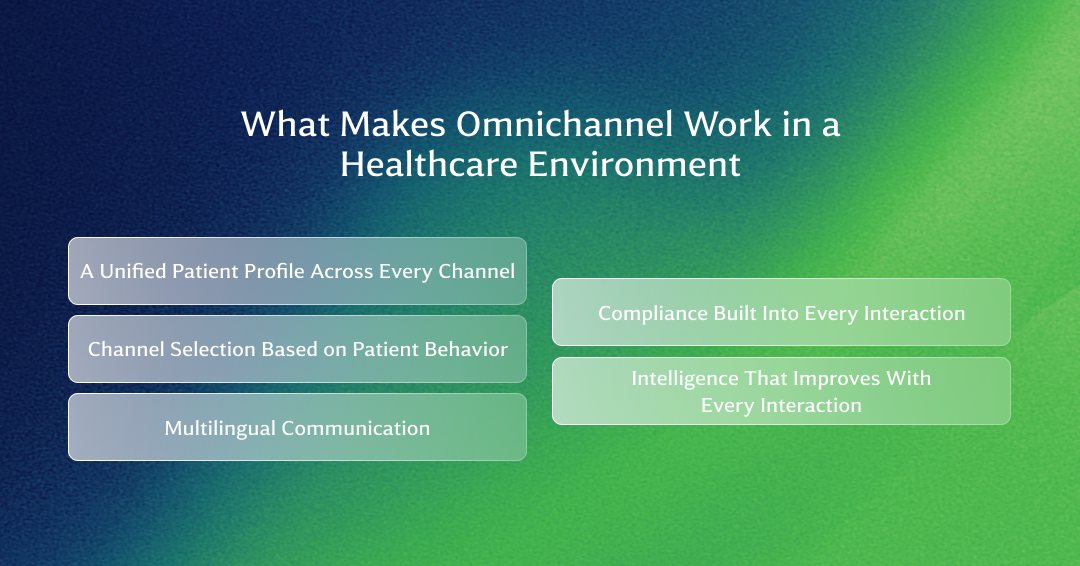
Omnichannel falls apart when your channels don't share data with each other. A patient who updated their phone number in the portal shouldn't still be receiving calls on their old number.
A unified patient profile removes this fragmentation. It ensures that all the information you need to engage with a patient can be found in one place. Contact details and preferences, clinical history, language needs, and other engagement behavior — everything is stored under a single profile by integrating your EHR and CRM.
Without that, each channel operates with a partial view of the patient, which is the same fragmentation problem that omnichannel is supposed to solve.
We've already established how different patients respond to different channels. Sending reminders by email to someone who prefers a phone call is nothing but noise.
Your behavioral data should drive your outreach decisions. Communications shouldn't be based on what works for your health system. So track your patients' past engagement patterns. Which messages did they open and through which channels? Look at open and click rates.
RCS (Rich Communication Services) is worth mentioning here for your outreach strategy. It delivers interactive messages that show significantly higher engagement rates than standard SMS. Patients can simply tap a button embedded inside the rich text to confirm or reschedule an appointment. You can also include other interactive elements like maps and short clips.
Limiting your omnichannel patient experience to just English is a mistake. Healthcare organizations cater to a diverse population. Not communicating with them in their preferred language not only creates care gaps but also opens you up to compliance issues under Title VI.
Multilingual capability boosts your omnichannel reach at scale. It builds trust because patients start feeling heard and seen. However, your system needs to identify a patient's language preference first and then maintain the same coordinated outreach across every language that it delivers in English.
LinguaAI provides exactly this by supporting over a hundred languages. It's not just a translator. The AI is smart enough to catch context as well as cultural nuances in each language. You extend the full communication infrastructure across languages without requiring separate workflows to be built from scratch for each one.
Healthcare communication is regulated at several levels. HIPAA, HITRUST, SOC 2, PCI, etc. — all require your outreach to be compliant across channels. A reminder instantly becomes a liability if it was sent without proper data handling or consent management, regardless of whether it reaches the patient.
The right approach is to work with a platform where compliance is built into the channel architecture from the start. It shouldn't be bolted on after an audit. This is the easiest way to ensure that every interaction handles patient data the way regulatory bodies want.
Automating your system to send the same message to every patient on a list through every channel is just going to make them all disengage. What actually makes an intelligent omnichannel strategy in healthcare is the feedback loop. Track how patients actually respond to your outreach and make adjustments based on that data.
WestCX uses Journey Analytics to bring that visibility into every interaction. It catches engagement signals across SMS, email, voice, and digital channels to show you what's actually working and where patients are dropping off.
You'll know exactly which friction points are impacting your communication and what changes saw patients to act. The accuracy here improves over time as the system learns more from each interaction.
Unifying multiple channels under one omnichannel system becomes complicated when you're managing thousands of patients with different needs and preferences. You need AI to bring structure at such a scale.
Conversational AI for routine tasks - intelligent virtual agents (or IVAs) automatically handle inbound and outbound conversations across all channels. Patients can confirm appointments, reschedule, verify insurance, or get answers to common questions without navigating any phone trees.
IVAs hold conversations just like human agents. They understand context and can even capture sentiment and nuance without sounding like robotic scripts.
The biggest benefit of conversational AI is that you can scale up or down as needed. IVAs are also online 24/7. That means your office is providing exceptional support around the clock without adding headcount. That's convenience, which matters for most patients.
Agentic AI that acts on context - there's a more advanced AI layer that goes a step beyond answering FAQs. Agentic AI autonomously takes the next best action based on patient context. That means the system automatically reschedules when a patient misses an appointment. It will send an alternative slot if it realizes that the patient mostly visits on weekends instead of weekdays.
That, however, doesn't replace human judgment. Modern contact centers for healthcare maintain a balance by programming the AI to escalate complex or sensitive cases instead of moving patients inside a loop.
Multilingual AI as an equity differentiator - breaking down language barriers with AI is far more cost-efficient than hiring and training native speakers. The level and quality of communication remain consistent regardless of language or channel. This isn't a minor feature. Multilingual outreach in healthcare is a structural way to close care gaps across patient populations.
Predictive analytics and proactive outreach - AI is enabling providers to flip their healthcare communication from reactive to proactive. That shift is what separates an omnichannel patient experience from a simple communication upgrade.
Predictive analytics uses a patient's historical data to identify the chances they are likely to miss an appointment or fall off track. Their past interactions show behavioral patterns that allow care teams to intervene at the right moments. This also allows providers to identify and fix friction points at every touchpoint.
Most healthcare organizations hit a wall after attempting omnichannel patient engagement. The problems rarely come down to their technology. They surface after deployment because four gaps weren't plugged while implementing the new system.
Channels are connected technically but not operationally. You'll find plenty of ways to connect your patient portal with your mobile app and contact center. That, however, might still produce a broken experience.
This is because technical integration and operational alignment are two different things. Your new tools might be sharing data but the team behind them isn't.
Staff are stuck in siloed workflows. Continuing with the same problem mentioned above, basic platform integration doesn't automatically change how your teams work. A nurse might log a preference for text reminders but billing still sends a physical mail.
The patient in this case just got two different contacts without any coordination between them. These are two different workflows that stay intact until you redesign your workflows around shared information.
Data governance came after deployment. This is one of the most common reasons omnichannel models fail. You need clean and consistent patient data from the start. There shouldn't be any duplicate records, outdated info, or different formats.
You can't implement new engagement tools and expect your team to clean up the data after going live. The damage is already done by then. It's actually much harder and more expensive to fix that once the data is baked into the system.
Patient channel preferences were never properly studied. Providers sometimes just assume that all patients want digital communication. That's not always what the data shows. Older patients often prefer a phone call and younger patients expect a text or an in-app message.
An omnichannel patient experience starts with knowing how each patient population actually wants to be reached. It's not about how the organization finds it most convenient to reach them. When that research doesn't happen upfront, channel investments land in the wrong places and patients quietly disengage.
Most platforms promise omnichannel but what you actually get is a handful of disconnected tools trying to behave like a system. That's why even basic interactions break down. Your messages will still go out but they won't have context. Patients will respond but your team will have to start the conversation from scratch every time, which beats the whole point of having an omnichannel system.
What you should be looking for is simple in theory and rare in practice: one system that understands the full patient journey and acts on it in real time.
That starts with how the platform is built. A real omnichannel solution connects data, decisioning, and communication into a single flow. WestCX Orchestrate does this through three layers, where every interaction is informed by what came before it and what should happen next.
That structure turns your communication into a coordinated journey instead of a series of isolated touchpoints.
You can see that orchestration in action across the patient experience. A patient identified for preventive care is automatically placed into the right journey. Outreach is triggered at the right time, across the right channels. Scheduling, reminders, preparation instructions, and follow-ups all connect without losing context. Even feedback drives immediate next actions.
We’ve built WestCX to operate as that system of action. Automating outreach is just a part of our solution. The platform carries context forward, adapts in real time, and keeps every interaction connected from start to finish. That’s how you reduce no-shows, close referral gaps, and give patients an experience that actually feels coordinated.
In closing, having more channels won’t fix your engagement issues. You need one platform that makes them work together.
Schedule a demo with us and see how WestCX Orchestrate plays out in your own patient journeys.
If you're running a call center for a healthcare organization, you've probably been asked to cut costs while handling higher patient volumes than...

It's not hard to convince banks that customer experience matters. Every financial institution already knows it does. The harder challenge is...
In a way, customer service has always been built around supporting customers after they reach out. That approach creates unnecessary work and...
Healthcare providers are expected to keep every patient informed, but most of the day is spent just trying to keep up with communication. There are...
Managing chronic conditions often feels like trying to keep track of a conversation that keeps getting interrupted. You have patients coming in for a...
No one gets into healthcare to spend hours chasing paperwork or fixing broken workflows. Yet that’s still how a large part of the day goes for many...