Cross-Selling in Banking: Matching Account Signals to the Right Offer
Ever received a call from your bank trying to sell you an additional product or service? That's cross-selling, a sales technique that aims to...
6 min read

Imagine a patient who arrives at a hospital 10 minutes early, only to spend the next 15 minutes trying to find the right department. An intersection had no signs and the ones in the hallway pointed in the wrong direction. The patient has no choice but to go back to the front desk to ask for directions. However, by then, the patient is visibly frustrated and that feeling doesn’t just disappear when the actual appointment starts.
This is where healthcare wayfinding quietly shapes the entire patient experience, long before any clinical interaction begins. It helps schedules, staff time, and patients’ care perception move forward without any friction.
In this blog, we’ll look at why wayfinding matters more than it’s often given credit for. You’ll also get to know where things typically go wrong and what healthcare organizations can do to make getting around feel simple again.
Wayfinding isn't just a sign on a wall. That's only a small part of it. Actual wayfinding in healthcare refers to a full system that helps patients and staff move through a facility with confidence. That system includes physical signage, color-coded zones, floor markings, interactive kiosks, mobile apps, and printed apps. All of it works together.
Healthcare facilities are structurally difficult to navigate. Many have expanded over the decades to include new wings and buildings. That means no single sign can make it easy for new visitors to navigate a complex maze of hallways and annexes.
A confusing shopping mall is an inconvenience. But a confusing hospital means a patient might miss their appointment or procedure. That's not something patients should face since they are often anxious and unwell. This is why poor wayfinding in healthcare directly impacts revenue, staff, and patient satisfaction scores.
Let's start with missed appointments. That's lost revenue just because patients couldn't find their way. It also creates downstream delays that affect everyone else scheduled that day.
Then there is the staff time problem. Visitors often ask the front desk and nearby nurses for directions. That's time they could spend solving actual patient issues. A few minutes might seem small but add them up across a full shift and team, and then by a full year, and you're looking at a significant amount of reduced productivity.
Patient satisfaction scores follow the same pattern. The anxiety from finding their way from the wrong building carries into the appointment. It's similar to long wait times. The frustration that builds up early on shapes their entire experience that follows.
All of those issues compound to impact your reputation. Patients leave negative reviews and may hesitate to return or recommend the facility to others. That's the kind of gap that shows up in patient retention numbers.
A wayfinding system is only as strong as its weakest point. Getting the signage right won't work if you're ignoring accessibility. Digital tools improve wayfinding but you still can't skip staff training. Each element has the potential to leave a care gap.
Zoning is highly effective. It's how you give visitors a mental map of your facility. Each area is defined by its own color and name. A returning patient will know that the red hallway leads to radiology or the white wing holds the admin department.
Signage should remain consistent. They shouldn't look different from floor to floor, or use different names for the same department. That just creates confusion. A department that's called "Imaging" on the ground floor shouldn't be called "Radiology" on the third. Consistency in this case means patients can anticipate where information will be and trust what it says.
Accessibility is equally important. A wayfinding system that only works for some patients is not a complete system. High-contrast colors, large fonts, and braille elements address real needs across your patient population. Multilingual signage in particular is becoming a standard expectation.
Staff is the most reliable part of any wayfinding system. They’re the ones guiding patients and filling in the gaps when signage isn’t enough. Any improvements to your wayfinding system should also make it easier for employees to know the space well.
Digital tools fill gaps that static signage cannot cover. For example, a kiosk at the main entrance can print directions. Patients can use mobile apps to guide themselves to a specific room. Many providers also have digital screens on every floor that show a map of the entire building.
The fundamental limitation of static signs is that they cannot change. Maybe the radiology department moves to another floor or the basement closes down for renovation. The old signs will remain where they are until someone gets around to removing or updating them. That lag creates confusion and quietly erodes trust in the whole navigation system.
Digital wayfinding in healthcare solves this directly. Digital displays update the moment information changes. Kiosks can show current wait times, room assignments, and construction detours without requiring any physical intervention. That alone makes a meaningful difference in a large facility where conditions shift regularly.
Mobile navigation takes it further. Patients can receive a link before their appointment that guides them from home to their specific department inside the building. For large, multi-building campuses, this kind of pre-visit guidance removes one of the biggest frustration points before the patient even arrives.
Multi-language support is also far more practical with digital tools. Updating a physical sign's language means printing and installing new signage every time. A digital system serves multiple languages from the same screen with no physical change required.
Digital tools also connect to the broader patient journey in ways static signs simply cannot. A patient who checks in digitally can receive navigation guidance immediately. They don’t have to first approach the front desk to ask for information.
That connection between appointment systems and navigation is what separates a functional wayfinding setup from one that actually serves people well.
|
Digital Wayfinding |
Physical Wayfinding |
|
|
Language support |
Multiple languages on one screen |
Limited, separate signs required for each language |
|
Update speed |
Instant, updated from a central system |
Slow, requires physical replacement |
|
Personalization |
Can route by appointment, need, or preference |
None |
|
Accessibility |
Adjustable text, size, and audio |
Depends on design |
|
Coverage |
Extends to mobile devices |
Fixed locations only |
|
Maintenance cost |
Lower long-term |
Ongoing print and install costs |
|
Patient journey integration |
Can link to check-in, scheduling, and clinical systems |
None |
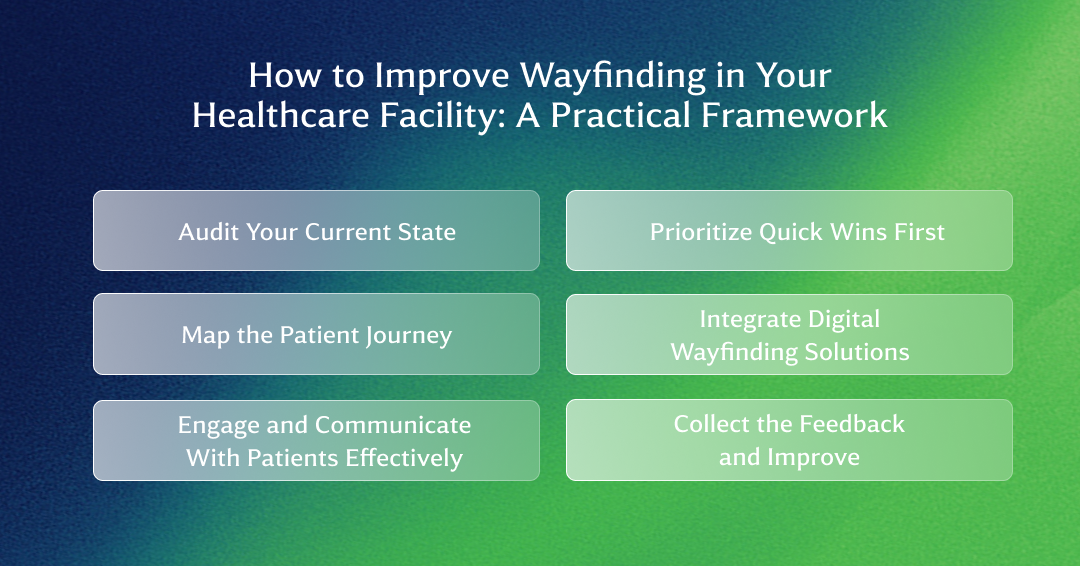
It's actually an ongoing process of finding and fixing gaps, and then checking back to see what changed. The framework below breaks that process into manageable steps.
Take a walk through your facility as a new visitor would. Start from the parking lot and see where exactly you have to stop and look around. For example, maybe the path leads to a T where the left turn circles back to the parking lot. You wouldn't know this as a new visitor. Note these moments down. They are your starting points.
Then talk to your staff. They know exactly where the system breaks down. They hear the same questions on repeat, which means those repeated questions point directly to a consistent failure. Add these gaps to the list from above.
Chart every decision point a patient encounters from arrival to their destination. At each point, ask one question: Does the patient know where to go next without needing to ask someone? If the answer is no, that point needs attention.
Some areas deserve priority ahead of others. Emergency entrances, oncology, radiology, and labor and delivery are high-anxiety destinations. Patients heading there are often stressed. The last thing they need is uncertainty about which direction to go. Fix those routes first.
Your patients are the most direct source of information about where navigation fails. Ask them for feedback about how easy it was to find a certain exam room or department. Run surveys and focus groups. They all surface problems that internal audits miss.
Pre-visit communication is also one of the quickest places to start. Sending patients specific directions alongside their appointment confirmation addresses navigation before they arrive. Most patients appreciate being told where to park, which entrance to use and what room to go to on what floor.
A full wayfinding overhaul takes time and budget. Start with the most obvious gaps like a hallway junction that's missing signage for all four routes or a confusing elevator bank with no guidance at ground level.
Fixing visible, specific problems immediately improves the experience for patients coming through the door today. These small wins also build internal momentum. Securing buy-in for larger investments is easier when leadership sees a real problem solved with measurable results
Once the foundational gaps are addressed, digital wayfinding is where you can make the most lasting improvements.
Interactive kiosks at main entrances give patients immediate guidance without requiring staff interaction. The provider's mobile app should include a facility map to guide people from their cars to their exact destination. Digital displays should update automatically when department locations or facility conditions change.
The key is integration. The best implementations pull appointment data so a patient who checks in digitally immediately receives a route to their destination, removing one more point of friction from an already stressful visit.
Once your digital wayfinding system is rolled out, turn back to measure what's happening. Track appointment punctuality rates before and after. Look at patient satisfaction data tied to facility experience and navigation. Ask staff whether the volume of directional questions has gone down. These metrics will confirm whether your digital changes had any effect.
Getting patients to the right place at the right time doesn’t end with signs and maps. It depends on how clearly you guide them through every step leading up to the visit.
WestCX Orchestrate enters here as a partner, not as a standalone tool, focused on improving the full patient experience. Our approach revolves around unifying communication, data, and workflows into one system so that patients aren’t left making guesses.
Instead of treating wayfinding as a separate problem, WestCX Orchestrate supports it through coordinated, AI-driven communication. Patients receive timely reminders, updates, and clear guidance tied to their appointments, helping them stay on track without needing to stop and ask for directions.
All this runs on the backs of our orchestration layers that ensure every message reaches the right patient at the right moment across channels like voice, SMS, and chat. That consistency is what turns a fragmented experience into one that feels connected from start to finish.
Schedule a demo to see how WestCX Orchestrate can help your patients move through your facility without adding more pressure on your team.

Ever received a call from your bank trying to sell you an additional product or service? That's cross-selling, a sales technique that aims to...

Call deflection is a way to resolve customer issues through self-service channels. It improves your operations and lowers your costs because...
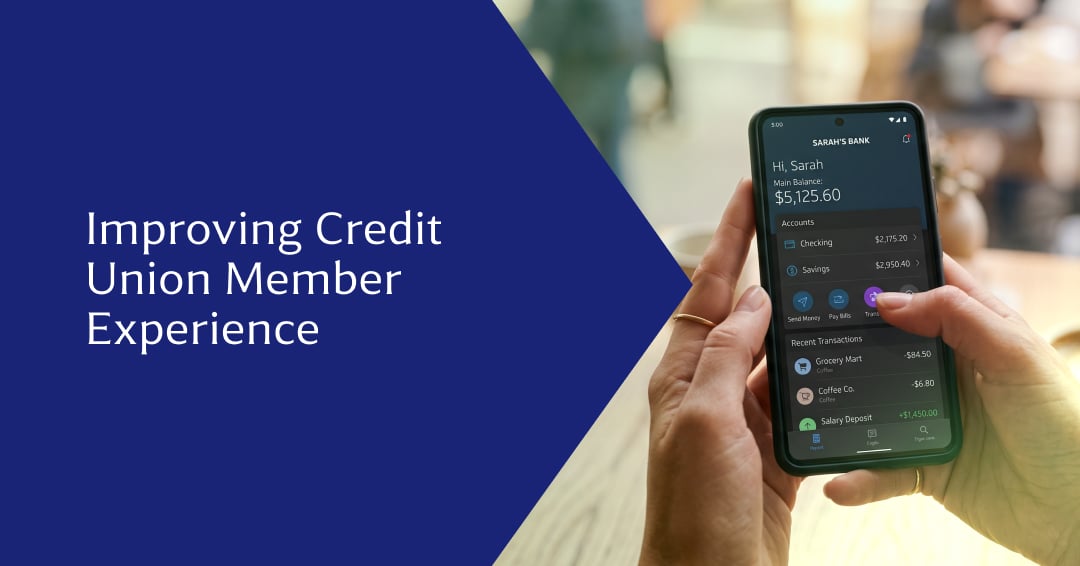
Credit unions usually think of customer service when someone asks about improving their member experience. That’s only one piece of the puzzle.
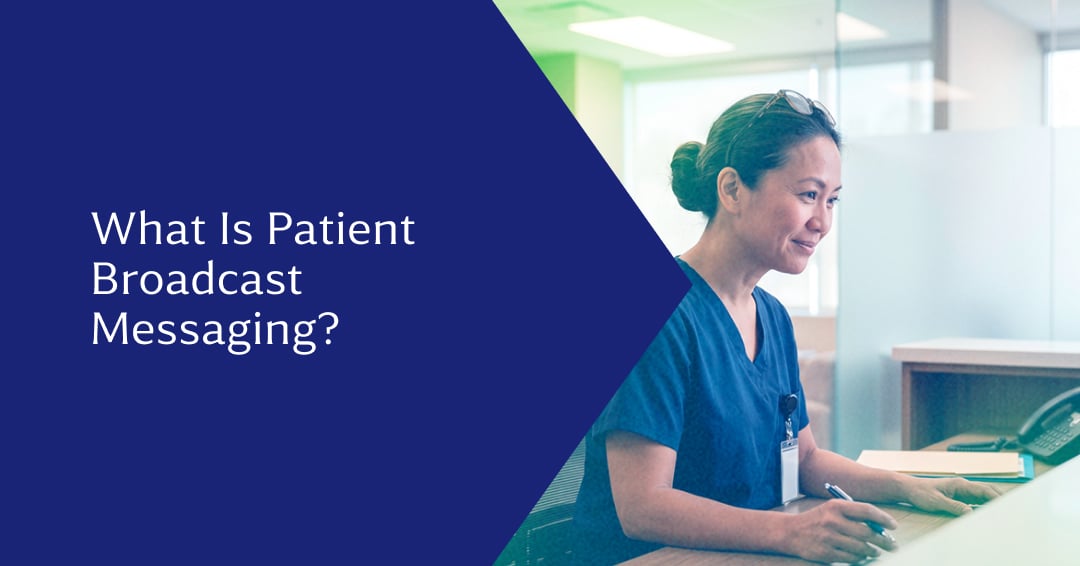
Healthcare providers are expected to keep every patient informed, but most of the day is spent just trying to keep up with communication. There are...

Regulated industries are already operating under heavy scrutiny. But data security concerns have only raised the stakes further.

Managing chronic conditions often feels like trying to keep track of a conversation that keeps getting interrupted. You have patients coming in for a...