Cross-Selling in Banking: Matching Account Signals to the Right Offer
Ever received a call from your bank trying to sell you an additional product or service? That's cross-selling, a sales technique that aims to...
9 min read

It's common for call centers to hire more agents or integrate self-service options to fix their high call volumes. Neither is a permanent solution because the calls aren't actually the problem. Your call center is dealing with high volumes because somewhere in your journey, customers are facing a dead end. So they have no other choice but to call the office. You can staff around that forever and still be unable to reduce call rates.
The real fix is connecting the journey itself. Your systems, channels, every data source needs to talk to each other. That ensures speedy resolutions and stops customers from needing a human agent in the loop all the time.
This blog breaks down why your call volume keeps climbing, what that actually costs you, and the specific fixes that bring it back down.
Increasing your headcount doesn't really fix a full queue. Every call is made for a reason, and that reason doesn't go away just because someone answered faster.
Without fixing the customer journey, adding more agents will still see your high call volumes return next month and then the month after. If you actually want to reduce call volumes, you have to find what's forcing the call in the first place. That’s often due to disconnected systems.
Each call has a backstory. Follow it far enough, and the call itself isn't really the source of the problem. It's just where the problem landed. The real source is usually what forced the customer to call in the first place.
There's no point to having self-service options if they're not effectively resolving problems. A customer who tries your website or chatbot but still can't resolve their issue has no choice but to call. It’s the most standard fallback for both new and old customers.
Hence, that call isn’t a new source of demand generation for your business, nor is it a preferred channel. An outdated, confusing website or a generic chatbot with no clean handoff just made the customer waste time before reaching an agent. Fix that gap, and you'll reduce call volumes faster than almost anything else you could try.
Your live agents need context on their screen whenever they pick up a call. If they have to make the caller wait while they switch between different tabs to pull information, they're effectively denting customer satisfaction.
In healthcare, for example, agents typically have to jump between the EHR, scheduling tool, phone and messaging platforms just to understand why the patient is calling. That workflow unnecessarily causes each call to run longer than necessary, and if the agent still fails to resolve the problem, the patient eventually calls back to add to your overall call volume.
A large volume of calls a call center receives daily are customers asking for simple updates. "What's my order status? Is my appointment confirmed? Was my payment accepted?" None of these calls need to happen. An automated update the moment something changes closes the loop before the customer even thinks to pick up the phone. However, most call centers treat the end of a call as the end of the journey, leaving the customer (or patient) to call back again and again for the same answer.
Using multiple channels means each one needs handoff protocols that actually help. A chatbot that can't reschedule an appointment should escalate to a human agent. If it keeps the customer trapped in a loop of generic responses instead, the customer might consider sending an email instead. But if they only receive an automated reply to call a number for all rescheduling purposes, the customer ends up exactly where the chatbot should have sent them in the first place, just three steps later and more frustrated.
Each handoff fails to solve the problem. They're instead working extra hard to push all customers into the phone funnel. Most customers won't even make it to the email stage. They'll pick up the phone the moment the chatbot fails them.
Quickly run through the list below. If some of these signs sound familiar, your call center is dealing with fragmented journeys that can't be fixed by simply increasing headcount.
Every action below is about closing a gap somewhere in the customer journey. We're effectively removing the reason the call had to be made instead of deflecting it to reduce call volumes on paper.
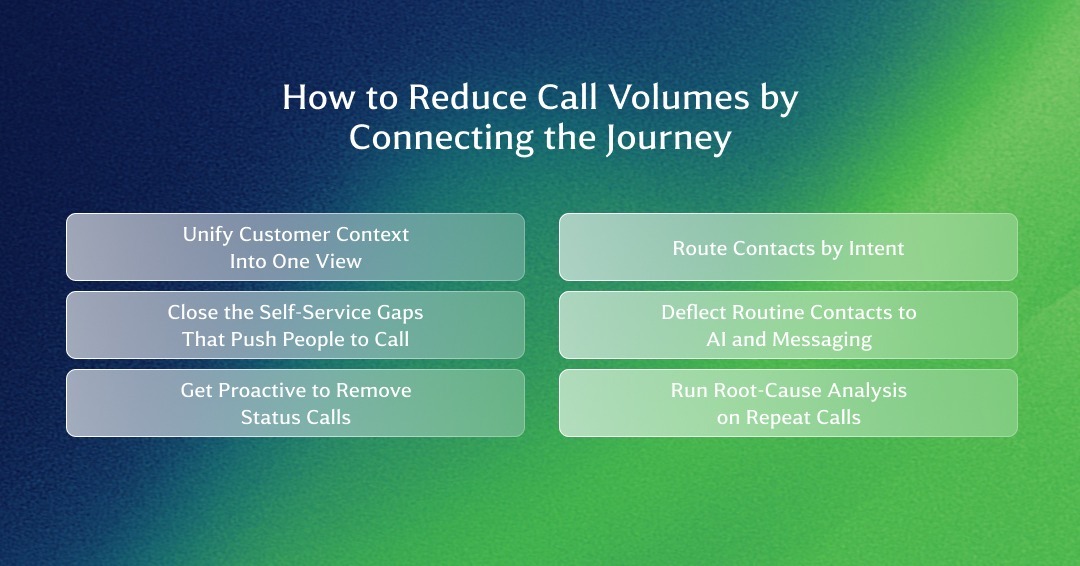
Give your live agents the full history of each customer. What products or services they're using right now? Did they reach out recently? If they did, what was their issue, and what channels did they use? What solutions have they already been given?
All this needs to be shown on a single screen, so that the agent can quickly scan through the information and move straight into resolution instead of asking the customer to repeat themselves.
This one move does more for resolution rates than anything else on this list, while directly reducing callback rates. Compare that to an agent clicking between five tabs while the customer explains, again, something the business already knows.
Audit every touchpoint (portal, chatbot, IVR menu) that's forcing customers to call the office. Then fix the workflow to finish self-service tasks within their own channels.
If a patient asks the chatbot to book an appointment or reschedule, make sure the chatbot is smart enough to actually do that without trapping them in an endless loop of generic responses or just falling back to a “call the office” failsafe.
If a request falls outside what it can handle, it should escalate to a human agent instead of stonewalling. The same standard applies to every other channel. The fewer steps it takes to finish a task in one channel, the fewer calls you get for no reason.
Your systems are already processing the customer's request in the background. Give them timely updates as that process moves, so they never have to call and ask if something's changed.
Text notifications are excellent for proactive engagement. They have the highest open and read rates of any channel. They also don't require the customer to install a separate app on their phone. That makes them the easiest update channel to scale, since the system can automatically send hundreds of reminders and alerts as soon as something changes without waiting on an agent to do it manually.
Routing needs to work on the first attempt. No customer wants to be connected to a department, only to be told to wait again while they're transferred to another.
Ignoring the intent behind each call just increases the odds of them hanging up or leaving without solving anything. It's why misrouting is a hidden callback driver that every call center needs to look for to reduce their call volumes.
A customer who lands in the wrong department is a callback waiting to happen. Your dashboard might log that under good handling rate, but the customer usually comes back with a fresh call an hour later.
Routine status checks, password resets, and FAQs don't require a live agent. These tasks are meant to be completed quickly without tying up a call center.
AI support assistants are significantly helpful in reducing this kind of routine call center volume. But only as long as they're reliable. What that means is giving the caller a clear option to reach a human agent whenever they want. An AI assistant that traps customers in a loop just delays the eventual callback while adding frustration on top.
The healthcare sector is a good example where AI assistants are being put to good use. Thousands of patients call in every week to book and confirm appointments, ask about referral and refill statuses, or check on lab results. None of that needs a nurse or someone from the front desk on the line. It just needs a system that can pull the right record and answer accurately.
Relying on your tech stack to stop repeat calls from happening at all is the wrong way to think about call volume reduction. Repeat calls are always going to happen. The smart move is auditing them to find out why.
If a fifth of your callbacks trace back to billing confusion, check how your statements are phrased or whether agents have access to the data they need to clear up the final tally on the call. Get that right, and you reduce call volume without adding headcount.
This is what separates real demand reduction from just shuffling the same contacts between channels. The callback log stops being a metric you report on and becomes a fix list for the rest of the journey.
It all comes down to how well the AI is integrated with all your connected systems. An AI assistant that can access the data it needs to understand full context is how your call center resolves calls at scale. An add-on AI solution is nothing more than just another layer for the call to pass through.
AI is quite effective at handling routine, repeat requests like general FAQs, booking, prior authorizations, password resets, etc. None of these calls are complicated, but they make up the large call volumes a call center sees every day. That simplicity is exactly why deflecting them works. You're not chasing any edge cases or high-value calls. The AI simply clears your queue of calls that don't require a human agent, leaving only the calls that do. If the goal is to reduce call volume without compromising CX, this is where you start.
An AI system is only as smart as the data being fed to it. Bolting it onto a stack where your CRM, billing, and other call center platforms don't talk to each other is just a model to see your containment rates fall apart.
The AI assistant will still resolve each call faster than any human agent, but from partial information. That means the caller is essentially receiving a faster wrong answer, and will call again. So you've just added a new channel instead of removing one.
Any vendor claiming its AI support assistants reduce call center volumes only holds when those assistants can read and write into the same systems the journey runs on. In healthcare, for example, any vendor pitching the "best AI platform to reduce patient call volumes" has to prove how deep that integration goes. The model is rarely the bottleneck. It’s often the data access that you need to confirm before signing anything.
The problem with increasing headcount is that your cost scales with volume. Every seasonal spike means another hiring and training cycle. Your business has to pay those additional staff expenses each month regardless of whether volume holds or keeps climbing.
In comparison, fixing the customer journey removes the reason for those additional hires entirely. Having an automated system that sends patients appointment reminders or a chatbot that does the same means you don't need more staff to keep track of each appointment in the EHR. So patients don't have to call to confirm their appointment statuses. That's a permanent solution while retaining the current staff strength.
So anchor your business case to what actually moves numbers: the cost incurred per call, the number of repeat calls for the same issue, and the average handle time. Someone calling three times about one prior authorization costs three times the handle time of a single resolved call. That wasted spend might not always appear in detail on a staffing spreadsheet, but it's usually the biggest lever you can pull to reduce the call rate without adding staff.
In summary, hiring more agents might solve your queue problem today, but fixing the disconnected systems behind it stops tomorrow's queues from filling up the same way.
Most engagement stacks treat high call volumes as a simple staffing math problem. Hold times climbing as queues back up? Hire more agents. It's the simplistic way of looking at it. You're basically betting that more staff will thin out the queues on their own.
WestCX starts from a different question: what if the customer never needed to call in the first place? We connect the outreach, the conversation, and everything that follows into one continuous flow that moves on its own. That's what makes us different from the generic solutions on the market. We don't manage fragmentation after it has already happened.
WestCX Orchestrate is the system that makes that journey possible. It uses AI functions to understand a caller's context, decide what they exactly need in the moment, and then act on it before the call ever gets placed. We're talking proactive engagement across voice, SMS, email, and other digital channels, timed to when customers are most likely to respond.
When someone does call, our AI agents already have their full history and journey context. So the system resolves scheduling, refills, and billing issues on the spot instead of starting from scratch. You can expect that efficiency to drop your routine call volumes by as much as 40%, with containment through automated voice reaching as high as 80%.
We've achieved the same results at scale, with a 15-25% improvement in experience and quality outcomes. WestCX Orchestrate isn't just a smarter way to fix a broken customer journey. It's an experienced one too, because we’ve built it on more than 2.3 billion interactions and 122 million consumers engaged.
If your call volume is still climbing no matter how many people you add, the problem is how many disconnected moments consumers still have to call about. Schedule a demo and allow WestCX Orchestrate to show you how to close those gaps.

Ever received a call from your bank trying to sell you an additional product or service? That's cross-selling, a sales technique that aims to...

Call deflection is a way to resolve customer issues through self-service channels. It improves your operations and lowers your costs because...
Credit unions usually think of customer service when someone asks about improving their member experience. That’s only one piece of the puzzle.

You’ve probably heard that pre-visit planning reduces no-shows and keeps your day running on time. It does but only when it’s done right.

In a way, customer service has always been built around supporting customers after they reach out. That approach creates unnecessary work and...

If you're running a call center for a healthcare organization, you've probably been asked to cut costs while handling higher patient volumes than...