Patient Journey Orchestration: From Real-Time Signals to Coordinated Care
Healthcare systems are a maze of appointments, referrals, eligibility checks, intake forms, reminders, and follow-ups. However, they're often...
13 min read
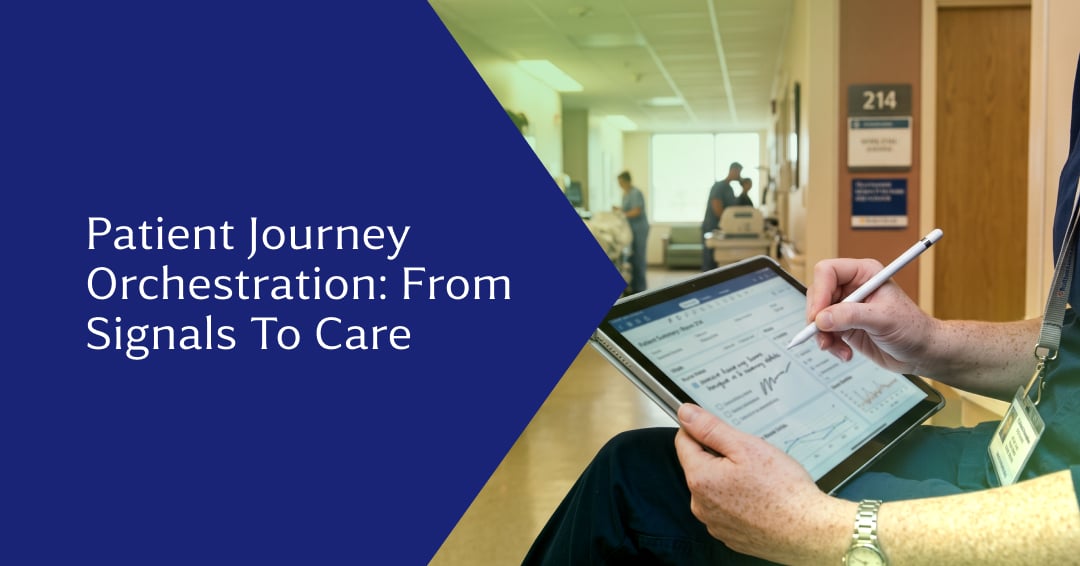
Healthcare systems are a maze of appointments, referrals, eligibility checks, intake forms, reminders, and follow-ups. However, they're often designed to function as separate events. So patients have to restart their journey every time they move from one point to the next, repeating themselves and leaving staff to chase information.
Patient journey orchestration connects those touchpoints so each step builds on the one before it. That keeps patients moving forward in their care journey without putting more work on already stretched staff.
Patient journey orchestration refers to a process that automatically coordinates every step a patient takes in their care journey.
It connects all your existing systems to access patient data in real time, trigger the best next action whenever a patient reaches a touchpoint or requires intervention. The idea is to keep patients moving forward in their care journey on their own with minimal manual effort.
That's different from care coordination, which is the clinical and administrative work itself. Think of journey orchestration as a layer beneath all that, monitoring how your staff and patients move and executing the next step before a person even has time to notice that something needs doing.
It's also not the same thing as patient engagement, even though the two are often lumped together. Engagement is the message the patient receives. Orchestration decides what to send, when, and why.
Take a patient as an example who was just logged into the EHR for an appointment tomorrow. Journey orchestration sees that and determines a reminder should be sent to the patient. Engagement is ensuring the reminder is personalized and honors the patient's channel preferences.
Care coordination is the staff work that follows if the patient needs to reschedule or has questions, even though that can also be automated via self-service to feed back into the orchestrated journey.
The retail and banking sectors follow a rather simpler and much more transactional goal when it comes to orchestrating their customer journeys. They're focused on getting someone to buy a product or open an account, and then keep them engaged so that they return to spend more. It's a really short and linear journey.
Healthcare follows the same event-driven logic as customer journey orchestration, but the patient journey is anything but short or linear. Each care episode can stretch over weeks or even months and quickly branch into multiple sub-journeys.
For example, a patient who schedules surgery doesn’t simply arrive on a given date. Their journey involves multiple touchpoints like preparation instructions, lab and medication reminders, appointment rescheduling, post-discharge check-ins and follow-ups, etc.
Healthcare data is also far more sensitive and highly regulated. Every message and trigger requires the patient's consent and HIPAA's blessing. While banking and finance see similar strict regulatory requirements, the difference is that patient journeys must also account for clinical context. A reminder that arrives too late or without the right information can affect patient outcomes, not just customer experience.
Additionally, the most valuable metric for a healthcare organization isn't conversion or revenue. Retail and banking optimize for conversions and revenue. Healthcare certainly cares about those too, but the bigger measure of success is whether patients show up for appointments, adhere to treatment plans, and follow up.
Coordinating care sounds simple until you trace how exactly a patient moves through a healthcare environment. Records are stored in different systems that don't share information. You have different teams optimizing for their own systems, so there's nobody who can actually see the full picture of where the patient stands.
Fragmented settings and records - A patient who sees a primary care doctor and then a specialist should be treated as a single care episode. However, as it often happens, those visits are recorded in two separate EHRs. Each event further branches out by storing lab tests separately as well, so the next provider has no idea what happened before. They have no choice but to ask the patient to repeat their history or do the same labs again.
Handoffs that lose patients - Discharge is one of the riskiest points in the patient journey. Patients are sent home with generic, templated instructions and often little support for what comes next. Follow-ups may be delayed or never happen, so by the time a patient returns for care, their condition may have become much worse.
Poor channel preferences and health literacy - Not every patient wants a phone call. Some may prefer a text, while others might only be available to answer calls at night. The message itself matters too. Vague instructions or complicated medical jargon can leave patients unsure about what to do next. A billing statement without a clear breakdown can make a patient hesitate to pay. Orchestrating the patient journey means accounting for these differences instead of assuming one channel or message works for everyone.
The clearest way to see orchestration at work is to just follow any single patient through one care episode. We'll use a scheduled surgery as an example because it involves multiple touchpoints and plenty of ways to go wrong. That should make it easy to see what orchestration actually does at each stage of the journey.
The journey starts in the EHR, where an order for surgery is logged or a clinical note indicates that the patient has been recommended for surgery. Either event can trigger the system to initiate outreach through the patient's preferred channels, inviting them to book their visit.
If it’s a virtual assistant, the patient will be guided through available dates and times. If the outreach message contained a direct link to an online self-scheduler, the patient can simply pick a slot and book it themselves.
Once a slot is confirmed, the system writes back to the EHR in real time without requiring any of your staff to re-enter the booking details by hand.
Based on the healthcare organization's predefined medical policies, the orchestration engine moves on to the intake process. The patient is automatically contacted again and guided through everything they need to do before the day of surgery.
They'll be asked to provide consent, fill out digital forms, verify their insurance, and complete any other required pre-visit steps. Depending on the procedure, they'll also receive preparation instructions, such as which medications to take or pause and whether they need to fast beforehand.
Everything depends on the consent. If the patient still hasn't given their consent three days out, the system resends the request before triggering a manual outreach from a staff member. Hence, the patient shows up ready on the day of surgery and is focused solely on their health rather than worrying about which forms to fill out.
That convenience applies to the staff as well, as most of their administrative work, such as collecting and verifying information, has already been done.
The days between the booking and surgery dates determine when and how often the system sends reminders. The goal is to keep patients informed without bombarding them with messages every day.
As the surgery date gets closer, those reminders become more practical, including logistical details such as where to park, which entrance to use, and the quickest route to the right department.
When the patient does arrive, they already know where to go and what to expect. That helps reduce most anxiety that patients carry with themselves to their provider.
This is the literal stage that patient journey orchestration has been setting up since the start. When the patient reports to the front desk, they're quickly checked in because the staff doesn't have to spend time asking questions the digital intake form has already answered. The patient also doesn't have to repeat their medical history or explain why they're there.
Since orchestration keeps all systems in sync, you could even say that the staff is more or less expecting the patient to show up. The patient gives their name or a simple ID, and the staff confirms their details in the system, moving the patient forward within minutes for the care that brought them there in the first place.
Discharge triggers the next stage of the orchestrated journey. While the patient is sent home with clear verbal and written instructions, the system also reaches out to confirm that they’re following their recovery plan.
A virtual assistant is highly convenient here because it can keep up with patients at scale. It doesn’t matter how many patients have been discharged this month; the system initiates follow-ups for each one of them as soon as their discharge status shows up in the EHR.
Patients can confirm they're taking the right medication and dosage, clear any confusion about the recovery instructions, and more without having to call the office.
Orchestration also knows that not every patient needs the same follow-up schedule. Since the system already has access to relevant patient data, it can tailor post-discharge outreach based on the procedure and the patient's needs.
So every message gives the patient something they can actually act on. That works wonders for care outcomes compared to a generic support message sent to everyone.
Those post-discharge check-ins don't end when the interaction does. Patients who report experiencing a new symptom are immediately prompted to schedule an appointment with their provider during the same interaction. They don't have to call the office later, sit in a queue, and wait for an agent to eventually find an available slot. Instead, they're sent straight back to the appointment stage, where the orchestration journey starts again based on their new needs.
In case the patient's health is critical, as in the case of chronic patients, the issue is automatically escalated for priority attention. That’s because catching a complication on day two instead of day five is often the difference between a quick consult and a full readmission.
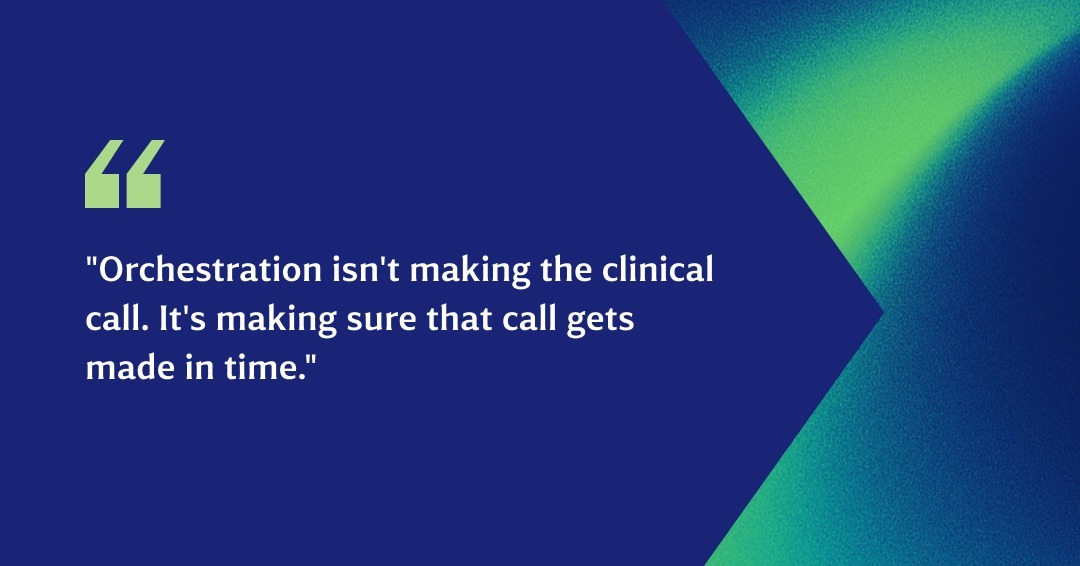
Do note that orchestration isn't making the clinical call here. It's making sure that call gets made in time.
The financial stage is one that either breaks or makes a patient's healthcare experience. Modern digital intakes are now smart enough to give patients a rough cost estimate upfront, so that they're not surprised by the number they see in the final bill.
Patients are also not messaged to simply pay up. The message contains the complete statement along with multiple payment options across whatever channel suits them. The virtual assistant is also available to answer any questions, including a direct support line to a billing specialist.
If the patient still hasn't paid in two to three days, the system sends a reminder and then another after a few more days before escalating the case for manual outreach.
It's also important to understand here that all patients don't receive the same nudge. Patient journey orchestration accounts for patients who've already viewed their bills. They're sent fewer nudges than those who haven't opened it. In the latter case, the system falls to a different channel until the message gets through.
It’s a small detail but one that’s the difference between a billing process that feels like it's paying attention and one that's just creating noise.
Healthcare leaders need more than just educational content about how journey orchestration works. They'll only invest if they know for sure that orchestration delivers measurable results.
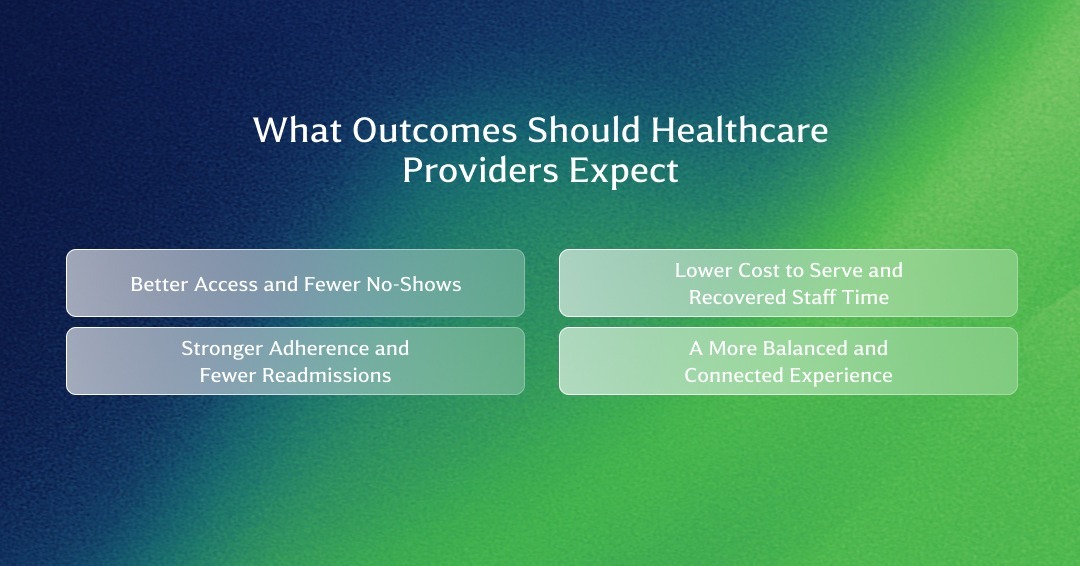
Automated appointment bookings and reminders enable healthcare organizations to manage full calendars without pulling their staff from more important matters.
That's faster access to care, which every patient demands from their provider. They'll actually show up if it takes only a couple of taps to reschedule. That alone recovers slots that would otherwise sit empty.
Timely and consistent outreach helps patients stay on track. Providers don't have to hope for patients to reach out when their condition worsens. Orchestration ensures that warning signs are caught early instead of becoming a full readmission that costs both patients and providers far more.
This is probably the clearest sign that orchestration is working. Your staff gets to actually focus on patients that genuinely need their help because they're not bogged down by routine calls. Not having to answer the same dozen questions all day long means they're not burning out, and instead become more productive, something that patients themselves feel during interactions.
Hence, retention rates go up and churn down. Healthcare organizations save in hiring and training costs, while having more flexibility to handle seasonal volume spikes in patient volume without constantly adding headcount.
The key to patient engagement is reaching them through the channels they actually use and communicating in a way that's actionable and helpful.
A Spanish patient will always respond better to messages in their native tongue. An older patient may prefer a phone call but a younger patient may be more comfortable with email. These might seem like small details, but they make it easier for patients to follow their care plans and take an active role in their own health.
Orchestration brings all these preferences into the journey itself. It adapts outreach for each patient based on their historical data and present needs instead of bundling everyone into an online portal. It’s not the patient’s job to figure out what their next steps are. The organization meets the patient where they are and guides them forward from there.
Orchestration only works if it can see the whole patient journey. A system that can only read EHR updates and not the billing prompts won't know if the patient called yesterday about a billing dispute. Even if the EHR-led system works well in this example, it's doing so in isolation and that's not what an orchestrated journey is about.
Below, we'll discuss the four core pillars that support a complete patient journey orchestration. If even one of them is missing, you're just using a standard reminder or appointment tool with the orchestration label.
Every orchestrated journey starts by pulling patient data from your connected systems. That's commonly the EHR, patient portal, billing platform, patient management systems, and the contact center. Bringing all that information together sounds simple enough, but the data in those systems rarely lines up perfectly.
Consider a patient who registered under her maiden name at the front desk but then uses her married name in the patient portal. Any system would pick that up as two different patients and send messages to both profiles separately.
An effective orchestration platform, however, uses data from all available sources to match patient identities before sending any message out. You can't expect every patient to enter their information perfectly every time. But you can build a system that reconciles those differences and keeps the journey connected.
Your calendar doesn't define orchestration. It's your events - a missed appointment or a discharge that trigger the system to move a patient forward in their journey in that exact moment.
A missed appointment should trigger outreach that same day while the patient still remembers why they booked that appointment. Follow-up sequences that are triggered within minutes of a discharge help instead of running check-ins after a weekly batch update.
Those actions within the moments are what orchestration is all about. Otherwise, you're just running a standard, slower reminder tool.
Once the system knows an event happened and has a full picture of the patient, it still has to decide what to do about it. That's where rules and models do the actual work. A patient who's overdue for a screening and already ignored two calls needs something different than a patient who just missed their first reminder.
The decisioning layer looks at where someone actually is in their journey and what they've already tried. It only then picks whatever's most likely to move them forward. If this part fails, every patient gets the same generic nudge regardless of where they stand.
Whatever action the system decides to take next has to reach the patient through their preferred channel. That ensures the patient actually responds in time. Their response then also has to make it back into the record to sync with other systems.
Say a patient confirms an appointment by text but that confirmation never reaches the scheduling system. Hence, a staff member calls to confirm but now the patient's answering the same question twice.
Automatic updates back to the EHR prevent that by having everyone work off the same information. Not having duplicate events also ensures cleaner data all around.
Many healthcare providers still rely on one of the most standard (and outdated) outreach strategies around. Maybe it's familiarity, or just that they're hesitant to overhaul the tech stack they've spent years building. Either way, their entire model runs solely on fixed reminders.
Their system will send a text message three or four days before the appointment. The staff will then follow up with a phone call if the patient doesn't confirm. The problem is that this model only knows how to handle one thing at a time. There's no logic to decide what comes next if something unexpected happens.
AI assistants completely change this model. It's not limited to sending a single message. The assistant can confirm an appointment and check eligibility against the payer on file within the same conversation.
That's possible because modern AI assistants can carry context from one step to the next. A patient who calls to reschedule doesn't get pushed out of the automated workflow or told to start over with a staff member. The assistant can handle the rescheduling and update the record without anyone on staff having to step in.
However, that doesn't mean patients are stuck in an AI workflow loop. The system knows its limits. If a patient's problem is deemed critical or the conversation includes something ambiguous or too complicated for it to address, the call gets escalated to a human agent.
So the assistant handles the repeatable steps in a patient's journey, while the staff handles the exceptions and the judgment calls. That division is what keeps this patient journey trustworthy instead of just fast.
Orchestrating journeys relies heavily on automation, but automation alone isn't orchestration. Both are meant to solve different problems, but most healthcare organizations often treat them as the same thing.
Automation follows a fixed rule to complete a fixed task. For example, sending a reminder two days after the booking. The system doesn't know what happened before the booking and doesn't take any further steps regardless of what happens after the reminder is sent.
Orchestration decides the next best action for a patient based on their current situation. What do they need right now and why? How will it help them move forward? It carries that context from one step to the next.
Taking the same example as above, an orchestrated system will actually skip sending a reminder if the patient has already confirmed. It will also escalate the patient to a human agent if they miss two reminders in a row.
Bolting an AI assistant onto an automated reminder tool doesn't create orchestration. The AI needs access to all existing systems for a unified view. It's only then that it can monitor the patient journey, catch event triggers, and decide what to do next.
That unified view, however, needs to follow compliance standards. Simply connecting all your systems isn't enough for a well-designed orchestrated journey. HIPAA, TCPA, and other regulatory bodies have different rules for different channels. A patient might give their consent for texts and opt out of calls. Your AI system needs to account for those preferences to stay compliant for every interaction.
Every action the system takes also needs a clear audit trail. What message was sent and via which channel? What trigger was involved and what that message achieved? This gives you proof for what's working and what's not. That's what lets a compliance team answer questions about a single interaction months later instead of trying to piece it back together from memory.
Most orchestration rollouts try to map the entire patient journey before the system has shown it can fix anything. It's better to start with one point where the journey visibly breaks down. Fix that first. Once patients and care teams both feel the difference, expand from there.
No-shows are the perfect place to start. Everyone from the front desk to the CFO already knows that metric by heart, and every point you shave off it pays for itself immediately. Win there first, and you've bought yourself the credibility to go after everything else.
WestCX is built around that exact logic. Our AI-driven communication and engagement platform has helped health systems cut no-shows by 35%, while containing 65% of inbound calls without an agent, saving $5,000+ per FTE annually, and retaining $9.8M+ in revenue per health system.
None of that happens by accident. WestCX Orchestrate is what's deciding, in real time, what each patient needs next. The same AI-driven intelligence that reminds someone about tomorrow's appointment is also resolving billing calls, closing preventive care gaps, and coordinating post-visit follow-up, without any of your staff members lifting a finger.
Once that first no-show journey earns its keep, you can move on to another touchpoint. It's the same engine, pointed at the next problem like inbound scheduling, billing and copay collection, or chronic care outreach. All that runs on the same WestCX Orchestrate tech you already have live. Your IT team doesn't need to be pulled in to rebuild your stack.
If your engagement stack feels like a pile of tools that don't talk to each other, schedule a demo with WestCX Orchestrate and let us find the first journey worth fixing.
Healthcare systems are a maze of appointments, referrals, eligibility checks, intake forms, reminders, and follow-ups. However, they're often...

Healthcare contact centers handle more than just scheduling and billing questions now. They're daily fielding prior authorization delays and...
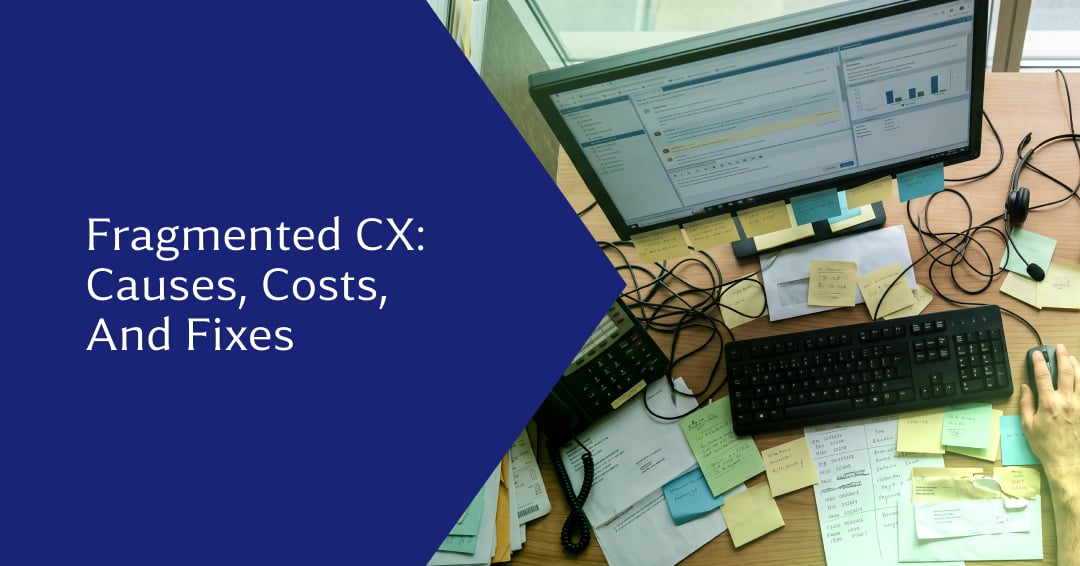
Fragmented customer experience doesn't just happen out of the blue. Organizations make it possible, one disconnected system at a time. They're...