Reduce Healthcare Call Center Costs Without Compromising Care
If you're running a call center for a healthcare organization, you've probably been asked to cut costs while handling higher patient volumes than...
11 min read
.png)
Healthcare organizations using manual scheduling face a significant amount of operational strain. Their front desk gets buried in routine calls and chasing information instead of focusing on the patients right in front of them. That chaos spills over into the patient experience. Patients struggle to get timely care and many end up turning to another provider that makes scheduling faster and easier.
Scheduling automation addresses that imbalance by coordinating communication across the entire patient journey. It reduces no-shows and fills the care gaps left behind by disengagement. You end up creating a more reliable path to care for both patients and staff.
Most people assume that "scheduling automation" is a system that sends a confirmation text after someone books. Either that or it automatically routes calls based on a script. That's just a rule-based system designed to follow a fixed logic. It only does what it's told to.
AI-driven automation works differently. It actually learns and adapts with every interaction. It also uses historical data to make predictions that loop back to help providers make informed decisions before a problem occurs.
That's the core difference. Rule-based systems react but AI systems anticipate.
In a scheduling context, a rule-based system will send every patient the same reminder two days before their visit. An AI system will look at a patient's history, identify them as high-risk for a no-show, and send a more personalized message. Outreach also happens much earlier so that care teams have time to intervene. The whole scheduling process adjusts based on what the data says about that specific patient.
That's the kind of system we're specifically highlighting in this blog, the one that learns from patient behavior to ensure no slots are left empty.
Healthcare organizations are constantly dealing with pressure from every direction at once. Patient volumes are up. Staffing is unstable. Margins are even tighter. To top that off, patients now compare their booking experience to how they book a flight ticket or a dinner reservation.
All that ties back to your scheduling. The only way to keep up with those expectations is to integrate AI. Here's what's actually driving the urgency for that right now.
No-shows have always been a problem. It alone costs the U.S. healthcare system around $150 billion every year. That's a significant amount of lost revenue from empty slots and wasted clinical time. Not to mention the patients who needed care but never received it. They usually end up back in the system once their condition worsens. So what could've been a simple visit turns into a far more expensive problem.
No-shows can also prove more costly than normal based on specialty. Primary care tends to see lower rates but that adds up quickly due to higher patient volumes and thinner margins. On the other hand, certain surgical specialties like dermatology see lighter schedules but their no-shows can climb 30% or higher to lose even more revenue per slot in comparison.
Late cancellations compound the problem. A cancellation with two hours' notice rarely gets backfilled. The patient who needed that slot didn't get it and the staff spent time preparing for a visit that never happened.
Now picture a healthcare organization operating multiple locations. Imagine how big a problem no-shows would be for them. Fixing scheduling for one location is hard enough but four or five? The only way around that is with automation. AI-driven scheduling actually reduces no-shows by 30%. It gives your outreach precision that can’t be matched by a generic reminder spam.
Every minute spent on routine scheduling is a minute that could be spent on higher-value interactions. That amounts to a lot of time in manual scheduling. You have staff fielding constant calls, switching between spreadsheets and screens to find open slots, chasing down availability information, etc.
Patients usually don't like to wait through all that. They'll either hang up or find another provider with a faster scheduling process. That's more pressure on the front desk to make each call count. That's also what burns out your staff faster.
You’re forcing staff to be consumed by tasks that a well-built system can handle automatically. Hiring more people just compounds the problem even more. You’re just scaling inefficiency to make your turnover even more expensive. The cost to replace a single nurse alone can set you back around $46,000 on average. That includes recruiting, training, and covering gaps in the meantime — those costs start stacking up into the millions.
The ability to schedule appointments online or from a mobile device is now important for around 90% of patients. Many, especially younger segments, will actually consider switching providers if they can't book online. This is because patients expect the same on-demand digital experience from healthcare that they already get everywhere else in their daily lives.
However, it's still common for patients to wait weeks for an appointment. That gap is a retention and acquisition problem, both of which can be addressed by AI-driven appointment scheduling. Patients are empowered to book visits on their own time and through their preferred channel. They don't have to wait for business hours or sit on hold. That also means fewer inbound calls, which solves your burnout problem.
Start with no-shows. Every missed appointment costs $150-200 on average. Considering a mid-sized clinic is facing around 20 no-shows per week, its losses cross $200,000 easily per year in revenue before accounting for other downstream expenses.
Now add staff hours. The average cost per inbound scheduling call in a healthcare call center sits at around $4.90, and patients make an average of 3.5 calls per scheduling need. That's nearly $17 in staff time for what could be a minute self-service interaction.
Then factor in patient attrition. As more healthcare organizations adopt automated scheduling tools, those relying on outdated manual systems risk losing patients to more accessible providers. Each patient who leaves takes a lifetime of visits with them.
On the ROI side, providers that automate their scheduling process typically recover their investment within a year. Their net ROI stands somewhere between 300-400%.
Small practices can usually get by with the front desk handling scheduling because patient volume stays manageable. But larger healthcare systems can’t just scale that up by hiring more staff. They’re juggling high volumes, multiple providers and specialties, different insurance rules, and often several locations at once.
Everything needs to align at the same time or else scheduling starts to fall apart. Here's what healthcare organizations are actually dealing with:
Demand keeps outpacing capacity - the number of patients is increasing but they're all competing for fewer slots. Many also need access to multiple specialties or different services within the same facility. That adds another layer of coordination and complexity. Even a small scheduling mistake here can snowball into long wait times.
Staff burnout is still a real operational constraint — both physicians and front desk teams are already stretched thin as it is. Pushing for longer hours usually just leads to higher churn and more staffing gaps down the line.
However, reducing hours or when a staffer calls out creates an even bigger scheduling ripple that affects the entire patient panel.
Manual scheduling creates errors and delays - this also ties in with our previous burnout point. An overwhelmed staff member is prone to making mistakes. They'll double-book patients or enter incorrect information that impacts patient experience.
Most manual scheduling processes are also bloated. The front desk has to confirm insurance, ask for details, check labs, enter any notes, and then notify the patient separately. Each step just increases the chance for errors.
No-shows and cancellations leak revenue - empty slots often remain empty because the front desk can't manage waitlists alongside their other duties. Contacting each patient and confirming their new appointment just requires too much work.
Patient expectations have also shifted - they now expect the same experience they get in their favorite store or subscription service. That includes same-day booking, digital options, mobile support, fast responses, accessibility features, etc.
Legacy scheduling systems can’t adapt - older tools were designed for static rules. They’re not meant to automatically pull data from your other systems or adjust based on patient preferences. Staff end up manually bridging every gap.
Multi-location health systems - managing availability and templates across different locations adds another challenge. Coordinating five or 10 providers with different EHRs quickly becomes an operational nightmare.
Not every platform is built to handle the scheduling volume and complexity of a large health system. The features below form a baseline for what a solid system should offer.
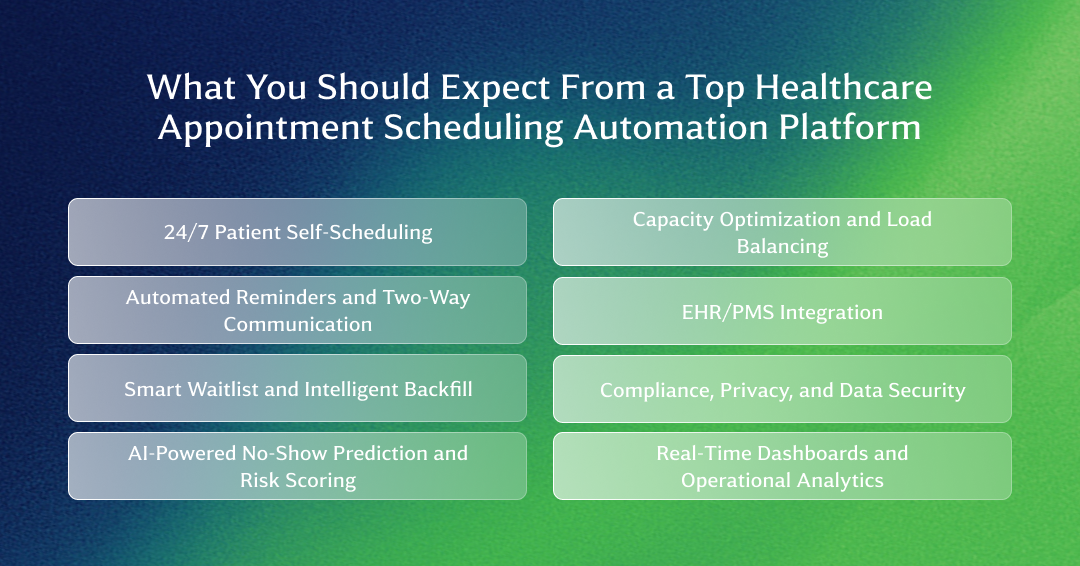
Patients should be able to book, cancel, or reschedule without calling the office. They shouldn't be bound to business hours or a single device. It’s worth noting here that many patients prefer mobiles for self-service. A phone chatbot still gets the job done but that experience may feel limited for patients juggling appointments on the go.
A well-designed self-scheduling tool also shows available slots in real time. Patients can actually choose slots that suit them, making it far more likely that they'll show up.
The freedom and convenience for patients to manage their bookings on their own terms significantly cuts inbound call volume for your staff. That's a major benefit of a modern scheduling solution.
A reminder that patients can only read solves half the problem. The other half is giving patients a direct way to confirm or cancel through the same message. That option alone reduces no-shows because patients can easily reschedule from the same interaction without starting a separate call or sending another text.
Doing this manually makes two-way communication difficult at scale. It increases call volume and adds unnecessary burden on the front desk. Automated reminders solve this by keeping the loop closed regardless of the channel. Patients receive the reminder, respond instantly, and the system updates without adding operational load.
A staff member shouldn't have to manually call through a list every time someone cancels. Smart waitlist management tracks cancellations as they happen. The system automatically reaches out to eligible patients on the waitlist and confirms them for the empty slots without involving the front desk in any way.
This matters most for large hospital systems and specialty departments where appointment slots are genuinely scarce. Every filled cancellation is revenue that would otherwise disappear.
AI can identify which patients need additional outreach. The system analyzes historical attendance patterns, appointment types, and other behavioral data to assign a risk score.
Those who score high are most likely to miss their upcoming appointment. These patients are automatically targeted for additional reminders and follow-up calls. That also includes a manual phone call by the front desk. Your staff still moves outcomes without spending time on patients who don't need additional contact.
Automating appointment scheduling across multiple locations focuses more on routing patients than just filling empty slots. A platform that understands capacity optimization can balance appointment loads across providers and sites. It can surface availability at less-utilized locations and prevent any one clinic from becoming overloaded while others sit at low capacity.
This is an extremely important feature for healthcare providers managing multiple locations. The coordination here to keep a balanced footfall ensures faster patient access by showing patients options they may not have known were available.
A scheduling platform that doesn't sync with your EHR or PMS creates more problems than it solves. You need information to flow both ways. New appointment bookings should automatically populate the EHR, while changes in provider availability or clinical templates should update the scheduling system without manual entry.
This integration also needs to handle multi-system environments. Many organizations run more than one EHR across their locations. The platform needs to support that complexity without requiring staff to manage data in two places.
Scheduling data is protected health information. Every message you send and every patient profile you access needs to meet HIPAA requirements. That also goes for every tool you've integrated to automate your scheduling workflows.
End-to-end encrypted communication is non-negotiable for healthcare providers. PHI also needs to be secured during transit and in storage. You also have access controls and data trails to ensure clear audits.
Not to forget, a signed BAA from the vendor is equally important. All these form the foundation of your automated scheduling system.
A good scheduling platform shows you what’s happening and why. That’s the real difference from basic online or automated schedulers, which are mostly built to fill slots.
A proper platform gives you a live dashboard. You can see how no-show rates are trending across locations and appointment types, or how many patients are actually adopting self-scheduling. That's alongside workload distribution and other metrics.
This visibility helps you improve your automation rules and make better staffing decisions. You can identify which providers are overbooked or which time slots consistently go unfilled. Your team can also connect the dots to understand what patterns are driving cancellations or delays.
The biggest mistake health systems make when automating their scheduling is layering it onto a broken process. You need to account for your existing workflows and the realities of scaling across multiple locations.
Start by mapping out exactly how scheduling works today before changing anything tomorrow. Document where most of your appointment requests are coming from and how staff are handling them. Note which EHR templates are in use and how many inbound calls the team takes per day.
It's best to involve your staff during audits. They'll tell you exactly where friction points lie and what tasks take up the most of their time.
This mapping process gives you a factual baseline to work on instead of assumptions. The kind of details you see here matters during implementation.
Now that you know what's broken, move on to defining what success should look like. Tie your automation goals to realistic KPIs like no-show rate reduction, call volume decrease, self-scheduling adoption rate, staff time saved per day, etc.
Then build your evaluation criteria from those targets. Does the scheduling platform integrate with your EHR? Does it support multi-location scheduling rules? Can it handle patient communication in the languages your patient population actually speaks? Does it meet HIPAA requirements across every communication channel? These questions filter out tools that demo well but don't fit your real environment.
Always start small when rolling out a new system. Pick one department or patient group that has a clearly measurable problem. Maybe a specific specialist in your organization has a high volume of manual scheduling work that's causing booking errors. Note those numbers down because it’s the only way you’ll be able to tell later if your new automated scheduler made a difference.
It's good to run the pilot for at least 2-3 months before assessing the data. Did something improve? Can that be further improved? What else needs to be changed for that? These questions need to be answered honestly before expanding the pilot program.
Additionally, when scaling to additional sites, document every workflow decision and configuration choice that drove success. Standardization is what prevents each new location from becoming a fresh implementation project.
Staff resistance to new tools is common. They either don't trust the platform or stick to the old manual process out of habit. The way around that is to prepare your managers before you go live. Give them role-specific training they can pass on to their teams.
Show your front desk exactly how an automated scheduler makes their job easier and faster. That's better than just telling them. Run workshops so staff can actually use the system in a low-pressure setting and get comfortable before they’re expected to rely on it during real patient interactions.
Make it part of your healthcare process to review your KPIs at least once a month. You're looking for patterns like appointment types that are still showing high no-show rates or patient groups that are still not using self-scheduling. Maybe one location is running below expected utilization even though others are using the same automation rules.
Use those findings to adjust your scheduling system and identify where manual work is still happening when it shouldn't be. This is a cycle that needs to repeat. Your new automation system won't reach its full potential on day one. It gets better as you learn from the data and close the remaining gaps.
Healthcare organizations can make a decision today: continue managing fragmented interactions or start orchestrating outcomes. The difference shows up in how disconnected systems and manual handoffs keep creating scheduling gaps your staff has to chase and patients have to work around.
You don’t fix that by adding more reminders or touchpoints. You fix it by connecting every outreach into a single, coordinated flow. WestCX does exactly that through its orchestration layers. We don't treat scheduling as a single action. Our automation manages the entire journey as a unified system.
That means every point of contact automatically guides patients to the next step based on timing, context, and behavior. So a missed confirmation can lead to a reschedule prompt or a completed booking can trigger tailored reminders.
The AI, furthermore, continuously learns and improves these flows in real time based on past interactions. That’s how organizations see 10-15% fewer no-shows and cancellations while improving reminder recall success by up to 30% with WestCX Orchestrate.
Scheduling stops being a series of disconnected tasks and becomes a coordinated system across multiple locations that keeps patients moving toward care without adding pressure on staff.
Schedule a demo right now and explore how WestCX Orchestrate can reshape your scheduling operations.
If you're running a call center for a healthcare organization, you've probably been asked to cut costs while handling higher patient volumes than...

It's not hard to convince banks that customer experience matters. Every financial institution already knows it does. The harder challenge is...

In a way, customer service has always been built around supporting customers after they reach out. That approach creates unnecessary work and...

Your full schedule doesn’t mean much if it doesn’t follow through. Patients will always cancel at the last minute and appointments easily run late....

Scheduling often looks simple on the surface until it starts breaking down. Your troubles might start with double bookings that lead to longer hold...

On paper, Epic gives health systems everything they need to manage patient care. In practice, keeping patients engaged still takes more than what’s...