Credit Union Fraud Prevention: Importance of Early Detection and Alerts
Credit unions spent the last decade making access faster. Members can now open online accounts within minutes, do instant transfers, and land...
9 min read
Credit unions spent the last decade making access faster. Members can now open online accounts within minutes, do instant transfers, and land deposits from mobile apps while on the move.
Fraudsters, however, have also been busy using those same access channels to fool both members and fraud prevention teams. The same digitization that shrank wait times also shrank the window where fraud gets noticed before it goes through.
Hence, the one-layer security pipeline where someone could verify themselves with a simple password no longer works. Fraud prevention in credit unions now demands a secure and closed loop, where a signal appears and the member is contacted immediately to confirm or dispute a charge.
This brings the whole program back to timing: how quickly the credit union can turn a suspicious flag into a confirmed outcome. The longer that takes, the more time fraud has to become a real loss.
Consumer fraud losses went from $12.5 billion in 2024 to $15.9 billion in 2025, as per the FTC's recent testimony before the Joint Economic Committee. That figure encompasses all types of consumer fraud in the U.S. and is not limited to credit union fraud, but it highlights the enormous scale of the problems faced by credit unions.
What those numbers don't show is how fraudsters don't scale down their efforts for a smaller institution. A credit union with 40,000 members and a bank with 10 million accounts get targeted with the same level and volume of payment scams. The only thing smaller is the credit union's fraud team, which is typically two or three people covering tasks that would normally require two or three hundred.
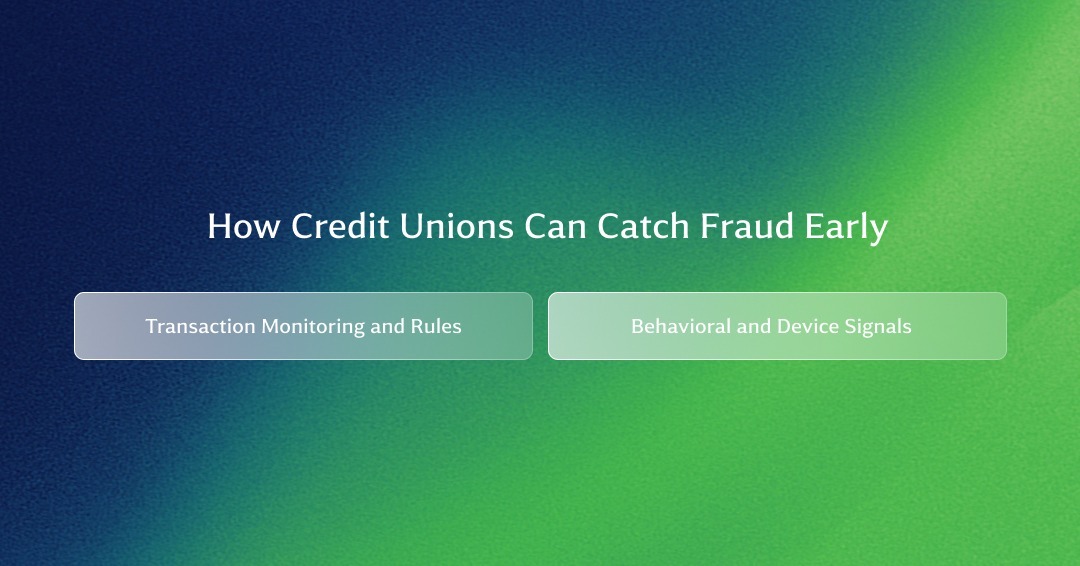
Preventing fraud in credit unions requires a detection system capable of spotting suspicious patterns. It typically has three layers, each looking for a different kind of pattern. However, those layers also have their own blind spots.
|
Signal |
What It Catches |
Where It Goes Dark |
|
Transaction monitoring and rules |
Transfers that break from a member's usual habits: larger deposits or transactions from a different location |
When the fraud stays inside normal ranges, or a legitimate transaction just happens to look suspicious |
|
Behavioral and device signals |
A login or session that doesn't match how a member normally behaves: wrong device, unusual timing, etc |
The member's real, sitting at home on their own laptop, doing what the scammer on the phone is saying |
|
Conversation signals |
The hesitation before answering or the "I just need this done today" urgency |
Nobody's listening for it or nothing gets said out loud in the first place |
Most credit unions are already running this layer. Velocity checks flag transactions that are coming in faster than normal. For example, a member might have a history of moving two large transactions at most within a day. So four or five becomes a red flag, especially when they're from an account the member keeps for small transfers. The layer also does geographic matching to ensure the member is logging in from the same location and the same device.
Stricter thresholds can help catch more fraud, but they also stop more legitimate transactions from going through. If members are being blocked from paying rent in a different city or buying an expensive gift for an event, they stop trusting the system. That'll likely ignore the next warning, even if it's real.
This layer tracks how members move through an interface. For instance, how fast or slow they type, the time they spend on each screen, their usual navigation order, etc. That pairs with login anomalies, like when someone logs in from a new IP address or a device.
The problem here is that none of that security can identify a genuine member following the instructions of a fraudster on the phone. The member will make the wire transfer from the same device and location, satisfying every other behavior signal to make that look legitimate.
This layer deals with what's called an authorized fraud. The transaction appears legitimate by all metrics because it was authorized by the member themselves. The account used is legitimate. The device used is recognized. Even the transfer amount lies within the normal range. Nothing separates the fraudulent transaction from a legitimate one.
What actually exposes the fraud is what the member says during the transfer. It can be the reason they mention for the transfer or how urgently they sound. They might also request to skip steps the credit union normally requires.
In social engineering cases, a member paying a known contractor will always describe the transfer differently from a member repeating a story fed to them by the scammer over the phone. Their vague answers to verification questions and refusal to explain why the transfer must be completed today do not show up in a transaction log.
This type of fraud prevention in credit unions requires real-time intent detection while the conversation is taking place. It's the only way a system can catch signals that scoring models don't. The usual detection stack most credit unions run stops at the transaction layer, while the best chance to catch the fraud is while the member is still on the line.
Preventing credit union fraud from the inside is a different issue altogether. The tools and controls you need here are not the ones you use to catch fraud at the transaction level.
ACFE's Occupational Fraud report finds that whistleblowers help uncover 43% of internal fraud compared to just 15% from internal audits. Over half of those tips came from employees. To be clear here, this is occupational fraud data, meaning someone with legitimate access is misusing it. It has nothing to do with card fraud or account takeover coming from outside the credit union.
The NCUA recommends that credit unions develop a written fraud policy, separate from general personnel policies. This policy should cover reporting procedures, employee conduct guidelines, and actions taken by the credit union upon confirmation of fraud.
The NCUA also recommends that accountants, frontline staff, and internal auditors take sequential leaves, typically five consecutive days, as fraud schemes that rely on routine maintenance often come to light when those in charge are away from their posts for extended periods.
Credit unions that solely rely on fraud models are just generating a probability value. It's only proven to be a fraud event when the member says the transaction wasn't theirs. So actions like freezing credit cards or initiating chargebacks wait in a queue until the member gives their confirmation.
This completely changes what a system should be detecting. A model that flags a suspicious transaction within five seconds might sound impressive, but if the member takes two hours to respond, the same detection has actually taken two hours, not five seconds. The speed of your model doesn't impact fraudsters. They'll continue to work their scam for as long as the window is open.
Hence, detection speed and confirmation speed are two sides of the same coin. They can't be treated as separate metrics. Credit union fraud teams that only report the model's response time are only reporting on what they control. The part that actually stops the bleeding is out of their hands, sitting in a text message a member hasn't opened yet.
There's no point to a fraud alert if it arrives after a transaction is done. That's just telling a member that they were scammed out of money instead of stopping the scam from happening. This is exactly the core problem with batch-based monitoring. Systems are equipped to detect fraud patterns, but only after the funds have left the account.
Credit unions can overcome this by using transaction monitoring instead, which basically sees the system catching the charge while it's still moving. If a system can flag an event the moment it happens, the credit union still has time to either hold the transaction or reach out to the member before the funds are cleared. This brief window between authorization and settlement completely changes the entire outcome.
Even the channel matters here. A push notification a member sees within ten seconds beats an email sitting unread until the next morning. The alert has to land while there's still time to do something about it.
False positives are usually why members stop checking their fraud alerts. Someone who always gets an alert when renewing their Netflix subscription learns to simply ignore the alert without reading it.
Delayed alerts are even worse. Receiving an alert in the evening for a coffee bought in the morning compounds the habit of swiping the alert away.
What actually improves response rates is removing the ambiguity. An alert that simply says "suspicious activity" damages engagement compared to an alert that mentions the merchant name and the amount. The member can just recognize the charge on sight, so they don't have to log into their app to check their statement and confirm if they need to call support.
The second key to improving response rates is action. A member should be able to confirm or deny a charge right from the alert. Every extra tap between the alert and the response hurts response rates, and that's usually the exact spot where preventing credit union fraud turns into damage control instead.
We made the case for how you can improve read and response rates for fraud alerts, but that also creates another problem. Scammers can send texts that look just like a legitimate verification alert from a credit union.
These texts contain a phishing link that directs members to a fake website designed to look like the real thing. The member thinks they're verifying their account, but they're actually handing those verification details right into the hands of the fraudsters.
Financial institutions like ESL Federal Credit Union have warned members about phishing texts. Penn State Federal Credit Union has issued a similar warning in the past after scammers called and texted members claiming their bank cards had been deactivated, then asked for account information to restore access.
Both cases follow the same pattern. Scammers perfectly mimic the format of genuine security alerts, making it impossible for members to distinguish them from the real thing simply by reading them. This is one of the most effective methods of credit union fraud, and it doesn't even require the scams to be clever. They just need to impersonate a system that the member already trusts.
The solution lies in improving your messaging technology. Awareness campaigns alone don't help as much. Regular text messages can be spoofed to appear like they're coming from the same number. But RCS messages aren't that easy to fool. They require senders to undergo brand verification before their verified name and logo can be displayed in the message thread. Mobile carriers and Google verify each sender before each message is sent, making it difficult for fraudsters to impersonate the credit union.
In the end, the only fraud alert that stays trustworthy once impersonation becomes common is one that never asks a member to click a link or type in a credential. That's the whole game.
In addition to sending text messages that read and look like the real thing, fraudsters are using voice cloning tools to sound like real members. They pull the voice data from a target's social media clips or voicemail greetings, and then generate responses to bypass basic security questions during a live call.
Live agents are typically under pressure to improve their call handling times, making it easier to fool them, especially if they sound like someone they regularly deal with. Hence, voice alone, regardless of how convincing it sounds, shouldn't be the only metric that confirms a wire transfer.
Out-of-band verification is precisely the control credit unions need for this problem. It forces wire requests and contact changes to go through a second channel, where the member needs to give actual details to verify a system, not a live agent.
The Michigan State University Federal Credit Union shows what that combination can look like in practice. After introducing voice and call risk intelligence, the $7 billion credit union reported protecting $2.57 million in member balances within a year.
The takeaway isn't that one control can stop every voice-cloning attack. What works is stacking independent signals into the verification process, so a fraudster has to beat several different checks at once instead of just one.
The sequence of a fraud workflow largely determines its effectiveness. Even the best models won't catch every threat if their most effective workflow comes last. Here's how that should work; each of these steps exists to cut one specific delay out of the process:
Flagging a transaction is just half the job. The other (and more critical) half is reaching the member before the fraudulent charge becomes irreversible, and that’s what most credit unions still handle by hand.
Someone has to review the case, decide how serious it is, and then contact the member, hoping they pick up in time. Either that or they send a text that the member can easily ignore. WestCX ensures that doesn't happen. Our communication and engagement platform acts as a bridge between fraud detection and member notification, so both actions happen automatically at the same time instead of waiting on the other.
We power that automation through WestCX Orchestrate, our orchestration engine that follows the member journey and uses the context around each interaction to determine what should happen next.
So your fraud prevention systems aren't just automatically dialing the first contact number on the list. It looks at the member's profile, past usage behavior, account status, communication preferences, the flagged amount, and the credit union's security protocols to determine the appropriate response.
That might mean sending an instant SMS/RCS message asking the member to confirm or dispute the charge. If the amount is significantly higher than what that member normally spends, it could escalate to a voice call instead. But if the transaction pattern looks more serious, the case gets routed to a fraud specialist with the relevant context already attached.
The decision happens in the moment, using the same member context the platform carries across channels, so the response changes with the situation rather than forcing every fraud alert through the same process.
A global fintech leader processing millions of card transactions a quarter leaned on this same detection logic to catch suspicious call patterns and route them straight to specialized agents before they escalated into real losses. That proactive approach helped prevent millions of dollars in fraud while speeding up the response.
If your current setup treats fraud detection and member communication as two separate systems, it’s worth looking into WestCX Orchestrate. Schedule a demo, and let our specialist show you how exactly our systems handle a live fraud scenario.
Credit unions spent the last decade making access faster. Members can now open online accounts within minutes, do instant transfers, and land...

Ever received a call from your bank trying to sell you an additional product or service? That's cross-selling, a sales technique that aims to...

Call deflection is a way to resolve customer issues through self-service channels. It improves your operations and lowers your costs because...