The Role of Generative AI in Deflecting Calls Without an Agent
Generative systems have changed what happens after a call has been routed. Instead of simply pointing callers towards a FAQ page or another generic...
10 min read
Generative systems have changed what happens after a call has been routed. Instead of simply pointing callers towards a FAQ page or another generic self-service option, the new generative models can actually hold a conversation, pull account details and system signals for context, and take actions to resolve a call without any handoffs. That gives a new meaning to how call deflection isn't just redirection.
Gartner expects agentic AI to resolve 80% of all common/routine customer service questions without a human by 2029. That's set to significantly eliminate callbacks while reducing operational costs by 30%.
So what you should be asking right now is which call drivers for your business can actually be resolved without a live agent, and which ones only appear to be resolved until someone manually confirms. That's what this piece will help you sort out.
The older automated call systems were designed to only match callers to a pre-written script. The newer generative AI models and call deflection work differently. They actually listen to the caller, understand what they're trying to achieve, and then generate a relevant response. This completely changes the very nature of automated call handling today.
The only caller problems IVR menus can handle are the ones known to the person writing their scripts. So any requests outside those pre-set paths are either abandoned or routed to a live agent by default, which eliminates the whole reason for an automated call handling system in the first place.
For example, a patient calls to ask why their last week's refill never went through and whether that delay will affect their next refill as well. A scripted system only matches the word "refill" to a refill queue, which might mean the patient is then asked by the system whether they want to apply for a refill. It naturally frustrates the customer, but even worse is that the second part of their question remains unanswered.
A generative system listens to the whole conversation and then checks the patient's refill status against the pharmacy record. The patient is then given a proper explanation as to why their refill didn't get through and what that delay means for future refills.
Hence, generative models can address long-tail requests that the old IVRs were never meant to.
Every scripted question can only return a response someone has already stored in the system. Generative AI, however, builds its answers from your internal policy documents, account records, and historical caller data to deflect calls.
This approach delivers better answers in comparison, but they're only as accurate and relevant as the systems you've integrated. If a generative AI model can't access your up-to-date records or accounts, the responses will be either generic or outdated.
The whole point of generative AI call handling systems is their ability to take action on their own. An IVR that tells a patient to call another number to book an appointment is different from an AI system that can schedule the visit and process a refill request within the same conversation.
Something needs to be changed or modified in your records to be called a resolution. That requires your system to have both read and write access. Organizations running read-only systems have AI that can only identify a problem, leaving callers to resolve the problem on their own.
AI agents in healthcare are already handling complex, multi-level requests with this kind of read-write permission. They complete the entire process from dialogue to verification to confirmation in a single interaction.
Each call driver should clear four conditions before being routed to an automation queue. That’s the basic rule for automated call handling regardless of the industry.
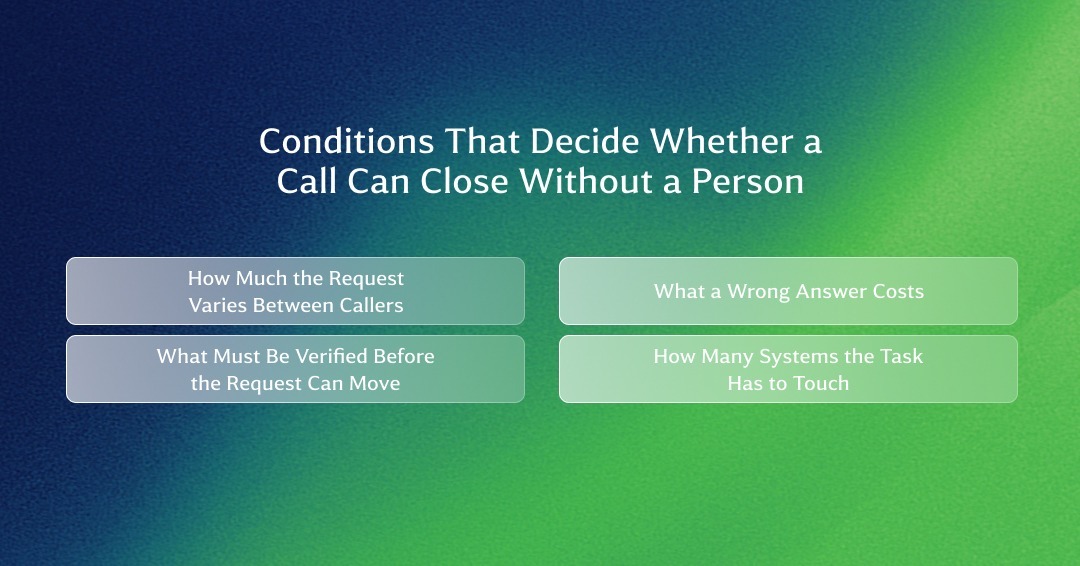
How intents vary from caller to caller determines the queues you need. A prescription refill check is relatively straightforward because the process is usually the same from one caller to the next.
A billing dispute, however, can mean very different things depending on why the caller is disputing the charge. One caller may have been billed twice for the same service, another may have been charged for something they never used, while a third may simply want clarification on a charge they don't recognize or remember.
While all three fall under billing disputes, each requires a different resolution path. That makes them different from a routine refill check, where the caller's context has far less impact on what happens next. So both (billing and refill checks) can’t be in the same queue.
Requests that actually warrant automation usually need to be verified first. Someone calling to ask when a retail office closes doesn't need to prove who they are. But a caller who wants to change a payment method or receive their medical records by email does.
Some of that verification can happen within the call itself. The caller might provide an account number or complete an OTP check, giving the system enough information to confirm their identity and continue.
But there are also cases where someone calls on behalf of someone else. They might not be able to pass the checks as easily. When that happens, the system should immediately route the caller to a live agent instead of trapping them in a loop of repeated prompts.
The consequence of getting an answer wrong defines your automated call handling system. Most businesses assume that automation queues are typically meant for routine or easy questions. But a caller who gets the wrong store hours is only going to call back and ask for a live agent. This gets worse for regulated industries where a wrong answer about drug coverage or deposit policy can cost you a claim or a regulatory violation.
That's why call drivers with significant consequences need tighter guardrails than everything else. The system should quote directly from an approved source instead of generating an answer out of thin air. If there's no source, the system should say so and route the case to a live agent.
A task that only needs one system to complete is easy to automate. But a request that involves scheduling, payer eligibility systems, and clinical records requires access to all three systems.
Such multi-system tasks are also prone to failing if even one handoff breaks down in one system. When that happens, the system should complete what it can and then route the rest to a live agent with all the context of what has already been done and what still needs to be resolved.
Here's a table that shows how a few common call drivers are scored to determine whether they should be automated or not:
|
Call Driver |
Intent Variation |
Verification Required |
Cost of a Wrong Answer |
Systems Touched |
Verdict |
|
General information/FAQs |
Low |
None |
Low |
1 |
Automate |
|
Appointment reschedule |
Moderate |
Light |
Moderate |
1 (scheduling) |
Automate |
|
Billing dispute |
High |
Full Identity Check |
High |
2 (billing, CRM) |
Route to a live agent |
|
Medical insurance eligibility change mid-call |
High |
Full Identity Check |
High |
3 (payer, billing, EHR) |
Route to a live agent |
Without knowing exactly why your customers are calling, any generative AI and call deflection solution you add will potentially automate the wrong calls. The steps below tell you how to list those reasons and then rank them to automate the most costly ones first.
There are four sources every business can pull from to get their call drivers:
Once you have a list of reasons your customers called, rank them by calls made per year, the average handle time, and how often the same customer calls back about the same issue. Any call reason that ranks high across all three metrics is your most expensive problem. This is the one your generative AI models should be automating on priority.
|
Call Reason |
Yearly Volume |
Average Handle Time |
Repeat Rate |
|
Password reset |
42,000 |
3.5 mins |
8% |
|
Appointment scheduling/rescheduling |
31,000 |
6 mins |
14% |
|
Billing question |
27,500 |
9 mins |
22% |
|
Insurance eligibility |
19,0000 |
11 mins |
31% |
High call volume and low repetition rate usually mean that the problem was resolved on the first contact. Automating that saves time, but it's not fixing anything broken. However, a high call volume and high repetition rate do point to something broken in the process. Automation is effective here but only if it can fix that gap.
By now, you know that call reasons scoring high across all three metrics are your strongest automation candidates. But you still need to decide which of those candidates to automate first. Go with requests that have high volume and can deliver a measurable result within the first few months. A call reason may have enough volume to justify automation, but if it takes five or six months to prove its value, you may struggle to maintain budget support.
You also need to decide beforehand what success looks like so you can tell whether the system is delivering as expected. Depending on the use case, that could mean a higher containment rate, shorter handle times, or fewer repeat calls.
Let's first dive into the failures before discussing their solutions. The following four use cases commonly pop up when businesses deploy their generative AI-driven call deflection system.
Sometimes, a generative AI model gives different answers to the same question. It might change phrase the answer differently the first time, but change the context completely the next time someone asks the same question.
That makes a single successful test run misleading. It only proves that the system gave the right answer in that one interaction. It doesn't tell you whether it will give the right answer consistently across thousands of conversations. You'll eventually discover that problem but only after your customers have been impacted.
Generative AI systems keep a conversation going even when they can't find an answer in the source material. A live agent would typically be hesitant to answer a question they're not sure about. A generative system, however, makes an assumption and presents it as a confident answer. The customer has no reason to question that answer, but later calls back with the same problem that could have been addressed in the first interaction. That extra interaction bloats your call queues and damages the customer relationship.
Most dashboards make containment look better than it really is. They count a caller who hangs up mid-conversation the same way they count a caller whose issue was actually resolved.
That inflates your containment rate and makes the AI deflection look more successful than it is. It also hides why customers are abandoning calls in the first place. So your reports keep labeling frustrated customers as successful interactions.
Voice calls have a much shorter timing window than chat sessions. It typically takes 250 milliseconds on average for a conversation to transition from one speaker to the next, according to research on turn-taking in ten languages.
A generative AI system that takes two or three seconds to respond breaks that natural rhythm. The caller may interrupt or repeat the question. Some may simply hang up.
The answer might eventually be correct, but the delay has already changed how the caller experiences the conversation. That gives latency a whole new meaning for a live call. It can determine whether the customer stays on the line long enough to hear the answer.
It's pretty common for vendors to focus solely on resolution rates when they're selling their generative AI and call deflection solutions. The conversation completely ignores the controls that actually decide whether those same automation numbers hold up once the system is live. Here are four of them that you should be looking for:
Using deflection rate as a sole metric presents a major problem. It only tracks the calls left behind in the queue. It doesn't tell you whether the system has actually solved any problems. The following four metrics are what you need to answer the harder and more complicated cases:
|
Metric |
What It Proves |
What It Hides |
|
Problems resolved without escalation |
The agent handled the request from start to finish |
Calls that weren't escalated even though the customer was frustrated |
|
Repeat contact within a defined window |
Whether the solution was effective or not |
Repeat contacts that come back through a different channel |
|
Abandoned during a call |
Caller hung up or gave up during the session |
Abandonment that happens before a live agent intervenes |
|
Cost per call resolved |
What it costs actually to resolve one problem |
Setup and integration costs already invested |
Combining these numbers gives you a clearer picture of whether your generative AI is actually deflecting calls or simply moving them somewhere else. A call that gets routed to another queue may look like a successful deflection, but the customer's issue still hasn't been resolved. That's why a high deflection rate paired with a high repeat-contact rate usually means calls are being redirected rather than resolved.
If you’re looking to quickly check whether your automation is saving money, compare your cost per resolved contact with the cost of handling the same request through an agent. You can also use our ROI calculator for that.
Your call deflection only works if the AI can do more than answer basic questions. The system needs context to understand what the caller is trying to achieve, take action to complete the request, and know when to escalate the call to a human specialist.
Take a regulated industry like healthcare as an example. Someone calling for a routine prescription refill or appointment scheduling shouldn't have to explain or verify themselves every time they move between systems, channels, or people.
That's the difference a well-designed platform like WestCX makes. Our agentic AI system already knows what the caller wants and completes their request inside a single interaction. Here's what makes that possible:
All four of these workflows run through WestCX Orchestrate, our orchestration engine that integrates the decisioning behind each action into one connected system. That intelligence enables it to choose the next best action for each caller in real time based on where they are in their journey and what they're asking for right now.
You also don't have to worry about compliance. WestCX Orchestrate is HIPAA- and HITRUST-certified. It also carries PCI and SOC 2 certification, so governance is built right into the workflows and every interaction stays secure and compliant.
Schedule a demo to see for yourself how WestCX Orchestrate can help you deflect calls with AI that understands the request, takes action on live records, and brings in a human with the full context when needed.
Generative systems have changed what happens after a call has been routed. Instead of simply pointing callers towards a FAQ page or another generic...
Hold times ultimately come down to the number of calls coming in, the capacity to answer them, and what callers do instead of waiting. Hiring more...
A credit union with hundreds of thousands of members can just as easily lose a significant portion of those relationships without realizing it....