Cross-Selling in Banking: Matching Account Signals to the Right Offer
Ever received a call from your bank trying to sell you an additional product or service? That's cross-selling, a sales technique that aims to...
11 min read
Every business understands the importance of retaining its customers. They're also putting real effort into reducing churn rates. However, most brands are still losing customers to competitors. The problem here isn't a lack of activity. It's that a lot of what gets labeled as "retention efforts" doesn't actually build any reason to stay.
Loyalty works differently. It shows up when customers return to buy from you again without expecting a discount. They don't need reminders to engage with your business.
Such loyalty only happens when businesses understand what actually drives it. This blog breaks down just that and explains how to build loyalty into your business in a way that holds up over time.
They may sound like the same thing but they're not. A retained customer stays because leaving is inconvenient. Maybe they're locked into a contract or switching will take too much of an effort. But remove that friction and they'll likely leave.
A loyal customer, however, stays because they genuinely want to. They might even find a competitor attractive on certain aspects but they'll still stay because they trust you.
That difference shows up directly in your numbers. A new customer can cost 5-25 times more than retaining an existing one. A mere 5% increase in retention alone can boost profits by 25-95%. Hence, mixing up retention and loyalty can prove to be an expensive mistake.
Most customer relationships start transactionally. They found your product and bought it because the price made sense. There's no particular attachment to your brand here. It's just a sensible decision at that moment.
Such customers return when you reliably deliver what they paid for. But that foundation is a fragile one. A competitor with a slightly better deal or a faster checkout can easily take that customer without much trouble.
Emotional loyalty is harder to copy. It builds when customers feel like a brand actually knows them and cares about more than the sale. Such customers begin to identify themselves with you. They talk about you and stay even when they have reasons not to.
But this doesn't mean that you skip transactional loyalty. You start there and work toward emotional.
Customer loyalty used to be a simpler concept. You delivered a good product, treated customers well, and they would return. That's not as simple anymore. True loyalty, the kind where a customer actively chooses you over everyone else, dropped 29% in 2025. That's a 5% fall from the year before.
Most consumers switch brands due to rising costs, but cost sensitivity alone doesn't explain the whole picture. Surveys indicate that 44% of Gen Z shoppers believe product quality is getting worse. A separate report found the same share of consumers think customer service is declining too. People aren't just looking for the next cheapest buy. They feel brands are delivering less.
Those declining numbers have a real dollar figure attached to them. U.S. businesses lose around $136.8 billion every year because of poor customer retention. That compounds quickly because acquiring a new customer is significantly more costly than holding onto an existing one.
In 2026, the gap between brands that take loyalty seriously and those that don't is only getting wider. So the only question that remains is what you're actually doing about it?
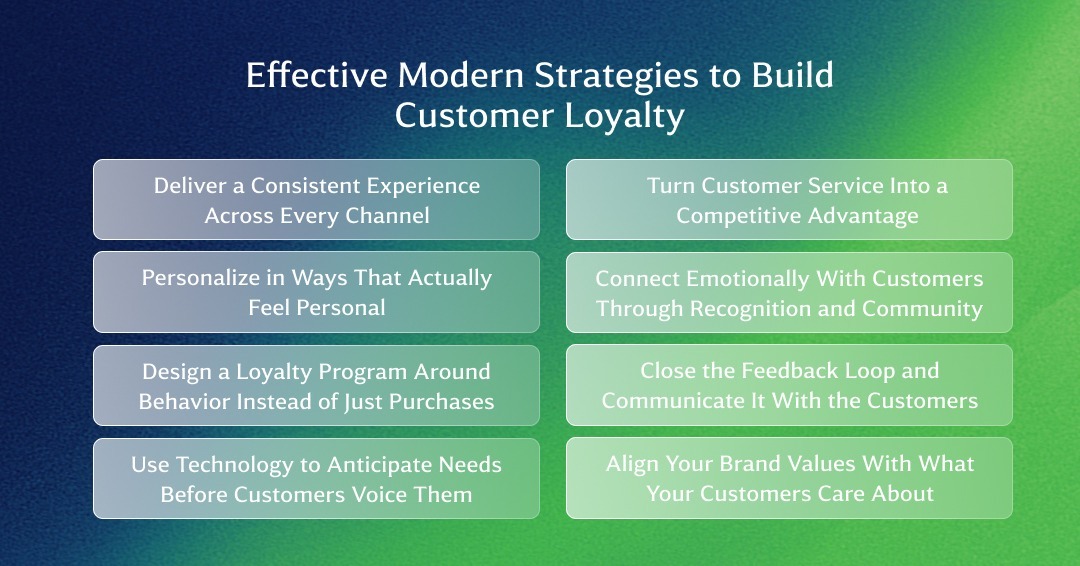
There’s no shortcut to building a loyal following. It comes down to consistently making the right calls and actually caring about the experience at every step.
Consistency is the most underrated loyalty driver out there. Companies with strong omnichannel customer engagement actually retain 89% of their customers. That's compared to just 33% for those with weaker approaches.
These omnichannel customers spend more per order and also stick around longer. Their higher lifetime value is what makes them some of the most valuable customers a business can have.
Imagine a customer who emails your support team and explains their issue in detail. They follow up on chat an hour later and have to repeat the whole story. But the rep has no record of the earlier conversation. Their tone only adds to the growing customer frustration. The problem still gets solved, but by the end, the customer has quietly decided they don't want to go through that again.
That's how an inconsistent experience can cause an exit event. Customers should be able to freely move between your support channels without losing context. The quality shouldn't vary depending on which door they walked through.
Real personalization is built on three things: behavior, timing, and preferences. It's beyond just remembering the customer's name or birthday.
Behavior personalization involves looking at a customer's activities and using that to deliver relevant next steps. This includes knowing what a customer is browsing, what they've previously bought, how often they engage, etc.
Timing matters here as well. A reminder before a subscription expires is a great way to show customers that you care about them. As another example, alerting a customer to a limited discount on a product they've been browsing for the last week.
Finally, preference-based personalization. This is where you learn what a customer actually wants and reflect that in how you communicate.
All three personalization pillars combine to retain customers. That’s important because 76% of consumers feel frustrated if their shopping experience is impersonal. 63% will actually stop buying from brands that either use poor personalization tactics or push too much.
Most loyalty programs only focus on rewarding more spending. That model isn't wrong but it mostly attracts customers looking for better deals. You won't earn their loyalty.
Three program types are worth knowing here. Points-based programs reward cumulative spending. Tiered programs unlock better benefits as customers move up. Value-based programs tie rewards to things customers actually care about like early product access or exclusive experiences.
What separates a good program from a forgettable one comes down to specific choices.
The moment a customer hits a problem shapes their relationship more than any campaign. How quickly you respond and how empowered your team is to actually solve the issue—both matter. That and whether the customer walks away feeling heard determine whether the relationship grows or quietly ends.
This is why businesses shouldn't treat customer service as a cost to minimize. The ones that genuinely build customer loyalty at scale treat it as one of their most important growth tools.
The thing is that customers tend to only give back loyalty when they feel the brand is loyal to them. Empowering your staff to make calls like waiving a fee shows customers you value them more than policies. That kind of experience is what keeps them from even considering your competitors.
Proactive service takes things a step further. Fixing issues before customers ever have to reach out is a huge competitive edge. Most companies don’t realize there’s a problem until the calls start piling up about something like delayed shipping. The ones that stand out let customers know upfront and upgrade to overnight delivery to stay ahead of the problem.
Some moments in a customer journey carry significant weight. Something like a product ordered dozens of times or a milestone spend level. Acknowledging these moments earns you a lot of loyalty at very little cost.
Most businesses have systems that track such moments. Sending an email to a customer on their first anniversary or their 50th order with an exclusive discount moves the relationship from commercial to personal. Customers start identifying themselves with your brand and that alone boosts retention on several fronts.
Sephora's Beauty Insider community is worth pointing to here. It's a forum where customers ask questions and get personalized recommendations. It has helped the brand become a platform for a relationship that extends well beyond any individual purchase. That kind of belonging is nearly impossible to replicate with discounts.
Asking for feedback has become completely standard but few companies actually do something with it. Customers who fill out surveys and never hear what happened next eventually stop bothering. They've learned it goes nowhere.
What actually builds customer trust and loyalty is closing the loop by showing customers that their input led to a real change. That starts with collecting feedback without making it a chore. Make sure that your surveys are short and that they're sent at the right time. Two questions after a support interaction are enough. 20 questions a week afterwards is of little use.
Following that comes communication about what changed. Don't be afraid to explicitly say what improved because of their feedback. It treats customers as participants in the business rather than as data sources. Customers who see that their input actually matters are more likely to give honest feedback again. They become more invested in your business.
Most businesses are already using customer data to understand what has already happened. An effective loyalty program uses the same data to predict what's about to happen.
The difference matters. A customer who has ordered the same product every six weeks for a year and hasn't ordered in eight weeks is showing a pattern. Someone else whose email engagement has dropped sharply over 30 days is showing you something else. Behavioral data creates such patterns that make anticipation possible.
AI tools make this kind of work more accessible than it used to be. Predictive models can surface which customers are trending toward churning and which products someone is likely to need next based on their history. AI also suggests the best moments to reach out.
Take a subscription business as an example. It may notice that customers who don't use a specific feature in their first 30 days tend to churn at a higher rate. They build an automated check-in that goes out at day 20 to show those customers exactly how to use the feature. That outreach helps to drop early churn. The product remains the same. The only thing that changed is how the business got ahead of a known pattern before it became a loss.
Customers don't always choose brands due to product quality or price. Sometimes they choose based on whether the brand's values reflect their own. Younger customers in particular research what a brand stands for before committing.
This is where vague mission statements fall completely flat. Those generic lines about "putting people first" on a website don't do much. Customers have developed a real sensitivity to hollow positioning. They're quick to notice when a brand's words don't match its actual behavior.
Patagonia is the clearest example here. Their environmental commitments appear in their supply chain, repair programs, political positions, and the products themselves. Their values are embedded in how the company operates. That kind of coherence is what earns actual trust.
Businesses that want to do this well can start by asking themselves what their company actually cares about beyond revenue. It’s easy to say everything but that’s not the point. The real test is what are you willing to take a clear, public stand on?
Once that answer is specific and true, communicate it through concrete actions. The customers who share those values will find you and when they do, you'll find them among the most loyal customers you have. That's how you build customer trust and loyalty that doesn't need to be bought or manufactured.
Businesses don't lose customers overnight. They lose them slowly through small failures that keep piling up. Here's what those things actually look like.
Dropping off after the sale. One of the main drivers of loyalty decline is that most brands focus entirely on the shopping experience and forget about what happens after the purchase.
Inconsistent or slow support. Most customers will abandon a brand after a single bad customer service experience. One interaction is all it takes. All the goodwill you built up can vanish because someone waited too long or got an unhelpful response.
Talking to everyone the same way. Generic communication is another factor that destroys customer loyalty. Sending the same mass email to your entire list signals that you don't really know your customers.
Overpromising and underdelivering. Many businesses tend to promise the moon. The thing is that customers will hold you to that promise. This is another area where customers quickly lose trust in a brand when its claims don't match reality. Fast shipping, high product quality, service guarantees, etc—every promise needs to be fulfilled.
Rewarding new customers while ignoring loyal ones. Some brands reserve their best deals for new customers. Loyal customers notice this and when they leave, they usually don't say why. Introductory pricing and exclusive offers for new customers only make sense when they're not punishing your loyal customers.
Treating loyalty programs as an afterthought. A poorly designed program does more damage than no program at all. You can announce as many discounts as you want but they won't earn you loyalty. These steps only attract deal-seekers who leave after buying.
NPS gets all the attention when it comes to measuring loyalty. But treating it as the only loyalty metric gives you an incomplete picture. Here are some other metrics your framework should include:
Businesses are no longer using AI just because of its hype. They're using it to retain more customers in ways that weren't possible before at scale.
One of the biggest gaps in loyalty has always been personalization. AI helps you figure out what the right offer is for each customer based on their historical data.
You're not just sending attractive offers. You’re delivering an experience that feels like it was built just for them. That's what it means to build customer trust and loyalty at scale.
AI makes it possible to predict which customers are about to walk away. The system uses several indicators to measure their risk levels. A loyal customer of 2 years suddenly disengaging or delaying purchases can easily go unnoticed in a sea of thousands of customers. AI, thought, sees these warning signs to let you step in early with personalized offers or a re-engagement message.
Most loyalty programs hand everyone the same 10% off. AI makes it possible to reward each customer in a way that actually means something to them.
Starbucks is one of those examples that keeps coming up and for good reason. Their AI looks at data like past orders, local weather, and where you are to decide what kind of offer you’re most likely to respond to. That contributed to 4 million additional visits in early 2024 and a 13% increase in active rewards members.
This should be obvious. Your customers won't stick around if your support experience is slow or frustrating. AI makes a real difference here. It can handle routine queries automatically and cut down response times.
More advanced systems take it further by using NLP to understand context, adjust tone, and even support multiple languages. The experience still feels human, just faster and more consistent.
However, keep in mind that AI isn't a fix for a poor product or a bad experience. The strategies to build loyalty in customers include both the human and the technical. AI handles the data and the scale. The relationship itself still has to be earned.
Most businesses already know what a good customer experience looks like. Their struggle is in how to actually deliver that consistently at scale. Gaps usually show up in slow responses, disconnected channels, and support teams stuck handling the same issues over and over.
WestCX Orchestrate changes that equation. We bring your communication into one place and use AI to handle routine interactions across voice, SMS, chat, and more. Your customers no longer have to wait around for simple answers.
Our AI communication platform isn't designed to just react to every request. It uses conversational AI and automation to route, respond, and personalize each interaction based on real data. That's how we ensure customer journeys feel connected at every point.
Our system quietly handles the volume in the background while your team is free to focus on the conversations that actually need a human touch. Your customers will notice immediately how they get the right response at the right time without ever having to chase it.
If you’re looking to build loyalty, this is the kind of infrastructure that makes it possible to deliver on it every day. Schedule a demo right now to see how WestCX Orchestrate makes every interaction feel intentional.

Ever received a call from your bank trying to sell you an additional product or service? That's cross-selling, a sales technique that aims to...

Call deflection is a way to resolve customer issues through self-service channels. It improves your operations and lowers your costs because...
Credit unions usually think of customer service when someone asks about improving their member experience. That’s only one piece of the puzzle.
You don't improve customer experience by accident. Every interaction across different teams and channels has the power to shape how a customer sees...

The first few minutes of a digital onboarding journey are all it takes for a customer to judge how the rest of their banking experience will feel. A...

You can deliver excellent care and still lose patients in the gaps between interactions. Those gaps are where expectations have quietly changed in...