Cross-Selling in Banking: Matching Account Signals to the Right Offer
Ever received a call from your bank trying to sell you an additional product or service? That's cross-selling, a sales technique that aims to...
8 min read
Thousands of patients walk into their provider's office every day to be handed a clipboard. It's the same form they've filled several times before: full name, date of birth, insurance details, contact details, etc. They fill it out again anyway, wondering why the information isn't recorded somewhere.
That's genuine frustration because the front desk re-enters that same information into their system as patients stand in line. It's a routine and familiar process that's been around for decades. Except that now, traditional check-ins are costing providers in more ways than just revenue.
Digital check-in systems do more than just remove paper-based forms. They change how patients experience their first point of contact with a provider. That shift has a measurable impact on how providers run their operations more efficiently and how consistently patients follow through with their care.
Everyone knows how expensive paper-based intakes are but that isn't the only problem. Your staff easily spends around 15 minutes per patient on manual data entry alone. That adds up to several hours for providers seeing 40-50 patients a day.
Manual entries and handwritten forms are also prone to mistakes and human errors. Nearly half of all providers say that patient information errors are a primary cause of denied claims. Those denials turn inefficiency into revenue losses that further compound over time.
Patients aren't too happy about manual check-ins either. Seeing a full waiting room and a clipboard of forms will convince them to leave. Even if they endure the visit, they'll still consider finding another provider for the next time. So, in addition to revenue lost, traditional check-in systems leave care gaps as well.
That just makes the whole situation even worse. More than 50% of medical groups reported an increase in patient no-show rates over the last few years. 37% of them saw a specific rise in 2023 onwards. This spike is growing further and paper-based check-in does nothing to address that problem.
The main selling point of digital check-ins is that the process starts before the actual appointment.
A patient who books an appointment immediately receives a text or email with a secure link. They don't need to download any app or create an account. The link takes them to an intake form where they can enter all their information at their own pace. These fields include personal and insurance details, medical history, current medications, reason for visit, consent forms, etc.
Some digital intakes allow patients to simply upload a photo of their insurance card. The system automatically populates details from that and enables the patient to pay their copay right there.
Now, on the day of the appointment, the patient gets an automated confirmation. The front desk already has their information in the system. So they can quickly process the patient when they walk in. The clinical team can review the patient's record beforehand as well because it's all in the EHR.
Digital medical check-in systems improve daily experiences in ways that go well beyond saving a few minutes at the front desk. Here's what actually changes.
Your front desk starts working as a coordination hub instead of a data entry station. Staff no longer need to accept paper forms, decipher handwriting, and manually type information while the patient waits. Patients are technically already registered before they arrive. They just have to confirm their presence in the office.
This means your queues move much faster and your staff have time to attend to patients who actually need help. That's a 50% reduction in time spent on patient scheduling and registration via digital intake tools.
Many inbound calls are informational. Patients will call the office to ask what forms to bring and whether their insurance will be accepted. Most also ask about their copay and a dozen other questions. Those calls take time. They also create holding times for everyone else calling.
But digital intakes already answer most of those questions automatically as part of the workflow. Patients confirm their details and insurance coverage in advance. They also know exactly how to prepare for the visit.
We've already pointed out how digital intakes require patients to type in their own information at their own leisure. That information lands directly in the EHR and is far more accurate than what a staff member can transcribe from a handwritten form. There's little chance of entering the wrong information because your front desk has trouble reading bad handwriting.
Quality EHR data here means fewer denials for providers. Your team members also don't have to keep chasing patients to ask for the correct address or insurance ID.
Manual intake is highly repetitive. Your front desk has to keep processing paper forms in large volumes every single day. This isn't what they signed up for.
A 2023 survey found that paperwork and regulatory tasks are some of the biggest reasons front teams feel stressed. Staff say these responsibilities take time away from actually helping patients.
Digital intake systems handle all those tasks automatically. Your staff can actually focus on interactions that require their judgment and presence. This also means reduced turnover, which is another expense providers often deal with.
Check-in is the first thing a patient experiences when they come to a practice. You want that to feel organized and respectful. It's how you build trust early on in the patient journey.
Those that don't risk losing patients to providers who do. More than half of millennials and Gen Xers say they would switch to a different provider if digital options weren't available. Hence, engagement during check-ins actually drives patient retention.
The revenue cycle impact of a strong digital patient check-in process is one of the strongest arguments for adopting it.
Upfront collection rates improve because patients can see their balance and pay their copay during pre-registration. Claim denials fall because your systems have accurate billing data. Providers see their no-show rates drop as well because patients tend to show up when they don't face long wait times during scheduling and registration.
The positive changes providers experience on the operational side mirror what patients feel on the other end of the process.
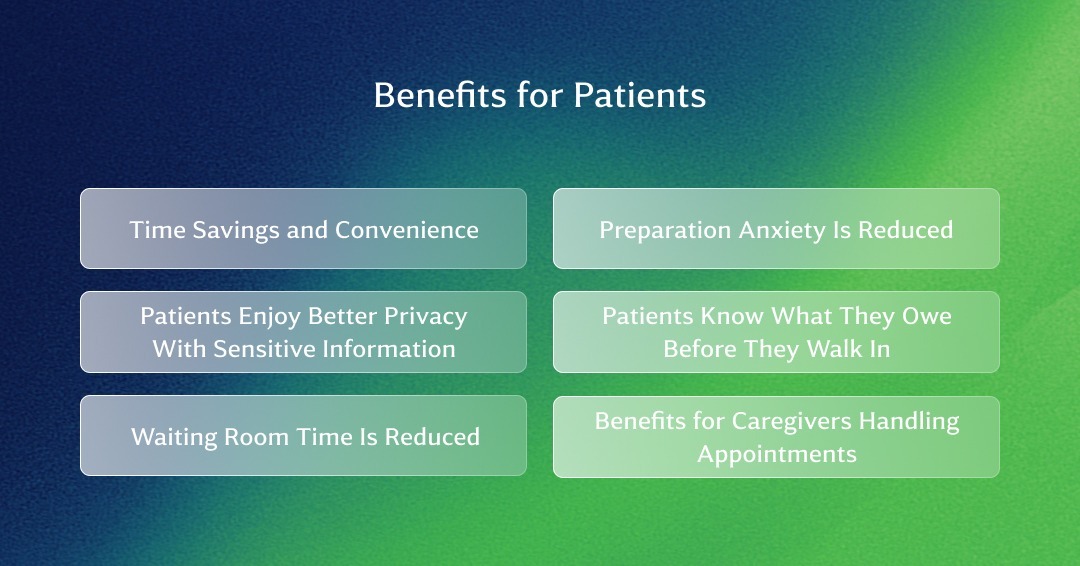
Every patient who fills out a form in a waiting room wishes they could have done it at home. Digital check-ins offer exactly that. Patients can complete them on their phones whenever it suits them. There's no pressure from people watching because you need more time to fill out all the fields.
Walking in with all paperwork done beforehand completely changes the provider experience. The convenience factor is consistently one of the top reasons patients choose or stay with a provider.
A waiting room is a shared space. Filling out questions in view of others about mental health history, financial situation, or sensitive symptoms on a paper form can sometimes create a reluctance to be fully honest.
That reluctance goes away at home. Patients are more likely to disclose sensitive history and provide complete information when they're in a private setting. That means the clinical picture a provider gets from a digitally completed intake form is often more complete than what a paper form in a waiting room produces.
Every patient features sitting in a crowded waiting room. They'll most often arrive earlier just to get ahead of the line.
Pre-registered patients don't have to face any such issues because there's no form to hand over or insurance card details to copy. Staff acknowledge their arrival and can call them back far sooner than the time it takes with manual check-ins.
That speed matters to patients. Consistently shorter waits earn providers a reputation for respecting people's time. This translates directly to loyalty and positive referrals.
Walking into a medical appointment unprepared adds stress. Digital check-ins allow patients to review their forms and visit instructions in advance. This means they're already mentally prepared by the time they walk into the office.
That preparation also has clinical value. Patients arrive fully focused on their care. They're not distracted by waiting rooms and admin tasks. They're only thinking about their appointment.
That mindset leads to more meaningful conversations. Patients come in ready to engage by asking more questions and sharing more concerns. Providers remain fully focused on treatment instead of pulling out information. That leads to better outcomes.
Even a good provider experience turns sour when patients see a bill that's more than they expected. It's an uncomfortable and awkward moment for both patients and staff. The situation can even become worse if patients start disputing the bill.
With digital patient check-in, that moment doesn't happen. Insurance verification runs during pre-registration. That means patients see their estimated balance and they can pay the copay right then. The bill is already settled by the time patients arrive. You see first-pass payment rates improve and a significant reduction in billing disputes.
Not every patient manages their own healthcare. Proxy and caregiver access to patient portals more than doubled between 2020 and 2024. That reflects a growing patient population whose appointments are being managed by someone else.
Digital intake makes that coordination easy and practical. A family member managing care for a parent can complete pre-registration from wherever they are. They can upload insurance documents and confirm the appointment without needing to be physically present at the office.
The patient still gets seen because their details are already in the EHR. The caregiver doesn’t even need to go out of their way.
Every platform isn't built the same. Take the following features as a checklist when evaluating your options. They separate a system that works from one that creates new problems.
A phased approach works best when switching to a digital patient check-in system. It gives your team time to adjust without disrupting your daily operations.
The first thing to do is to audit your current workflows. How is a patient normally processed and where do they usually face bottlenecks? Is check-in faster or slower on certain days than normal—why? Make a list of all these friction points. They ensure that you're not adding technology on top of a broken process.
The next step is to bring in your staff. Your front desk knows exactly where things break down. They are the ones fielding questions from patients and managing queues every day. Getting their input early makes the transition smoother.
From there, start with a small rollout. Choose one appointment type or patient group to test your digital check-in system. This gives you a controlled setting to see what works and what needs fixing before the change reaches your full patient volume.
Make sure to involve the patients as well. Send them a short text or email to explain the new digital check-in process. Most patients adjust without issue when the instructions are clear and the reason makes sense to them.
Finally, expect the adjustment period to take longer than you think. Some patients will still walk up to the desk out of habit. Your staff also needs time to stop defaulting to the old process. A well-implemented digital patient check-in system usually finds its footing over 2-3 months. Give it that time and make adjustments as you go.
Most digital check-in solutions are just there to clean up your front desk. They help patients fill out forms faster, but the rest of the patient journey still runs in fragments. That disconnect shows up in every step that follows.
WestCX Orchestrate is built differently to close those gaps and connect the entire patient journey. Our platform unifies communication, data, and workflows into a single system so that every interaction builds on the last instead of starting over.
WestCX Orchestrate uses AI-native orchestration to manage how and when patients are engaged, ensuring the right action happens at the right time across channels.
That matters the moment a patient checks in. The system automatically triggers what comes next instead of limiting itself to a form. That means insurance collection, reminders, and even copays can happen within the same flow.
These interactions aren’t static either. They’re guided by conversational AI that can schedule appointments and answer general or billing questions within a single exchange that feels natural to the patient.
This whole process is driven by orchestration layers that continuously capture data, apply logic, and deliver communication across voice, SMS, chat, and more. Your practice sees fewer manual handoffs, fewer missed steps, and a check-in process that actually carries forward into the rest of the visit.
If you’re ready to make check-in part of a more connected patient experience, we’d be glad to show you how it works. Schedule a demo and start the conversation.

Ever received a call from your bank trying to sell you an additional product or service? That's cross-selling, a sales technique that aims to...

Call deflection is a way to resolve customer issues through self-service channels. It improves your operations and lowers your costs because...
Credit unions usually think of customer service when someone asks about improving their member experience. That’s only one piece of the puzzle.

Healthcare data moves through every part of care delivery. However, it's often scattered and poorly controlled. That reality creates gaps in...
Managing chronic conditions often feels like trying to keep track of a conversation that keeps getting interrupted. You have patients coming in for a...
Healthcare providers are expected to keep every patient informed, but most of the day is spent just trying to keep up with communication. There are...