How to Reduce Hold Time With Rising Call Volume
Hold times ultimately come down to the number of calls coming in, the capacity to answer them, and what callers do instead of waiting. Hiring more...
8 min read
Hold times ultimately come down to the number of calls coming in, the capacity to answer them, and what callers do instead of waiting. Hiring more staff is only a partial solution to reducing hold times in a contact center. It’s the slowest and most expensive approach. But it’s often the first thing businesses turn to because counting heads is faster than figuring out why callers are waiting in the first place.
There are also two different types of hold time to consider. The first is the time a caller spends waiting in the queue before an agent picks up. The second is when an agent puts a caller on hold after answering. They’re both forms of waiting, but they happen for different reasons and need different fixes, so we’ll be covering them separately.
Keep in mind that the Average Speed of Answer only measures the first kind of waiting. It completely excludes the time spent navigating an IVR menu, so a team comparing its number with an industry benchmark may not be measuring exactly the same thing.
Three factors determine hold times for a contact center. You first have the arrival rate, which refers to the total number of calls received in a given time period. There's effective capacity that relays how many calls your existing agents/teams can handle within that said period. Queue discipline is the last one that establishes the order in which calls get answered from a queue.
The first and third factors are pretty straightforward. Arrival rate is just your call volume, while queue discipline oversees which calls get picked up first. This typically follows a first-come-first-served approach, with priority given to escalations. Effective capacity, however, is what most contact centers get wrong.
100 live agents doesn't necessarily mean a contact center is getting 100 agents' worth of answering capacity. People take breaks or are required to take part in training workshops. They're also spending time after a call ends to log notes and update their records.
Some contact centers use the same live agents for multiple queues, which means that they're not available for any one of them while they're dealing with the other. Run these additional numbers, and the same 100 live agents might actually be doing the work of maybe 70.
You gain that clarity only by tracking the ratio between effective capacity and arrival rate. So your call queues clear quickly, and hold times stay low when arrivals are below capacity. But when arrivals reach or cross that threshold, effective capacity becomes difficult to predict. The next section will discuss this threshold and the resulting issue of abandoned calls.
A small increase in call volume doesn't always mean a small increase in wait times. Once your contact center gets close to its capacity, even a modest jump in demand can put pressure on your agents and send hold times climbing.
Hold time doesn't increase at the same rate as call volume. When you have enough available agents, a small increase in call volume is easy to absorb. However, as your agents get busier, that same level of capacity starts disappearing, so that same small increase in demand can quickly become longer queues with higher wait times.
Take a contact center, for example, that's running at 85% occupancy. The average wait time sits around 30 seconds during a normal week one. The volume then climbs by 6% in week two, which pushes the occupancy past 90%. That 6% uptick never registers as a red flag on a dashboard, but it's enough to increase the hold times from 30 seconds to 6 mins. The support team simply lost the capacity (or room) it had to absorb a busy hour.
It's why teams aiming to reduce hold times need to focus on occupancy, not just call volume. But there’s also another problem. The staffing models many workforce management tools use don’t fully reflect what happens when queues get busy.
The Erlang C model assumes callers will wait forever and never abandon the queue until they reach an agent. This assumption was reasonable decades ago because there was no choice but to wait and listen to the hold music. Today, callers can hang up, call back later, or switch to another channel when the wait gets too long.
Erlang A fixed that by factoring in abandonment. It's now the recommended model for modern contact centers. However, most staffing tools still run on Erlang C. That's a big part of why staffing plans look solid on paper and then fall apart the moment volume spikes.
Most callers who hang up before reaching an agent are going to call back. These redials put unnecessary strain on the channel for something that could have been fixed in the first attempt. That abandoned call today is tomorrow's arrival. So your contact center is generating tomorrow's queue today, and this keeps compounding every single day.
There's a documented example of exactly this from a 2026 study of Missouri's SNAP call centers. Researchers used call data from four centers to separate fresh demand (people calling for help for the first time) from repeat calls for the same issue.
The difference was striking. The four centers received 228, 2,931, 2,396, and 712 calls per day, but the model estimated only 145, 623, 700, and 165 of those were fresh calls. That means a large share of the daily volume wasn't new demand at all. It was redial traffic created by callers who couldn't get through the first time and tried again.
In short, the loop was as follows: new call > queue > abandon > redial > queue again.
That cycle makes it clear how every abandoned call feeds tomorrow's arrival count, which directly increases wait times and abandonment rates. A plan built to improve hold time without accounting for this loop is working off an arrival rate that's already too low.
The problem with historical arrival data is that it includes the redials and callbacks caused by staff shortages in the previous quarter. That creates a problem for your next forecast. The volume you're using to predict future demand already includes some demand caused by your previous staffing shortfall. That's a trap for any contact center trying to reduce hold times.
For example, if last quarter's staffing woes caused a large number of redials, using that data to forecast the next quarter ends up staffing for an artificially inflated demand your own queue created by failing to answer callers quickly enough.
A list of ways to reduce hold time in a contact center should always be ranked by how much queue time each call actually removes. The goal should be to stop calls from arriving in the first place, and the ones that do should be processed fast.
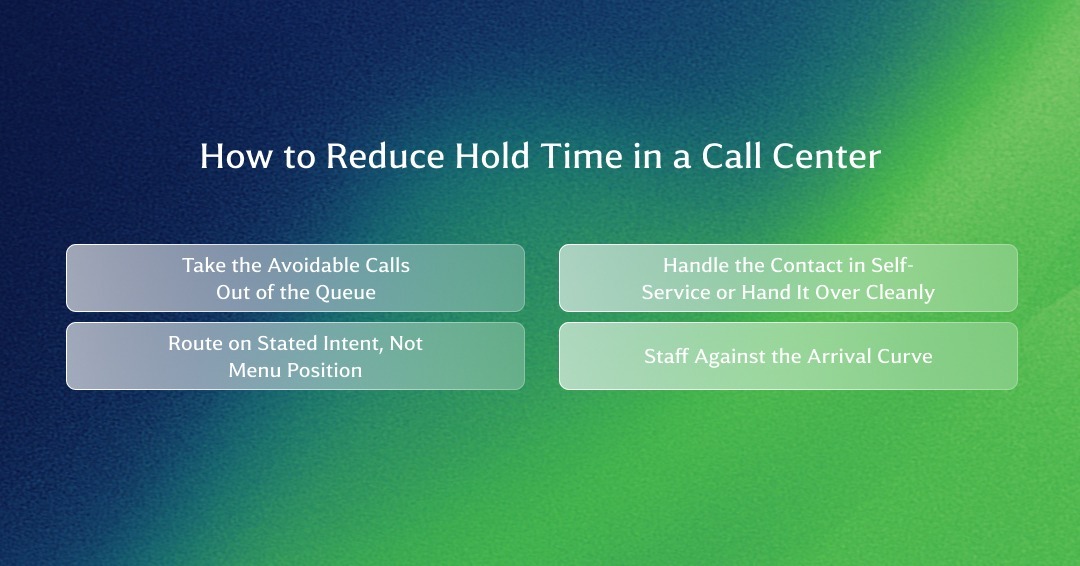
Routine calls like status checks and appointment confirmations don't require a human agent to resolve, so start with them first. But don't pull them from a guess regardless of how obvious they seem. Filter them through your call driver data by labeling each call by reason, and then sorting them by their individual call volume and complexity. The ones repeating the most but have low complexity are the calls you can eliminate through proactive notifications.
Routing calls based on which buttons someone pressed in a menu often doesn't relate to what they actually need. Connecting a caller to the wrong department also burns your capacity twice as fast. The wrong agent who picks up has to transfer the call, and then again for the second agent who picks.
The better approach is to route on what the caller says. While that requires you to move away from the old static IVR menus, it's one of the more direct ways to reduce hold time because it reduces the number of transfers and redials at the source.
Self-service queues only work if they actually resolve problems. Otherwise, you're just creating an additional queue for no reason other than delaying the inevitable callback. The CFPB looked at this in its 2023 review of chatbots in consumer finance and found that 80% of people who talked to a chatbot walked away more frustrated, and 78% ended up needing a human anyway. That's the cost of deflection without resolution. Your customers return later, angrier than before.
This is why better IVR containment with IVAs isn't about keeping customers away from live agents. It's about resolving what can be resolved automatically and recognizing when a human needs to step in. The handoff should also be clean, meaning that it should carry over authentication data, what the customer has already said, and what actions the automation has taken. The agent can then pick up where the IVA left off instead of making the customer start over.
Staffing should always be the last measure on your list of ways to reduce hold times in a contact center. That's because of two reasons: it's slow, eats a lot of resources, and can be a highly expensive mistake.
Most contact centers aren't tripping over increasing headcounts. The mistake they end up making is planning their staffing around the wrong details. For example, a team that's staffed for a day might be overstaffed in the evening while understaffed in the morning when peak calls hit. Hence, teams should be staffed against arrival data instead of daily call volume.
“Hold time” usually means the time a caller spends waiting for an agent to answer. But what if an agent picks up but then puts the caller back on hold because they need to check information or confirm something from their supervisor? That's a secondary definition for hold time. The caller reached an agent, but they're still waiting for someone or some system to pick up again.
Your live agents need three things to reduce this type of hold time:
Every extra minute an agent spends searching for customer information, additional context, or another colleague adds to the contact center's average handle time. Fix those mid-conversation pauses, and your queue starts moving faster.
The consequences of long hold times aren't always about hurting satisfaction scores. In highly regulated industries like healthcare, a long wait can prevent someone from getting the help they need when they need it.
That's why the Centers for Medicare & Medicaid Services (CMS) sets specific call center standards for Medicare Advantage and Part D plans. The average hold time must be kept below 2 minutes and the average disconnect (or abandonment) rate below 5%.
CMS reviews these results each quarter, and organizations that miss either target can face compliance action. In other words, for regulated contact centers, hold time can easily be a compliance concern.
The way CMS defines hold time warrants a closer look here. The regulatory body says that it's the time between the end of the recorded greeting and the moment a live agent picks up. Lengthy automated greetings are not included in the waiting time threshold, but the waiting time afterward is counted. This hasn't changed in 2026.
Unlike healthcare, though, the banking and credit union sector doesn’t have any of these concerns. There are no federal hold times that they need to meet. There’s still plenty of pressure to reduce hold time, but for different reasons like meeting customer expectations and reducing the operational cost of keeping people waiting.
The fastest way to reduce your hold times is to make sure those calls never need to wait for an agent in the first place. Someone waiting in a queue for a routine status check is taking a slot that a self-service channel could resolve in seconds, and the calls that do need an agent should route once, without any unnecessary transfers or delays.
WestCX changes that starting point to resolve requests before they reach an agent. Our AI-powered virtual assistants hold actual human-like conversations, resolving multi-level tasks within the same interaction without losing context.
That intelligent automation comes on the back of WestCX Orchestrate, our orchestration engine that treats every call as part of the same journey instead of an isolated event. This enables it to identify what the caller wants and where they stand in that journey as the conversation happens.
Consider a patient calling their healthcare provider to reschedule an appointment. A traditional IVR might make them navigate several prompts to verify their identity, choose a reason for calling, and eventually reach a scheduling queue. But our IVAs immediately understand the patient's request in natural language and can reschedule the appointment without bringing a live agent into the interaction. That's one less call entering the queue in the first place.
The same approach applies to other routine requests like prescription refills, bill payments, balance inquiries, insurance verification, etc. 80% of inbound calls are contained through automated voice with no agent required, and bill pay and copay collection alone hits 62% containment on average in our internal deployments.
But not every call should stay with an AI. Our communication platform knows when to step aside. Calls that need a human specialist are routed immediately, along with the context and any relevant customer data. The agent picks up exactly where the AI left off, so the caller never has to explain themselves twice.
That also changes what happens outside the phone queue. WestCX Orchestrate coordinates proactive communication across voice, SMS, RCS, email, and web chat, giving organizations another way to address a need before it turns into an inbound call.
None of that comes at the cost of compliance. WestCX is HIPAA, HITRUST, TCPA, PCI and SOC 2 certified, so regulated contact centers get containment without cutting corners on data handling.
Schedule a demo and see for yourself how WestCX Orchestrate can automate your communication channels to reduce hold times.
Hold times ultimately come down to the number of calls coming in, the capacity to answer them, and what callers do instead of waiting. Hiring more...
A credit union with hundreds of thousands of members can just as easily lose a significant portion of those relationships without realizing it....
Credit unions spent the last decade making access faster. Members can now open online accounts within minutes, do instant transfers, and land...