Reduce Healthcare Call Center Costs Without Compromising Care
If you're running a call center for a healthcare organization, you've probably been asked to cut costs while handling higher patient volumes than...
8 min read
Higher containment rates have long been seen as a winning self-service strategy. Every call resolved without involving an agent naturally reduces your operational costs, shortens wait times, and frees your team to focus on more complex conversations.
But a strong containment rate is only meaningful when it reflects genuine resolution. The goal isn't simply to keep customers away from an agent. You have to actually help them complete what they came to do, without them needing to call back or repeat the same issue later.
AI-driven IVAs lead that conversation. They’re not meant to replace the importance of containment rates. They instead redefine what successful containment should look like for your business in the first place, delivering the kind of experience that keeps customers from coming back with the same problem.
IVR containment measures the percentage of customer calls that were automatically resolved without involving any human agent. It's one of many KPIs that contact centers rely on more than anything else to improve their self-service capabilities while keeping operational costs under control.
In simpler words, every call the IVR menu "contains" is one less call that you don't have to pay an agent to handle. The higher the IVR containment rate, the more free time (and resources) your live agents have to solve more complex matters.
Traditional IVR systems are based on fixed menus. You've likely come across them in your lifetime. It's the call where you listen to a prerecorded voice read through every option, asking you to either press 1 for sales or 2 for billing.
The long wait times are frustrating enough, but there's also no actual guarantee that the route you pick will actually solve your problem. If it doesn't, you have no choice but to start all over again.
The other problem with legacy IVR menus is that they assume the caller knows which option applies to them. Most callers don't or have nuanced issues that fall into multiple categories. Should a customer calling about a billing charge that's tied to a service outage choose the "billing" or "service" channel? They'll either cross their fingers or just hit 0 to talk to a human operator who can route them accordingly.
This brings us to a more concerning problem. Repeat customers tend to just bypass the entire menu by hitting 0 as soon as the recorded greetings play. That makes the entire DTMF menu meaningless because it's just faster to talk to a human than to use self-service.
These calls are technically a system failure, but they never get recorded as such. The dashboard shows them as just another transferred call. They're treated the same as a customer who went through the IVR properly and still needed an agent.
Both are recorded as wins in the dashboard, even though one of them abandoned the system, and the other, who followed protocols, still didn't get their issue resolved.
Picture someone calling about a late payment. The IVR's chatbot gives them a generic response about due dates that doesn't solve their problem.
So they just hang up and call again, this time going straight for a human agent. They might also send an email or use live chat instead to get their problem resolved. This running around isn't a good look for a brand and unnecessarily balloons operational costs.
Hence, chasing the containment rate as just a standalone number often makes things worse. Adding more options to the menu or more human agents, for example, won't solve the underlying problem for customers. It'll just hurt the CX more.
Every contact center doesn't handle the same set of problems. The kinds of customers they serve, the issues they resolve, and the complexity of those conversations vary from one industry to another. Hence, you can't simply hold a single benchmark for a good containment rate across all industries.
IVR containment rate usually hovers around 30-50%, with success rates dropping fast as callers cycle through three or more phone menu layers. Swapping in an IVA significantly boosts those numbers to land around 60-80% because conversational AI even resolves most mid-tier complex calls.
Payers have to deal with added friction. Many of their automated calls require them to navigate someone else's phone tree just to confirm a single detail. A containment rate less than 50% is pretty routine, but leaders do manage to achieve up to 80% with a proper IVA system.
The pharma sector sits lower because the calls skew toward quick, single-purpose tasks like checking refill status. The average IVR containment benchmark has been logged at around 40%, improving to 60-85% with conversational AI assistants.
Fintech is where the numbers start to spike. Most payment-processing platforms report automation rates of 65% and above after the system is fine-tuned to their workflows. That said, global bank leaders have achieved a massive 90% call containment rate with a virtual assistant alone that now handles more than 80% of their routine queries.
IVAs (Interactive Virtual Assistants) turn the whole menu system into a conversational experience. These AI-driven chatbots actually listen to each caller to understand their issue and then route them accordingly.
Not only that, IVAs keep track of the conversation even after the caller has been sent to the sales or billing department. Hence, customers never have to listen to any hold music or start over. They just have to explain their situation after the first few seconds and be instantly directed to a potential resolution.
Automated CX engagement platforms like WestCX use IVAs to achieve more than 60% call containment rate for their financial partners. That's a significant volume their live agents never have to deal with.
Modern IVRs can catch keywords or keyphrases to determine the next possible step. For example, a caller might ask why they were charged twice. The IVR will here “charged” and give the caller three sub-options, none of which are guaranteed to solve the problem.
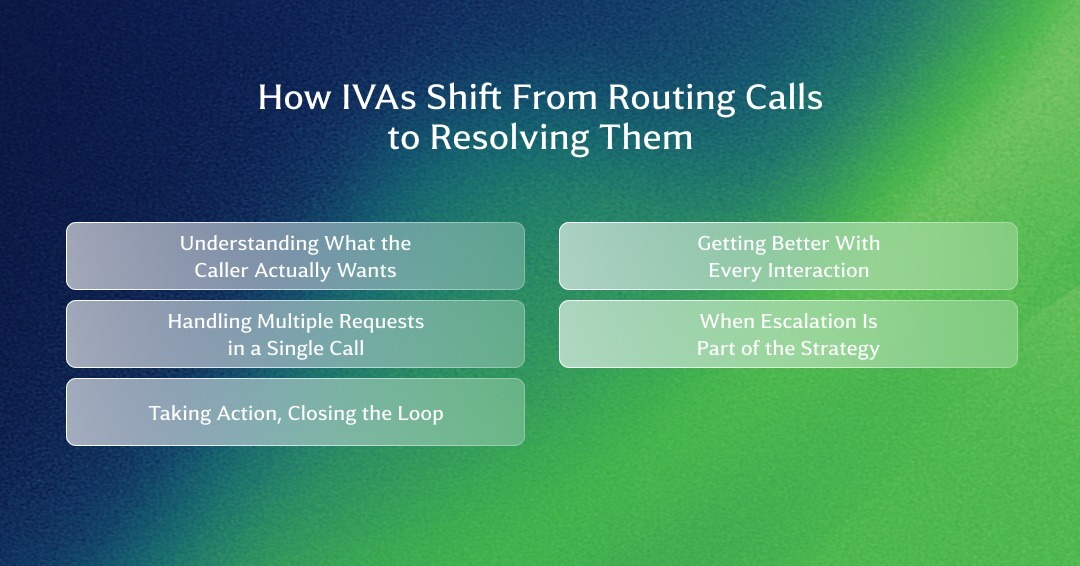
Despite the speech recognition upgrade, modern IVRs are fundamentally still phone trees. IVAs, however, don’t follow any script. They use NLU models instead of matching keywords. So a caller doesn’t have to specifically say “charged” to trigger a response. They can phrase their problem however they want and the IVA will pick it up regardless.
Hence, you have one system that recognizes keywords and another that understands language. Most legacy IVR containment failures start right there, at the moment a plain sentence gets treated like a routing puzzle instead of a request.
Legacy IVR only has the capacity to cater to a single topic. If a customer is calling about two separate issues, they have to wait until the first one gets through before starting over for the next one.
IVAs don’t have that limitation. Conversational AI enables them to understand and manage multiple intents within the same conversation without breaking down. So a caller can mention a billing dispute, be told it’s due to outdated contact details, and then be routed to update their address within the same call.
The customer never feels like they’re handling two separate issues. Hence, modern IVAs keep multiple interactions contained even when the conversation branches out into new domains.
Understanding what a caller wants is only helpful when your system can actually do something about it. IVAs can be easily integrated with your existing systems, such as CRM, CMS, billing and order platforms. That enables the IVA to actually resolve the problem instead of handing it off to a human agent.
Most of the calls that your agents receive daily aren’t complicated. They’re routine tasks that are escalated to your agents because the IVR couldn’t solve the customer’s problem. Since IVAs close that gap, each one of those routine calls becomes a containment rate win.
IVR menus require someone to manually make changes. It might take weeks or months before a decision is reached to add new options because callers are hitting a wall.
IVAs adapt on the go. Every call is an interaction the AI learns from. The system picks up on different phrasing and uses outcomes to improve its intent recognition.
So the more the interactions, the more data an IVA has to improve resolution rates without involving any human staffer to rebuild the flowchart-like menu from scratch. That’s a major advantage for enterprise contact centers because they automatically adapt to seasonal trends.
Escalations are always part of a containment strategy. You can't expect callers to remain stuck in an AI-driven conversation loop. Sometimes the issue lies beyond what an IVA can handle or as it often happens, the caller just might ask to speak to a human specialist from the start. While this also happens with traditional IVRs, the difference lies in how handoffs are managed.
IVAs transfer the full conversation as well as the context along with the call. Your live agent steps in with a full understanding of what the customer asked or what solutions have already been tried. Hence, they pick up the conversation from where it ended instead of asking the customer to repeat themselves or proposing the same generic solution that hasn't worked. This maintains high customer satisfaction rates for even those calls that were never going to close out inside the IVA to begin with.
Relying purely on containment rate is a costly mistake. It only tells you how many calls ended without a transfer. There's no clarity on what percentage of those calls even resolved an issue. So a high containment rate may make you look successful on paper, but in reality, you just might be failing most of your customers.
Hence, your containment strategy needs to be built around more metrics than just containment rate. For example, "repeat contact rate" confirms how many callers called back the next day for the same issue. Most modern contact centers lean on "resolution rates" as well to track how many problems are actually being solved on average.
You also have your CSAT reports, specifically for contained calls instead of the whole contact center. Not to forget your escalation quality and success; how many calls are being transferred, and once a caller leaves the system for a human agent, do they repeat themselves?
Your containment rates start making sense when they're tracked alongside these metrics.
Convincing a room full of stakeholders is usually the hardest part of launching an IVA program. They often know the benefits of virtual assistants and automated workflows, but they're understandably hesitant to invest without clear evidence that the technology will actually make a difference.
Start by positioning IVA as an addition to the existing IVR. Stakeholders aren't fans of replacing their entire communication framework. Explain to them that an IVA works alongside an IVR to handle calls the phone tree can't finish. You're not investing in building something from scratch.
Next, build your case around containment lift, agent capacity, and the cost per resolution. A five-point gain in containment for a few hundred thousand calls a month means fewer transfers and more free agent hours for the calls that genuinely need a person. Your resolution costs also drop in the same motion because self-service transactions cost a fraction of an agent-handled one. Put these three numbers side by side to make a solid ROI case.
This is where compliance usually steps in to ask how the system authenticates callers, what it does when a request falls outside its scope, and how disclosures get logged along the way. You'll also find IT asking what systems and tools the IVA will actually integrate with.
The best answer to both sets of questions is a phased rollout. Launch on one low-risk call type, something like balance inquiries or payment confirmations. Track their containment and complaint volume for 2-3 months and then expand once those numbers hold steady. That gives every stakeholder a chance to see progress before committing to the next step.
Higher containment rates only matter if customers walk away feeling like they actually got somewhere. Most automation projects absorb call volume, sure, but they also leave customers trapped in menu trees that go nowhere.
Even an IVA alone isn't the answer if it's just designed to hold a conversation for a minute before escalating the second the caller says something it didn't expect.
That's the real containment problem, and it's the one WestCX is built to solve. Our IVAs use advanced conversational AI to understand a caller's intent and hold a genuine two-way conversation in natural language, resolving everything the caller needs in that same conversation.
Someone needs to reschedule an appointment, make a payment, and confirm the office's location? They can phrase all three requests any way they like, and our IVAs will pick them up with ease, keeping the interaction moving without ever pulling in a human agent.
That understanding and context are what actually drive your containment rates. WestCX Orchestrate understands where each customer sits in their journey and determines the next best action in real time.
That orchestration is what lets the IVAs resolve more requests instead of handing them off at the first sign of complexity. Your live agents stay focused on the calls that genuinely need human judgment. The system handles the rest on its own, sending forms, payment links, or other details right in the conversation instead of forcing a separate follow-up.
If your containment rate has been stuck for a while, or you’re finding it difficult to balance resolution numbers with good CX, it’s worth seeing what a well-designed IVA can do for your contact center. Schedule a free demo with WestCX Orchestrate, and we’ll walk you through it.

If you're running a call center for a healthcare organization, you've probably been asked to cut costs while handling higher patient volumes than...

It's not hard to convince banks that customer experience matters. Every financial institution already knows it does. The harder challenge is...

In a way, customer service has always been built around supporting customers after they reach out. That approach creates unnecessary work and...
Wait times have become one of the most visible friction points in healthcare today. This is something a patient experiences long before they ever...

Every healthcare organization deals with missed appointments. The schedule may look full on paper, but the day often ends with empty slots from...

Imagine a patient who arrives at a hospital 10 minutes early, only to spend the next 15 minutes trying to find the right department. An intersection...