Cross-Selling in Banking: Matching Account Signals to the Right Offer
Ever received a call from your bank trying to sell you an additional product or service? That's cross-selling, a sales technique that aims to...
7 min read
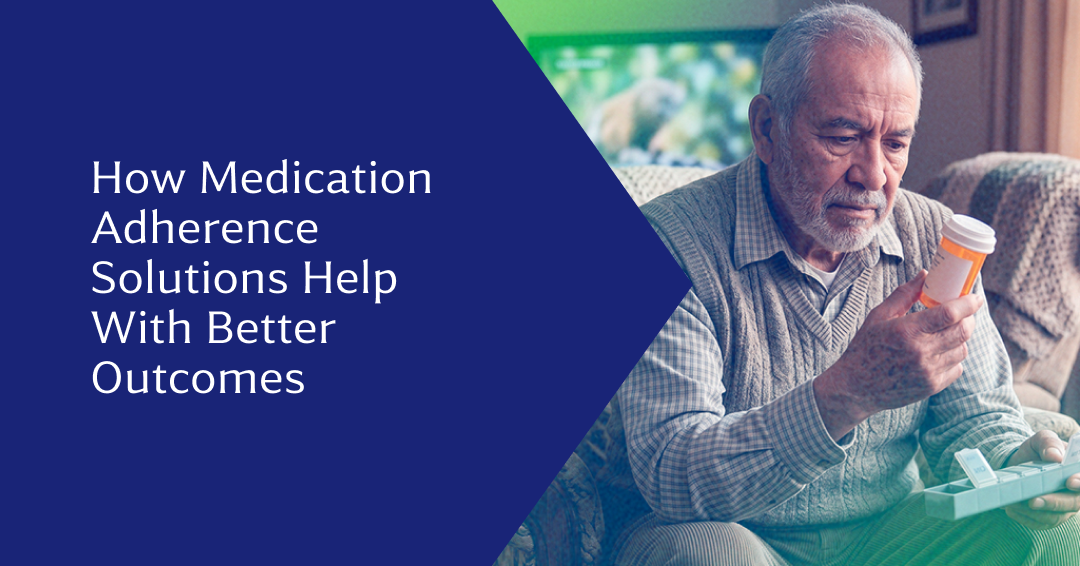
You can have the best treatment plans but they won’t mean much if patients don’t follow them. Missed doses and delayed refills slow down progress. That further leads to complications and hospital visits that otherwise are preventable.
It's not just a clinical challenge for healthcare providers. They need to know when adherence starts to slip and they need to know it early. Medication adherence solutions answer that call for modern providers. They help surface gaps early and give care teams a way to respond before small issues turn into bigger ones.
Let’s look at why non-adherence happens in the first place and then go over how these solutions help improve outcomes.
The financial impact of non-adherence isn't minor. It's a massive drain on healthcare budgets. In the U.S. alone, non-adherence contributes to over 125,000 preventable deaths every year, while costing the healthcare system around $100-300 billion in unnecessary ER visits and hospitalizations.
On top of that, only about half of chronic patients take their medications as prescribed, which directly undermines treatment outcomes. These figures aren't outliers. They represent a predictable, recurring loss that providers and payers absorb year after year.
You can’t really fix the problem until you understand what’s behind it. These are the kinds of friction patients deal with when they’re just trying to stay on track with their meds:
Forgetfulness comes first, especially in older patients who are often managing multiple conditions. Throw in busy work routines and daily chores and a pill easily becomes the last thing on someone's mind.
Cost stops a lot of patients before they even get started. Americans still pay more out of pocket for medication than patients in any other developed country. Insurance gaps make that even worse. High copays eventually convince patients to skip their doses or refills entirely.
Side effect fears push patients away. Reading something off the internet or hearing about a symptom from a friend can easily convince patients to stop their medications. The problem is worse when care teams haven't prepared patients for what to expect during the early weeks of treatment.
Poor follow-up leaves patients on their own after the appointment ends. They feel more isolated as weeks go by without any regular communication from their providers. This blocks a clear path back to adherence when they eventually fall off track.
It's easy to blame patients for not sticking to their medications. In reality though, it's just as much because of a communication failure.
Patients tend to start making assumptions about their health when they don't hear from their providers between appointments. Some dizziness might seem like a dangerous side effect, except that it's normal during the first few weeks. But since their care team never prepared them, they'll just stop taking their meds until the next appointment.
The situation might even become worse if they feel better and skip their visits even. Non-adherence will eventually catch up to them and they'll find themselves back in readmission.
Hence, low engagement and poor adherence move together. Patients who feel disconnected from their providers just disengage quietly. By the time anyone notices, they may have been off track for weeks.
Every missed touchpoint is a missed opportunity. A simple call in the first couple of weeks can catch side effect concerns before they become reasons to quit. Adherence has a better chance of improving if a care team reaches out after the first missed refill.
So it's incorrect to say that non adherence is only a patient problem. It's what happens when the relationship between patient and provider breaks down.
A medication adherence solution is a platform that's built specifically around consistent engagement. It usually combines different tools and services to ensure patients stick to their treatment plans.
A strong solution usually involves timely and personalized reminders for each patient. The system uses patient data to use preferred channels and catch early warning signs so that someone can step in quickly before non-adherence kicks in.
That said, you can't label a basic reminder tool as an adherence solution. The difference lies in how your solution can respond to context. There are several tools that can ping patients at different intervals. But few can adapt to their behavior and support the care team's ability to intervene.
WestCX Orchestrate does this through its Mosaicx and Televox platforms. They use conversational AI to handle patient communication at scale without losing context. Everything from refill reminders to pickup notifications and vaccine outreach across channels is automatically handled by the system.
WestCX Orchestratealso feeds analytics back to pharmacy and care teams so they can see what's happening in real time. That shift shows up in the numbers. Early results point to up to 80% of routine inquiries being automated, along with a 20-35% lift in refill rates.
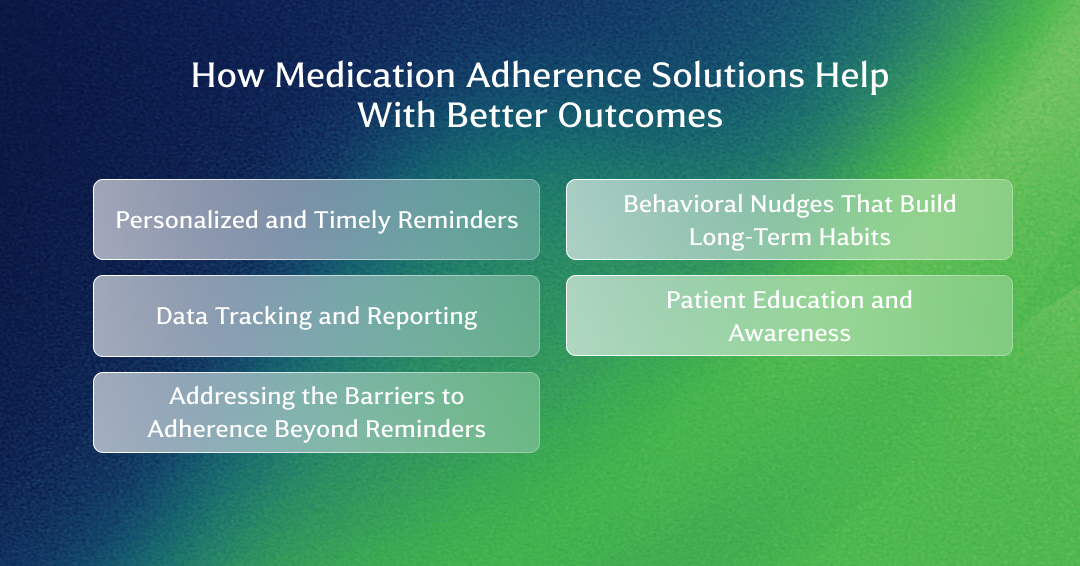
A single reminder isn't enough to keep patients on track. They stay because of a consistent system that makes it easier to continue. Here's what that looks like in practice.
A generic message sent at the same time every day will only go so far. Personalization matters for adherence, not just in timing, but in channel and content as well.
This is because a patient managing two chronic conditions doesn't need the same outreach as someone just starting a specialty therapy for the first time. One patient might respond well to texts while another to phone calls. Your reminders need to account for that context to keep patients on track.
WestCX Orchestrate, for example, adapts outreach based on patient history and behavior. So instead of sending the same message to every patient and hoping it lands, the system adjusts. That small shift makes outreach feel relevant rather than automated.
Adherence data gives care teams early visibility into patients who are quietly slipping away. This ensures that a missed refill doesn't become an ER visit.
Tracking analytics is all about spotting patterns. A patient who stops responding to reminders after two weeks on a new therapy may be dealing with side effects. Someone else who misses a refill window by several days might be facing a cost problem. Providers don't see such signals until the patient's condition becomes worse.
Adherence data also improve clinical decision-making. When care teams can see trends across a patient population, they know where to direct their time. They can prioritize outreach and adjust their intervention strategies for patients who actually need attention. That kind of visibility ties directly to fewer readmissions and better outcomes.
Reminders don't help patients who can't pay for their refills. They also don't clear up confusion about how a medication is supposed to be taken. Most patients don't even have an idea why continuing their care plan matters when they start feeling better.
Strong adherence solutions work below the surface. They look at why a specific patient isn't following their treatment and route them toward the right kind of support instead of waiting another two months. That might mean connecting them to a patient assistance program, flagging a concern for a pharmacist, or delivering condition-specific education before the patient completely disengages.
This is the difference between a basic reminder tool and an adherence solution system that intervenes. Reminders reach the patient who forgot. Interventions reach the patient who stopped trusting the plan.
Adhering to a medication regimen for months or years is hard. It can't just rely on daily motivation. Patients need to take it up as a habit. This, however, requires a lot of effort.
That's what behavioral nudges are designed to build. A simple message that says "You've taken your medication 10 days in a row" works wonders. It makes adherence feel like progress rather than an obligation.
Small prompts like one-tap refill confirmations and pickup reminders with directions further reduce friction and lower the effort required to stay on track.
These approaches are grounded in behavioral science. The goal isn't to persuade patients to take their medication. It's to design a path where adherence becomes the default.
Education addresses every reason why patients struggle with medication adherence. Someone who knows about how a drug behaves or what its side effects are gives them confidence to stick with their care plan.
This education, however, should be delivered at the right moment. That might be an in-app article after a new prescription is filled or a brief explainer sent when a patient flags a concern. The format matters less than making sure the right information reaches the right patient before they decide to stop.
Healthcare providers need to understand that not every medication adherence solution is the right one for them. The best fit depends on your patient population and what gaps you're actually trying to close. Make sure to run the following five criteria with every vendor before committing to anything.
If the tools don't connect with your existing EHR, you'll spend more time on workarounds than on patients. Many providers, for instance, use AI to pull medication history directly into EHR systems. Removing all types of manual data entry means removing human errors as well. That's the standard worth measuring others against.
Blanket outreach doesn't change behavior. Look for tools that tailor messages based on patient behavior and preferences. This makes sure that your communication targets the right patient with the right message at the right time.
Patients don't all respond to the same channel. Confirm whether your platform can meet patients on devices they already use. Some vendors only market the channels that's convnient for them.
Look for platforms that track adherence trends and give you usable data at both the individual and population level. The Tabula Rasa and Equiscript partnership is a good example worth mentioning here. Their clinical algorithms identify high-risk patients so pharmacists can intervene early.
A tool your team doesn't understand is a tool that won't get used. Ask vendors directly how long onboarding takes or what happens when something breaks after launch. The faster your staff can work the platform with confidence, the faster it starts affecting real patient outcomes.
Sending more reminders isn’t going to help you close your adherence gap. That might even drop patients faster. What you need is a platform of tools and services that reach patients at the right moments.
WestCX Orchestrate treats adherence as part of a bigger communication problem. Our orchestration layer connects conversations, data, and timing into a single system that actually adapts to how patients behave. That means every interaction (refill reminder, follow-up, missed appointment) is driven by real signals instead of guesswork.
It's what makes WestCX Orchestrate different in practice. We're not just automating your outreach. We're continuously adjusting your communication. So if a patient ignores a message, the system tries another channel or timing. What works refines the approach for the next patient, ensuring every small adjustment adds up to reduce more gaps in care with consistent engagement.
If you’re trying to close adherence gaps without adding more manual work to your team, it’s worth seeing how this plays out in a real workflow. Request a demo and take a closer look at how WestCX Orchestrate turns everyday patient communication into something that actually moves outcomes.

Ever received a call from your bank trying to sell you an additional product or service? That's cross-selling, a sales technique that aims to...

Call deflection is a way to resolve customer issues through self-service channels. It improves your operations and lowers your costs because...

Credit unions usually think of customer service when someone asks about improving their member experience. That’s only one piece of the puzzle.

Most healthcare providers already have tools designed to help patients stay on their medications. Reminder texts and patient portals aren’t exactly...

Nearly half of all patients don’t take their medications as prescribed. A significant share never even fills the first prescription. That’s the...

Regulated industries are already operating under heavy scrutiny. But data security concerns have only raised the stakes further.